Who ruled the rock of Dunamase?
The myths of the rock?
Rising like a jagged crown over County Laois, the Rock of Dunamase is no mere ruin—it’s a pulse of Ireland’s past, where kings, knights, and rebels clashed. This limestone fortress, perched 46 meters above the plains, holds stories of Viking raids, Norman conquests, and Gaelic defiance. If you’re wondering about the Rock of Dunamase history, its cost, or how to visit, you’re in the right place. Let’s dive into the FAQs that unlock this ancient gem.
FAQs About the Rock of Dunamase
Why is the Rock of Dunamase Historically Significant?
The Rock of Dunamase history is a saga of power and betrayal. Starting as Dún Másc, a 9th-century Christian hillfort, it was plundered by Vikings in 842 and 845. In the 12th century, it became a Norman stronghold when Dermot MacMurrough gifted it to Strongbow, sparking the Norman invasion. William Marshal fortified it into a medieval masterpiece. Later, the O’Moore clan held it until its slighting in 1650 by Cromwellian forces. From early Christian roots to Norman glory and Gaelic resistance, Dunamase shaped Ireland’s story.
How Much Does It Cost to Go to the Rock of Dunamase?
No Rock of Dunamase tickets needed—it’s free! Managed by the Office of Public Works, this National Monument has no entrance fee. The Rock of Dunamase opening hours are dawn to dusk, year-round. The Rock of Dunamase walk is a short, steep climb from the N80 parking lot—bring sturdy shoes for the gravel path.
What Happened to the Rock of Dunamase?
The Rock of Dunamase history is one of rise and ruin. A 9th-century Christian fort, it was sacked by Vikings. Normans, led by who built the Rock of Dunamase’s stone castle (Meiler Fitzhenry and William Marshal), made it a powerhouse in the 12th-13th centuries. It passed to the Mortimers, then the O’Moores, before being slighted in 1650, left to crumble. A brief 18th-century revival by Sir John Parnell faded, but 1990s excavations preserved its legacy.
Is the Rock of Dunamase Free?
Yes, completely free! No Rock of Dunamase tickets or fees—just park off the N80 and take the Rock of Dunamase walk. Open dawn to dusk (Rock of Dunamase opening hours), it’s accessible to all, though the steep, uneven path isn’t wheelchair-friendly. A free audio guide from Laois County Council enhances the experience.
What Does the Name Dunamase Mean?
Dunamase comes from the Irish “Dún Másc,” meaning “Fort of Másc.” “Dún” is a fortress, and “Másc” likely refers to a historical or mythical figure. This name ties to its early Christian roots and enduring legacy in the Rock of Dunamase history. Pronounce it “Doon Mahsk” for a taste of its ancient magic.
Who Built the Rock of Dunamase?
The original hillfort was likely built by 9th-century Christians, but the stone castle was crafted by Normans. Meiler Fitzhenry began fortifications in the late 12th century, and William Marshal, the “Greatest Knight,” enhanced it in the 13th century with thick walls and a gatehouse, as detailed in the Rock of Dunamase facts.
What Did the Rock of Dunamase Look Like?
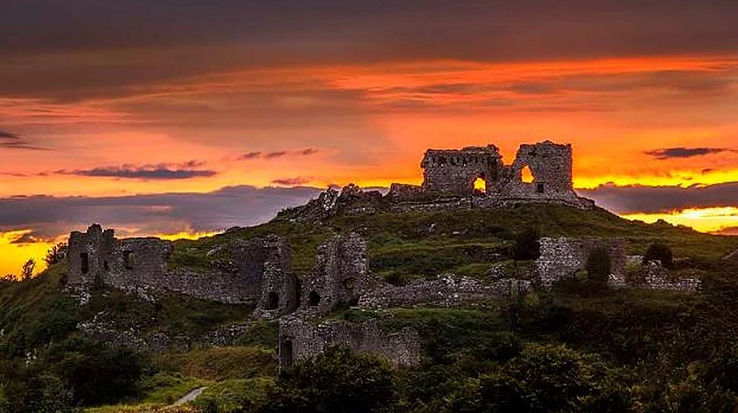
In its prime, the Rock of Dunamase was a Norman fortress with towering stone walls, a fortified gatehouse, a great hall, and defensive towers. Check a Rock of Dunamase map at the site to see its compact layout. Today, its ruins—crumbling arches and Parnell’s 18th-century banqueting hall—evoke its lost grandeur.
Plan Your Visit
Ready to explore? The Rock of Dunamase sits off the N80, east of Portlaoise, County Laois (use coordinates 53°1′54″N, 7°12′37″W or a Rock of Dunamase map). The Rock of Dunamase walk is a 10-minute climb from the parking lot—steep but worth it for the views. No Rock of Dunamase tickets are needed, and it’s open dawn to dusk (Rock of Dunamase opening hours). Rock of Dunamase facts: It starred in *Leap Year*, was mentioned by Ptolemy in 140 AD, and yielded 5,500 artifacts in the 1990s. This is history you can touch, feel, and breathe—no price tag required.
About the Author
