Ah, Tír na nÓg. Arguably one of the most popular places to feature in the many captivating tales and legends from Irish mythology.
It’s a name that conjures images of ancient magic, timeless beauty, and a longing for a world untouched by sorrow or decay. But what exactly is this ethereal realm, and what makes its stories so enduring?
For those not yet familiar with the magical land of Tír na nÓg, it was a place where it was believed that any who reached it would be granted eternal youth. It’s far more than just a fairytale; it’s a profound cultural Tir na nog symbol, representing the Celtic ideal of youth, beauty, and the yearning for a perfect, joyful existence.
This mythical island in Irish mythology is truly known as the Celtic Otherworld, a realm of eternal youth, beauty, and happiness, where its inhabitants never age and sorrow is unknown. This land is often associated with the Tuatha Dé Danann, a supernatural race in Irish folklore.
What is Tír na nÓg? Decoding the “Land of Youth”
So, let’s break down the Tir na nog meaning. “Tír na nÓg” literally translates to “Land of Youth.” Many years ago, people believed that there existed a land of eternal youth, a paradise free from the ravages of time. According to legend, if a person made it to Tír na nÓg, they’d remain the same age that they were at the time when they entered.
It was thought that this land of eternal youth existed somewhere out in the western sea, beyond the mortal shores of Tír na nÓg Ireland. It was here that those brave enough to find it would discover a land of immense beauty, a vibrant, lush paradise that only a select few would ever experience. It’s considered one of the names for the Celtic Otherworld, a parallel universe existing alongside our own, and is sometimes referred to as “Tír Tairngire,” suggesting it’s a place of fulfillment and happiness. It’s often depicted as a place where fairies (Tuath(a) Dé Danann) reside, emphasizing its otherworldly, magical nature. While not a place of afterlife, it could be reached through magical means, often involving crossing the sea.
To help you get the Tir na nog pronunciation right, it’s typically pronounced “teer nah NO-g.”
The Epic Tale of Oisín: A Classic Tír na nÓg Story
The Tír na nÓg story of Oisín and his journey to this mythical land is one of the most popular tales from Irish folklore. It perfectly encapsulates the allure and the peril of the Land of Youth.
Now, if you’ve never heard of Oisín before, he was the son of the great Irish warrior Fionn MacCumhaill, leader of the legendary Fianna. Oisín was himself a revered poet and a formidable member of the Fianna. It was on an outing to hunt deer with the Fianna that this extraordinary story all begins.
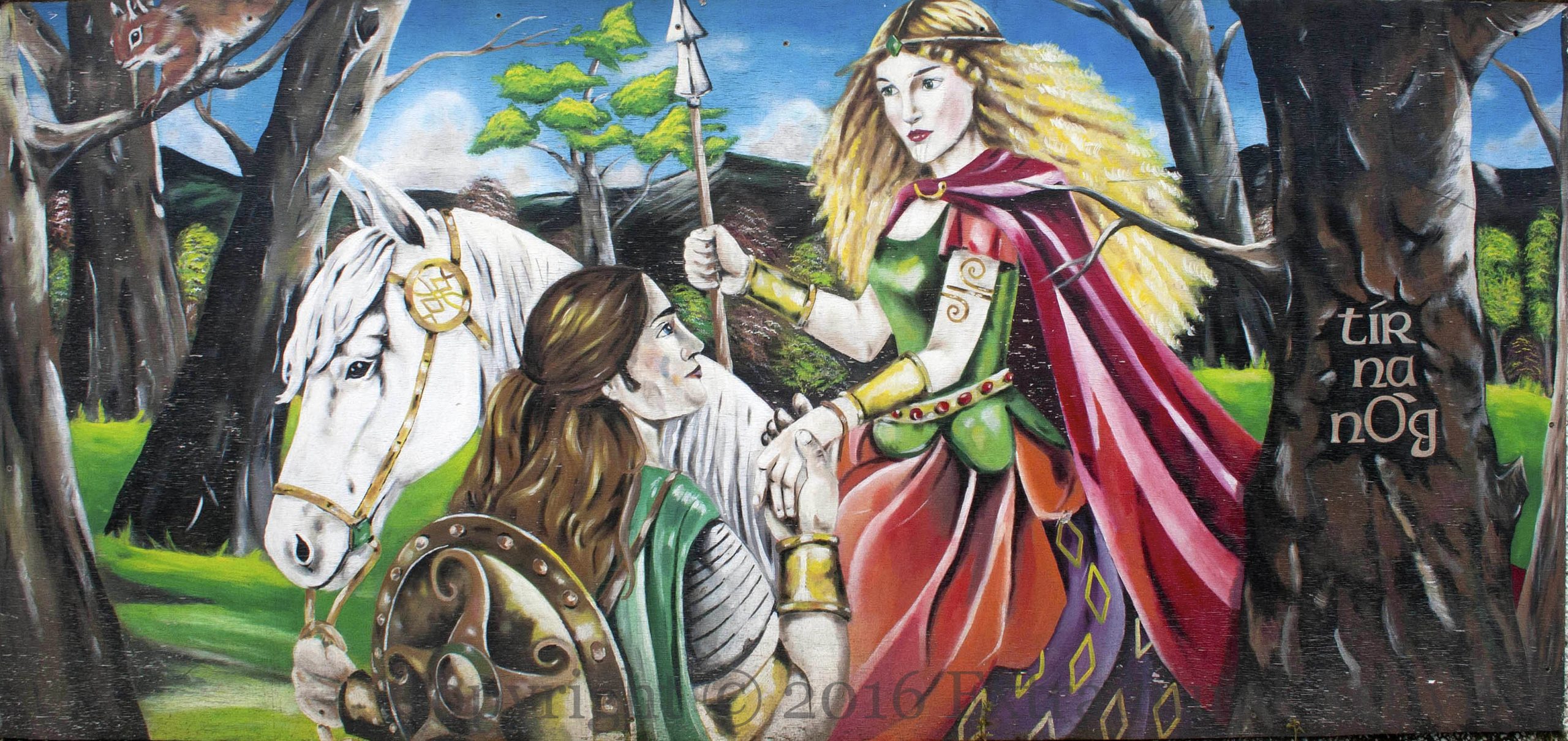
Oisín and the Fianna were resting after a busy morning of hunting in County Kerry when their peace was broken by the distinct sound of an approaching horse. They looked up, and their eyes beheld a woman riding a beautiful white Tír na nÓg horse. The ethereal beauty of the woman stunned the group of hardened men into awestruck silence.
The Daughter of Tír na nÓg: Niamh’s Arrival
It became clear to the Fianna that this was no ordinary woman. She was dressed like a princess, her garments shimmering, and she had long, flowing golden hair. As she drew closer, Fionn, with his keen warrior’s intuition, sensed that something profound was about to unfold.
Jumping to his feet, he commanded the woman to halt and state her business. She replied with a voice as clear as a bell, stating that her name was Niamh, the daughter of the King of Tír na nÓg. She went on to explain that she had heard tales of a valiant warrior named Oisín, and she wanted to propose an adventure to him – she wanted Oisín to return with her to the land of Tír na nÓg.
Fionn was taken aback. This mysterious, beautiful woman who appeared out of nowhere on a magnificent white horse wanted to whisk his son away to a land of eternal youth, a place from which he might never return? Not a chance, he thought! But Oisín was already captivated.
Love’s Call: Oisín’s Journey to the Land of Youth
Oisín was, in that moment, utterly drunk with love. He had never seen a woman of such breathtaking beauty and grace. He glanced over at his father, and Fionn, seeing the yearning in his son’s eyes, knew immediately that this would likely be the last time he would lay eyes on his beloved Oisín.
Oisín, with a heavy heart but an excited spirit, bid his goodbyes and left Ireland with Niamh. The pair travelled over land and stormy sea for several days and nights, without stopping, carried by the magic of Niamh’s white steed. The Tír na nÓg horse travelled with incredible speed, and Oisín, caught in the thrall of his new love and the promise of the journey, thought little of those he left behind.
Eventually, the pair arrived back in Tír na nÓg, where a massive celebration awaited them. The King and people of the Land of Youth had prepared a grand feast for Oisín’s arrival, and he immediately felt at home. Tír na nÓg was everything that he imagined it would be: a realm where sorrows were unknown and joy reigned supreme. Oisín was admired by many in Tír na nÓg. He told incredible stories of his time with the Fianna, and he had won the hand of the most beautiful woman in the land.
The Cruel Passage of Time: Three Hundred Years in the Blink of an Eye
Before long, Oisín and Niamh were wed, celebrating their union in the eternal bliss of the Land of Youth. Time, as mortals understand it, simply ceased to exist here. Days blended into weeks, weeks into months, and months into what felt like mere years. Although Oisín missed his family back in Ireland, he had no regrets about his new life in this magical land. He was happy, truly happy.
However, the nature of time in Tír na nÓg is deceptively benign. Oisín lost track of time quickly. He believed he had only spent three years in this wondrous realm, but little did he know, three years in Tír na nÓg was actually three hundred years back in Ireland and beyond. Eventually, a profound pang of homesickness began to creep into his heart. He longed to see his father, his friends, and the familiar green hills of his homeland.
One night, Oisín sat down with Niamh and expressed his deep longing to return home. Although she didn’t want him to leave Tír na nÓg, she understood the ache in his heart. She granted his wish, giving him her magical white horse and carefully explaining the path back to Ireland. It all seemed straightforward to Oisín. Then, Niamh delivered one final, crucial warning, a caveat that would determine his fate: if Oisín’s feet touched the ground in Ireland or if even one toe was set down on Irish soil, he would never be able to get back to Tír na nÓg.
A Return to a Changed World: Oisín’s Tragic End
Oisín left Tír na nÓg in good spirits, full of anticipation. In his mind, he had only been away for a mere three years. He looked forward to seeing his family and friends once again, expecting to find them just as he had left them.
However, when he eventually arrived back in Ireland, he was utterly shocked. Everything had changed. The vibrant, familiar landscape was now strange and ancient. His father, the legendary Fionn, the brave Fianna, and all of his friends and family had disappeared, long since turned to dust. Three centuries had passed, and the world he knew was gone.
Oisín was in a state of deep distress when he spotted a group of men in the distance, struggling to move a massive rock. He rode over to the men and, still mounted on Niamh’s magical Tír na nÓg horse, offered his assistance. He hadn’t forgotten what Niamh told him back in Tír na nÓg. He knew that he absolutely must not touch Irish soil. So, he decided that if he angled himself carefully in the horse’s saddle, he could still help move the enormous stone without dismounting.
The group pushed and pushed, Oisín straining from the saddle, and the stone began to slowly give way. It was then, in that moment of immense effort, that the saddle, old and weak from centuries of unseen wear, tore apart. Oisín, unable to hold on, fell straight onto Irish soil.
The end was tragically in sight. The moment Oisín hit the ground, he immediately knew that he was doomed. The magical Tír na nÓg horse fled, galloping back towards the western sea, and Oisín felt himself begin to shrivel. It was as if his body was ageing three hundred years in the space of mere seconds.
Oisín quickly became the oldest man in Ireland, a frail, ancient figure. The men around him panicked, terrified by the sudden transformation. They decided that the only thing to do would be to bring Oisín to a saint. And what saint is mightier than Ireland’s Patron Saint, Saint Patrick? Saint Patrick sat with the now ancient Oisín and listened with wonder to his incredible story. He explained to Oisín, gently but firmly, that time worked differently in Tír na nÓg. He explained that his father, the great Fionn, and everyone that he knew had long since passed, their lives lived and ended centuries ago.
Oisín was inconsolable, his heart shattered by the weight of loss. He cursed Tír na nÓg and the cruel misfortune it had brought him. Oisín continued to age rapidly, his ancient body finally succumbing to the millennia he had effectively lived. Before long, he passed away, his story a poignant reminder of the allure and the danger of escaping time.
The Enduring Legacy of Tír na nÓg
The legend of Tír na nÓg continues to fascinate, inspiring countless stories, poems, and even music, such as the famous Tír na nÓg band known for their folk music. The timeless nature of this Tír na nÓg song and story, its blend of beauty, magic, and profound sorrow, resonates deeply. It serves as a powerful reminder of the preciousness of mortal life and the irreversible nature of time, even when faced with the irresistible temptation of eternal youth.
Frequently Asked Questions
What does Tír na nÓg mean?
Tír na nÓg means “Land of Youth” in Irish Gaelic. It’s a mythical island in Irish mythology, known as the Celtic Otherworld.
What does Oisín mean in Tír na nÓg?
Oisín is the central human character in the most famous Tír na nÓg story. He is a legendary poet-hero, son of Fionn MacCumhaill, who travels to Tír na nÓg with Niamh and experiences eternal youth, only to tragically return to mortal Ireland centuries later. His name, Oisín, means “little deer.”
What is the moral of the story “Tír na nÓg”?
The moral of the story “Tír na nÓg” primarily highlights the irrevocable passage of time and the value of the mortal world, with all its joys and sorrows. It serves as a cautionary tale against trying to escape natural cycles and emphasizes that even eternal youth comes with the ultimate cost of losing connection to one’s loved ones and familiar reality.
What is the legend Tír na nÓg?
The legend of Tír na nÓg describes a mythical island or realm in Irish mythology, often referred to as the Celtic Otherworld. It is a place of eternal youth, beauty, and happiness, where inhabitants never age, get sick, or experience sorrow. It is believed to be inhabited by supernatural beings like the Tuatha Dé Danann and can be reached through magical means, often by crossing the sea.
What did Niamh say about Tír na nÓg?
Niamh, the fairy princess, told Oisín that Tír na nÓg was a land of eternal youth, beauty, and happiness. She also gave him a crucial warning: if his feet ever touched the soil of Ireland again after returning from Tír na nÓg, he would immediately age the centuries that had passed and be unable to return to the Land of Youth.
What is the Irish god realm?
The Irish god realm is often referred to as the Celtic Otherworld, which encompasses various mythical lands. Tír na nÓg is one of the most prominent names for this realm, along with others such as Mag Mell (“Plain of Honey”) or Iath nAilich (“The Noble Country”). These realms are typically depicted as paradisiacal lands beyond the mortal plane, often associated with gods, goddesses, and magical beings like the Tuatha Dé Danann.
About the Author
