In August 1598, as the summer sun bore down on the emerald fields of Armagh, a clash unfolded that would send shockwaves through the British Empire. The Battle of the Yellow Ford, fought along the banks of the River Blackwater, wasn’t just a victory for Ireland—it was a seismic moment in the Nine Years’ War. It was a day when Hugh O’Neill, Earl of Tyrone, and his Gaelic army delivered one of the most crushing defeats ever suffered by an English force on Irish soil.
This wasn’t just a battle of muskets and pikes. It was a battle of strategy, survival, and a burning desire for freedom. The Yellow Ford wasn’t simply a skirmish; it was a statement. Ireland could fight. Ireland could win.
A Prelude to Defiance
The Nine Years’ War had escalated into a full-scale rebellion, with Hugh O’Neill and his allies leading the charge against English attempts to dominate Ireland. The Battle of Clontibret in 1595 had shown the English that the Irish weren’t to be underestimated. By 1598, tensions reached a breaking point. The English, determined to solidify their grip, sent Sir Henry Bagenal, a commander already bloodied by previous encounters with O’Neill, to relieve the besieged Blackwater Fort.
For O’Neill, this wasn’t just another battle. This was about proving that Ireland could stand against the might of the empire. He marshaled an army of around 6,000 Gaelic soldiers, men hardened by years of resistance and inspired by the dream of an independent Ireland.
The Day of Reckoning
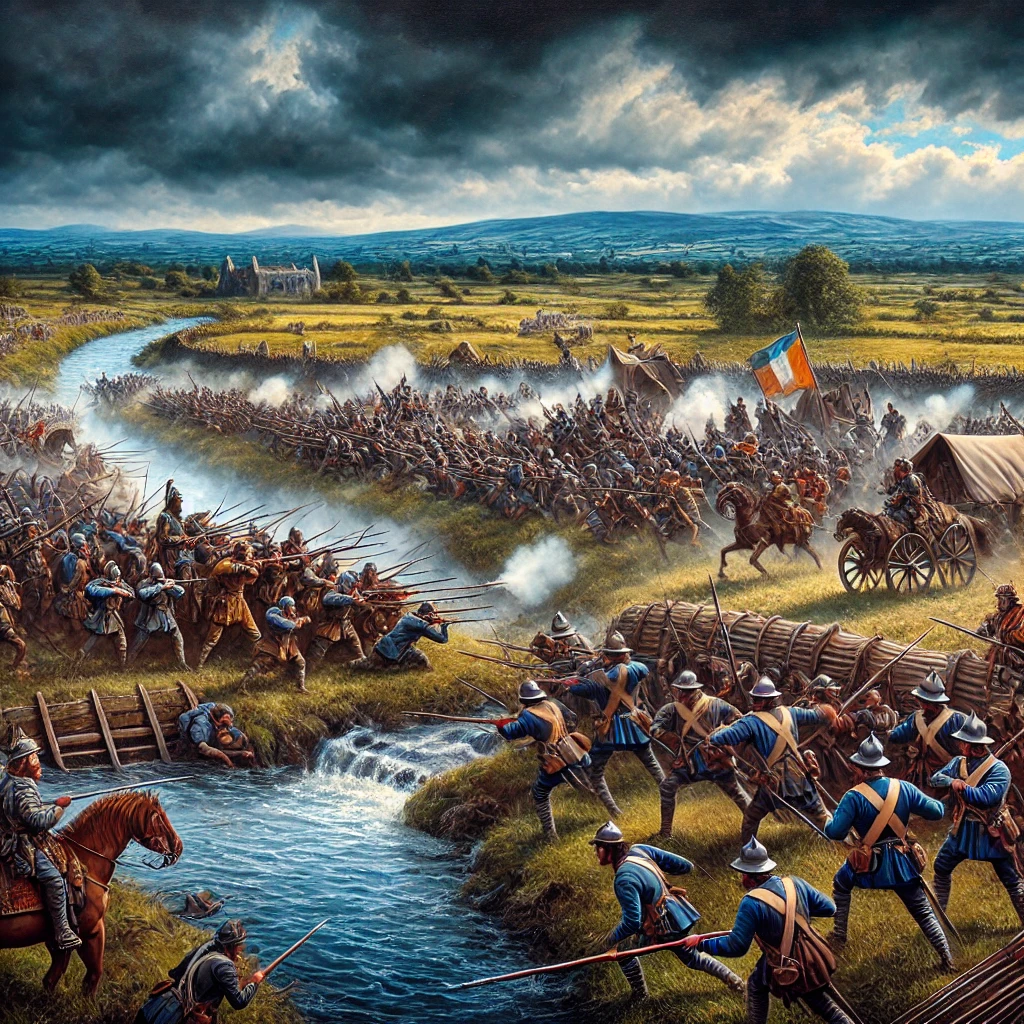
On August 14, 1598, Bagenal’s army, 4,000 strong, marched from Armagh toward the Blackwater Fort. What they didn’t know was that O’Neill had transformed the countryside into a death trap. The Irish forces had fortified the terrain, digging trenches, constructing barricades, and positioning their troops to strike with lethal precision.
As the English columns advanced, they were met with a devastating barrage of musket fire and arrows. Gaelic soldiers, hidden among the hedgerows and ditches, launched ambushes that fractured the disciplined ranks of Bagenal’s troops. The River Blackwater became a battlefield soaked in blood, its once-calm waters churning with the chaos of war.
The Turning Point
The English, weighed down by heavy armor and unfamiliar with the terrain, fell into disarray. O’Neill’s forces, lighter and more mobile, exploited every weakness, driving wedges between the English formations. Gaelic cavalry, swift and merciless, cut down stragglers while the infantry pressed relentlessly forward.
In the midst of the chaos, Sir Henry Bagenal himself was killed, a musket ball tearing through his ranks and silencing the man who had sought to crush the Irish rebellion. With their commander dead and their lines shattered, the English forces began to retreat, leaving behind weapons, supplies, and nearly 2,000 dead or wounded.
Victory and its Shadows
The Battle of the Yellow Ford was a resounding victory for the Irish. It sent shockwaves through the English administration and emboldened Gaelic resistance across the island. For a brief, shining moment, the dream of a free Ireland felt tantalizingly close.
But victory often carries its own costs. The English, though humiliated, would return with greater ferocity, leading to the devastating defeat at the Battle of Kinsale in 1601. The Yellow Ford, while a triumph, was a reminder that Ireland’s fight for freedom would be long and fraught with sacrifice.
The Legacy of the Yellow Ford
The Battle of the Yellow Ford remains one of the most significant military victories in Irish history. It was a moment when the Gaelic chieftains proved that unity, strategy, and unrelenting defiance could humble even the most powerful empire.
Hugh O’Neill’s brilliance as a tactician shone brightly that day, cementing his place as one of Ireland’s greatest military leaders. But it wasn’t just about O’Neill. It was about the thousands of men who fought beside him, who risked everything for a chance at sovereignty.
The River Still Flows
Today, the River Blackwater flows quietly through Armagh, its banks bearing little trace of the carnage that once stained its waters. But the story of the Yellow Ford endures, a testament to the resilience of a people who refused to bow.
The Yellow Ford is part of a broader tapestry of resistance, woven alongside battles like Clontibret and Kinsale. For more on these pivotal moments in Irish history, explore:
- The Battle of Clontibret: Ireland’s First Clash Against an Empire
- The Battle of Kinsale: Ireland’s Last Stand for Sovereignty
- Theobald Wolfe Tone: The Voice That Shook an Empire
- Robert Emmet: The Rebel Who Dreamed Beyond the Gallows
A Lesson in Defiance
The Battle of the Yellow Ford wasn’t just a victory. It was a reminder that even in the face of overwhelming odds, defiance can turn the tide. It was a moment when Ireland stood tall, unyielding, and unafraid.
“At the Yellow Ford, the River Blackwater ran red, but it carried with it the hope of a nation that refused to be silenced. And that hope, that unbreakable spirit, endures.”
About the Author
