There are men whose names are carved into the pages of history, and then there are those whose voices echo through time, haunting the halls of power and lighting fires in the hearts of revolutionaries. Theobald Wolfe Tone wasn’t just a man; he was an incendiary force. His words, his passion, his relentless belief in an Ireland free from the iron grip of the British Crown—these were the seeds of rebellion that Ireland would nurture long after his body was laid in the earth.
He called himself a democrat, a republican, a unifier of Catholics, Protestants, and Dissenters. But to the British Empire, he was a dangerous dreamer, a threat to their dominion. To the Irish people, he was something far greater: a symbol of what could be.
A Rebel Born of Privilege
Theobald Wolfe Tone was born in Dublin in 1763, a child of privilege in a world of oppression. As a Protestant in Ireland, he had access to the corridors of education and opportunity, but he also had eyes to see the grinding poverty and systemic injustices inflicted on his Catholic countrymen.
At Trinity College Dublin, he studied law, but his heart was already burning for something far more incendiary than courtroom rhetoric. By the time he penned his pamphlet Argument on Behalf of the Catholics of Ireland in 1791, Wolfe Tone had stripped away the polite veneer of his class and embraced the fiery conviction of a revolutionary.
He wasn’t interested in reforming British rule in Ireland—he wanted to obliterate it. He believed in a republic, one where religious divisions would be obliterated, and the people of Ireland—Catholic, Protestant, and Dissenter alike—would stand united as equals. He wasn’t just calling for change; he was demanding a reckoning.
The United Irishmen: A Dream Forged in Defiance
In 1791, Wolfe Tone became one of the founding members of the Society of United Irishmen, a group whose very existence was a declaration of war against British hegemony. Their mission? To create an Ireland where the chains of sectarianism and colonialism were shattered. Tone’s vision wasn’t just radical; it was incendiary.
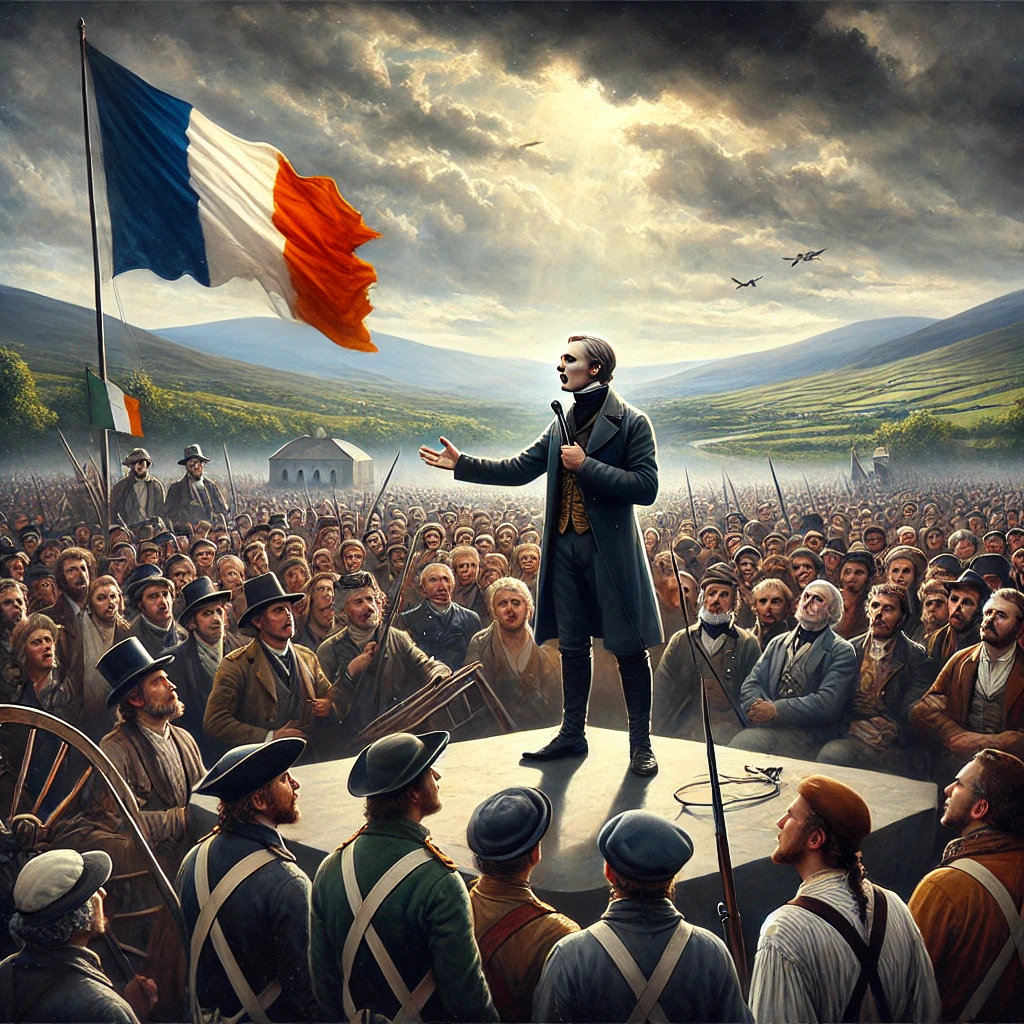
He traveled across the country, his voice lighting fires in villages and towns, calling for unity in a land long divided. The British saw a radical; the Irish saw a prophet. He spoke of freedom, of equality, of an Ireland where no man bowed to another. And he knew that the only way to achieve this was through revolution.
The French Connection: A Gamble for Liberation
Wolfe Tone wasn’t naive. He knew that Ireland alone couldn’t stand against the might of the British Empire. So, in 1796, he did what only a man of singular conviction would dare: he sailed to France, seeking aid from the architects of the French Revolution.
It was a gamble of extraordinary stakes. In Paris, he found ears willing to listen. He painted a picture of an Ireland ready to rise, ready to fight, ready to bleed for its freedom. The French, locked in their own battle against Britain, saw an opportunity. They promised troops, ships, and weapons. And Wolfe Tone returned to Ireland, a man carrying the weight of a nation’s hope.
The Failed Rebellion of 1798
The revolution Wolfe Tone had dreamed of, the one he had planned with such precision and passion, collapsed under the weight of betrayal, miscommunication, and British repression. The French fleet, meant to deliver salvation, was scattered by storms. The uprisings across Ireland, though fierce and brave, were crushed with brutal efficiency.
But even as the rebellion unraveled, Tone refused to surrender his dream. He took to the battlefield, fighting alongside the French forces that managed to land in Ireland in September 1798. At Ballinamuck, the Irish and French forces were defeated, and Wolfe Tone was captured shortly thereafter.
The Trial of a Patriot
Wolfe Tone’s trial was not just a formality; it was a spectacle. The British wanted to break him, to parade him as a warning to others. But Tone, ever the orator, turned his trial into a stage. He did not plead for mercy or beg for his life. Instead, he stood defiant, declaring his unwavering belief in the cause of Irish freedom.
“From my earliest youth, I have regarded the connection between Ireland and Great Britain as the curse of the Irish nation,” he said, his words searing through the courtroom. “I have labored to break that connection and to substitute the independence of my country.”
For the British, he was a traitor. For the Irish, he was a martyr.
The Martyr’s Death
On November 19, 1798, Theobald Wolfe Tone was sentenced to death by hanging. But even in death, he refused to bow to the empire that sought to crush him. Before his execution could be carried out, Tone attempted to take his own life, slitting his throat with a penknife smuggled into his cell. He lingered for several days before succumbing to his injuries.
His death was as defiant as his life. The British may have silenced his voice, but they could not extinguish his legacy.
A Legacy Written in Fire
Theobald Wolfe Tone was not the first to dream of Irish freedom, nor would he be the last. But his vision of a united Ireland, free from sectarianism and British rule, became the cornerstone of future rebellions. The echoes of his defiance rang loud in the Easter Rising of 1916, in the War of Independence, and in every Irish voice that dared to demand justice.
Tone’s life reminds us that revolutionaries are not measured by their successes but by their courage. His words, his actions, his unyielding belief in an Ireland unshackled from oppression—these are the fires that continue to burn.
Wolfe Tone’s Ireland Today
To walk through Ireland today is to walk in the shadow of Wolfe Tone. His name graces streets, statues, and memorials, but his true monument lies in the hearts of those who still dream of a republic united, equal, and free.
His story, like that of Robert Emmet, is a testament to the power of ideals, even in the face of impossible odds. As Emmet’s legacy reminds us of the cost of freedom, Wolfe Tone’s reminds us of its necessity. Read more about Emmet’s life and sacrifice here: Robert Emmet: The Rebel Who Dreamed Beyond the Gallows.
“To Tone, freedom wasn’t just a possibility; it was an inevitability. And though his life was cut short, his dream endured. Because dreams like Wolfe Tone’s—they don’t die. They roar.”
About the Author
