Few figures in Irish history have left a legacy as profound as Daniel O’Connell. Known as “The Liberator,” O’Connell was a lawyer, politician, and social reformer who dedicated his life to the pursuit of justice and equality. Through peaceful political activism, he reshaped Ireland’s history and inspired movements for civil rights worldwide.
In this blog, we’ll explore Daniel O’Connell’s life, his monumental achievements, and some fascinating facts about the man who became a symbol of Ireland’s fight for freedom.
Who Was Daniel O’Connell and What Did He Do?
Born on August 6, 1775, in Cahersiveen, County Kerry, Daniel O’Connell rose from humble beginnings to become one of Ireland’s most influential leaders. He is best known for his role in securing Catholic Emancipation, which granted Irish Catholics the right to sit in the British Parliament and hold public office.
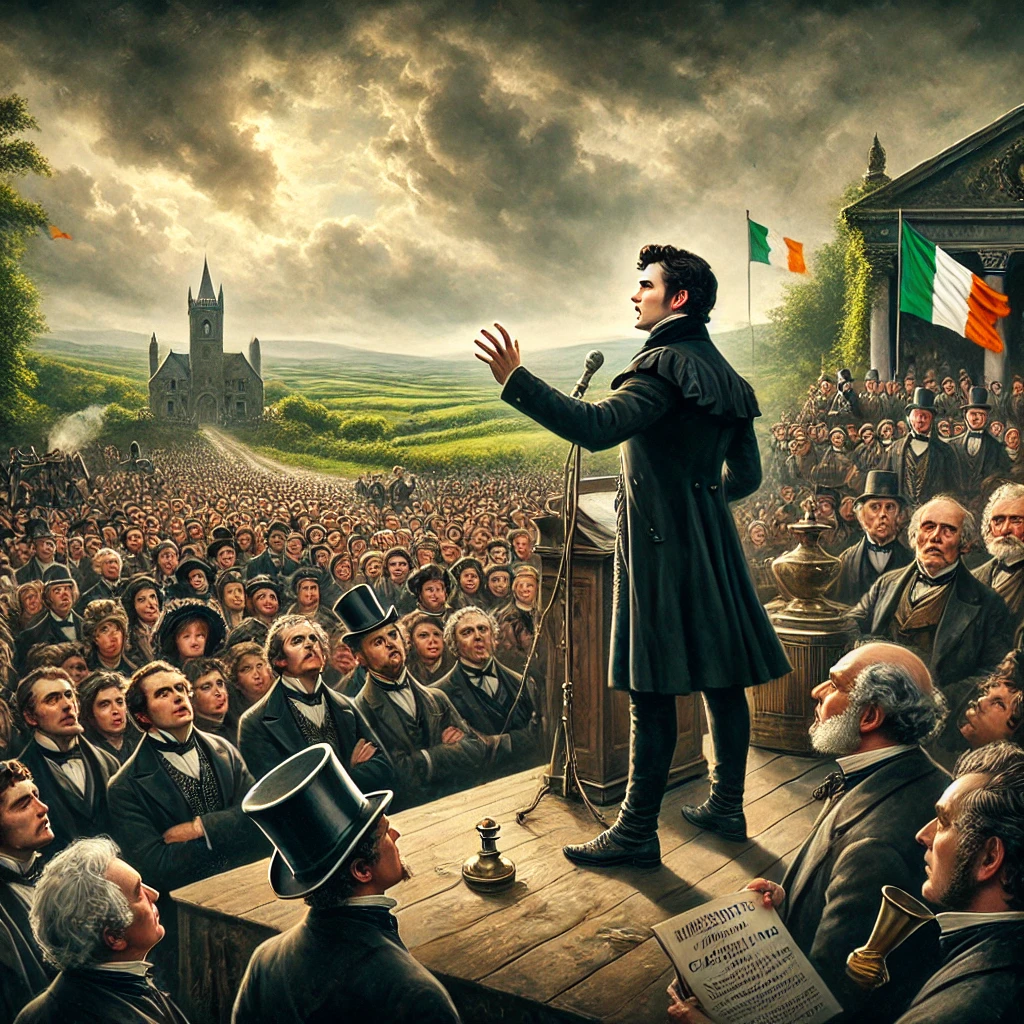
O’Connell’s peaceful methods were revolutionary in an era of rebellion and violence. By organizing mass rallies, known as monster meetings, he demonstrated the power of nonviolent resistance. This approach earned him respect not only in Ireland but also among global movements advocating for justice.
For another look at Irish leaders who fought for freedom, read about Robert Emmet: The Rebel Who Dreamed Beyond the Gallows and Henry Joy McCracken: A Rebel’s Heart and the Fire of Freedom.
Did Daniel O’Connell Abolish Slavery?
Although O’Connell is most famous for his work on Catholic Emancipation, he was also a fervent opponent of slavery. His advocacy against the institution earned him international recognition, particularly in the United States.
O’Connell publicly condemned slavery and refused to associate with Irish-Americans who supported it. He once declared:
“How can the generous sons of Ireland become the abettors and apostles of slavery?”
Through his speeches and alliances with abolitionists, O’Connell solidified his place as a global advocate for human rights.
Did Daniel O’Connell Have Any Illegitimate Children?
There is no credible evidence to suggest that Daniel O’Connell had any illegitimate children. O’Connell was deeply devoted to his wife, Mary O’Connell (née O’Connell), whom he married in 1802. Together, they had eleven children, and family was an integral part of his life. His loyalty to his family and his Catholic faith shaped both his personal and political choices.
Why Did Daniel O’Connell Go to France?
In 1791, O’Connell traveled to France to study law at Douai College, a Catholic seminary. At the time, Irish Catholics were barred from attending universities in their own country due to oppressive penal laws. His time in France exposed him to the ideals of the French Revolution, which heavily influenced his later advocacy for civil rights and equality.
However, O’Connell’s stay in France was cut short by the Reign of Terror, a period of extreme political upheaval and violence. Disillusioned by the Revolution’s descent into chaos, he returned to Ireland, firmly committed to achieving reform through peaceful means.
10 Facts About Daniel O’Connell
- Where Was Daniel O’Connell Born?
O’Connell was born in Cahersiveen, County Kerry, on August 6, 1775. - What Did Daniel O’Connell Do?
He secured Catholic Emancipation in 1829, allowing Catholics to participate in politics and hold public office in Ireland and Britain. - O’Connell’s Peaceful Activism
His mass rallies, known as monster meetings, were a key strategy in his campaign for Catholic rights. - Opposition to Slavery
O’Connell was a vocal opponent of slavery, earning him the title “The Liberator” on both sides of the Atlantic. - Legal Career
As a lawyer, O’Connell became famous for defending Irish Catholics against the oppressive laws of the time. - Family Man
O’Connell and his wife Mary had eleven children, and his devotion to his family was well-documented. - How Did Daniel O’Connell Die?
O’Connell died on May 15, 1847, in Genoa, Italy, while on a pilgrimage to Rome. He suffered from a heart condition aggravated by his relentless political efforts. - Daniel O’Connell’s Last Words
His last words reportedly reflected his deep spirituality:“My soul to God, my heart to Rome, my body to Ireland.”
- Where Did Daniel O’Connell Live?
O’Connell resided at Derrynane House, his family estate in County Kerry, which is now a museum dedicated to his legacy. - A Global Influence
His nonviolent methods inspired future leaders like Mahatma Gandhi and Martin Luther King Jr.
5 Facts About Daniel O’Connell
- O’Connell was nicknamed “The Liberator” for his role in Catholic Emancipation.
- He was the first Catholic to sit in the British Parliament in over 100 years.
- O’Connell was a fierce advocate for peaceful reform, denouncing violence even in the face of oppression.
- He was a contemporary and supporter of other Irish patriots like Robert Emmet and Henry Joy McCracken.
- Derrynane House, his home, remains a popular site for those seeking to understand his life and impact.
Legacy of Daniel O’Connell
Daniel O’Connell’s commitment to justice and equality continues to resonate today. His achievements laid the groundwork for Ireland’s eventual independence and influenced civil rights movements worldwide.
For more on Ireland’s revolutionary figures, explore Robert Emmet: The Rebel Who Dreamed Beyond the Gallows and Henry Joy McCracken: A Rebel’s Heart and the Fire of Freedom.
Daniel O Connell
Daniel O’Connell was more than a politician—he was a visionary leader whose dedication to justice and equality changed the course of Irish history. From securing Catholic Emancipation to his opposition to slavery, O’Connell’s influence extended far beyond his homeland.
As Ireland’s “Liberator,” his legacy endures in the principles of nonviolence and human rights that continue to inspire people worldwide. Plan a visit to Derrynane House or delve deeper into his life to truly appreciate the man who shaped Ireland’s destiny. 🍀
O’Connell’s Influence on Modern Civil Rights Movements
Daniel O’Connell’s approach to achieving reform through nonviolence and moral conviction set a precedent that would influence global leaders long after his death. Figures like Mahatma Gandhi and Martin Luther King Jr. admired O’Connell’s strategies, particularly his use of peaceful protest and his ability to galvanize large crowds for social change.
O’Connell’s emphasis on dialogue and persuasion, rather than rebellion or force, showed that progress could be achieved without bloodshed. His legacy reminds us of the enduring power of peaceful resistance in the face of injustice.
Daniel O’Connell’s Final Years
The relentless pressures of political life took a toll on Daniel O’Connell’s health. By the 1840s, he was suffering from a heart condition, exacerbated by his tireless campaigning for Irish rights. In 1847, during the devastating Great Famine, O’Connell embarked on a pilgrimage to Rome, seeking spiritual solace and hoping to recover his strength.
Unfortunately, he passed away in Genoa, Italy, on May 15, 1847, at the age of 71. His death marked the end of an era, but his influence continued to inspire generations of Irish leaders and activists.
O’Connell’s final wishes reflected his devotion to both his faith and his homeland. His heart was sent to Rome, while his body was returned to Ireland, where he was laid to rest in Glasnevin Cemetery, Dublin. His grave remains a place of pilgrimage for those honoring his contributions to Ireland and the world.
Where Did Daniel O’Connell Live?
O’Connell’s family estate, Derrynane House, in County Kerry, is a testament to his life and legacy. Nestled in a picturesque landscape of hills and coastlines, the house offers visitors a chance to explore artifacts, documents, and personal items that tell the story of The Liberator.
Today, Derrynane House is a national historic site and museum, drawing history enthusiasts and tourists alike. Its serene surroundings and insightful exhibits make it a must-visit destination for anyone tracing Ireland’s path to freedom.
Daniel O’Connell’s Family
Family was a cornerstone of O’Connell’s life. His marriage to Mary O’Connell was marked by mutual respect and devotion, and the couple had eleven children. Though O’Connell’s political career often kept him away from home, he remained deeply connected to his family and relied on their support during challenging times.
Several of O’Connell’s descendants continued his legacy, contributing to Irish society in various ways. His family’s steadfast loyalty to Ireland’s cultural and political heritage underscores the enduring impact of The Liberator’s life and values.
O’Connell’s Impact on Irish Identity
For Ireland, Daniel O’Connell was not just a political leader but a symbol of resilience and hope. At a time when the Irish Catholic majority faced systemic oppression under British rule, O’Connell gave his people a voice. His campaigns for equality, justice, and national pride helped shape the modern Irish identity.
Monuments to O’Connell can be found across Ireland, including the iconic O’Connell Street in Dublin, named in his honor. Statues, plaques, and schools bearing his name serve as a constant reminder of his pivotal role in Ireland’s journey toward freedom and equality.
10 More Facts About Daniel O’Connell
- First Catholic MP: In 1829, O’Connell became the first Catholic Member of Parliament in over 100 years, representing County Clare.
- Monster Meetings: His peaceful rallies often drew crowds of up to 100,000 people, a feat unparalleled in 19th-century politics.
- Legal Pioneer: O’Connell’s sharp legal mind helped countless Irish Catholics defend themselves against unjust laws.
- Global Fame: His anti-slavery speeches made him a celebrated figure in abolitionist circles in the U.S. and Britain.
- Supporter of Jewish Rights: O’Connell also advocated for the civil rights of Jewish communities, emphasizing his commitment to universal equality.
- Defiance of the Crown: O’Connell’s opposition to British rule earned him both admiration and imprisonment. He spent several months in Richmond Bridewell Prison in Dublin in 1844.
- Economic Impact: His campaigns for Irish tenant rights aimed to improve the lives of impoverished farmers during a time of widespread exploitation.
- Nationalist Inspiration: Later leaders, including Charles Stewart Parnell, drew on O’Connell’s methods and rhetoric in their own campaigns for Irish self-governance.
- Educational Legacy: O’Connell supported the establishment of Catholic schools and colleges, believing education was essential for Ireland’s progress.
- The O’Connell Tower: The O’Connell Tower in Glasnevin Cemetery is the tallest round tower in Ireland and serves as a tribute to his legacy.
Continuing O’Connell’s Story
Daniel O’Connell’s life is a powerful reminder of how one person’s dedication to justice and equality can change the course of history. His peaceful approach to activism continues to resonate in movements around the world, while his impact on Irish culture and identity remains immeasurable.
To further explore Ireland’s revolutionary history, delve into the stories of Robert Emmet: The Rebel Who Dreamed Beyond the Gallows and Henry Joy McCracken: A Rebel’s Heart and the Fire of Freedom.
Conclusion
Daniel O’Connell was not just The Liberator of Irish Catholics—he was a liberator of ideas, challenging systems of oppression with moral conviction and nonviolence. From his humble beginnings in County Kerry to his final pilgrimage to Rome, O’Connell’s life was defined by his unwavering commitment to justice, equality, and freedom.
His legacy is etched into the fabric of Ireland’s history and its fight for independence. Through his example, he continues to inspire those who dream of a fairer, more compassionate world. Plan a visit to Derrynane House, Glasnevin Cemetery, or one of the many monuments dedicated to O’Connell to connect with the legacy of this extraordinary figure. 🍀
About the Author

Seamus
Administrator
Seamus O Hanrachtaigh is an Irish historian, explorer, and storyteller passionate about uncovering the hidden gems and forgotten heritage of Ireland. With years of hands-on exploration across every county — from misty folklore-rich glens and ancient trails to secret coastal paths and vibrant traditional music sessions — he brings authentic, experience-backed insights to travelers seeking the real Ireland beyond the tourist trails. A regular contributor to Irish Central and other publications, Seamus specializes in Celtic traditions, genealogy, Irish history, and off-the-beaten-path road trips. Every guide on SecretIreland.ie draws from personal adventures, local conversations, rigorous research, and fresh 2026 discoveries to deliver trustworthy content filled with genuine craic and hidden stories that big guidebooks miss. When not chasing the next undiscovered spot, Seamus enjoys trad music sessions and fireside storytelling with fellow enthusiasts who value Ireland’s living culture.