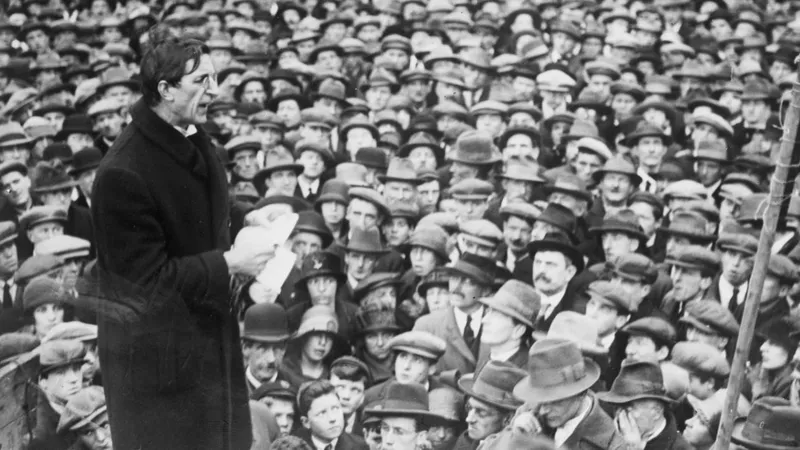
 Ireland’s journey to independence is filled with tales of rebellion, sacrifice, and remarkable figures who shaped the nation’s destiny.
Among them, Éamon de Valera stands out as a towering figure—an Irish president who not only survived the tumultuous Easter Rising but also pulled off a daring prison escape that cemented his place in history.
This blog dives into the gripping story of de Valera’s escape from Lincoln Prison, his political legacy, and why he remains a polarizing yet iconic figure.
Along the way, we’ll explore Michael Collins, What nationality was Éamon de Valera, How did Éamon de Valera die, and more, including 10 facts about Éamon de Valera to give you a full picture of this enigmatic leader.
Éamon de Valera: The Man Who Escaped Lincoln Prison
Éamon de Valera, born on October 14, 1882, in New York City, was a key figure in Ireland’s fight for independence. His life was marked by dramatic moments, but none were as cinematic as his escape from Lincoln Prison in England on February 3, 1919. This bold breakout, orchestrated with the help of Michael Collins, propelled de Valera to global prominence and solidified his role as a leader of the Irish Republic.
The Context: Easter Rising and Imprisonment
To understand de Valera’s escape, we must first look at What did Éamon de Valera do in the Easter Rising. In April 1916, de Valera was a commandant of the Irish Volunteers, leading the Third Battalion at Boland’s Mill in Dublin during the anti-British uprising. His forces held strategic positions, inflicting significant casualties on British troops. When the Rising was crushed, de Valera was among the last to surrender.
Arrested and sentenced to death, his life was spared—likely due to his American citizenship, the timing of his court-martial, and growing British reluctance to execute more rebels amid public backlash. Instead, he was sentenced to life imprisonment and sent to English jails, including Dartmoor, Maidstone, and Lewes.
Released under a general amnesty in June 1917, de Valera quickly rose to prominence. He was elected president of Sinn Féin in 1917 and won a parliamentary seat for East Clare. However, his activism led to another arrest in May 1918, this time for alleged anti-British plotting. He was sent to Lincoln Prison, setting the stage for his legendary escape.
The Great Escape: A Key in a Cake
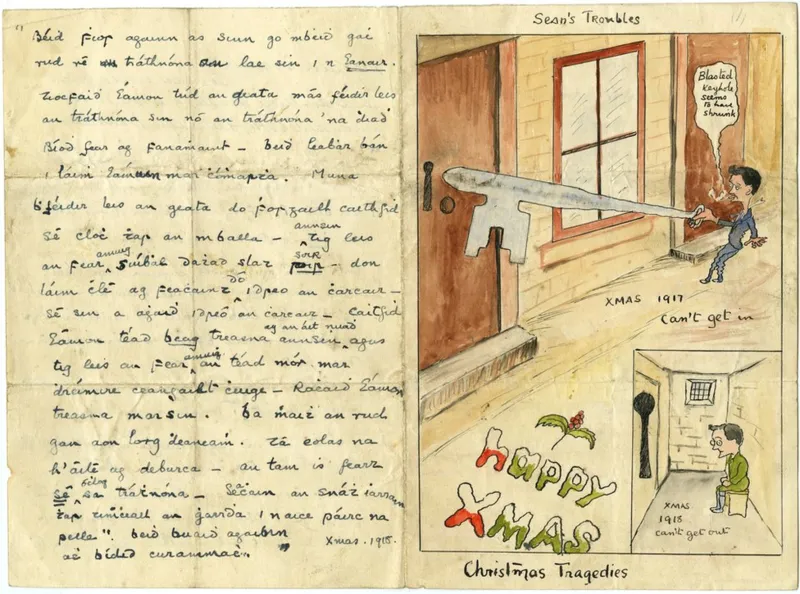
De Valera’s escape from Lincoln Prison is the stuff of legend, blending ingenuity, teamwork, and a touch of humor. Michael Collins, the mastermind of Irish republican intelligence, collaborated with Harry Boland to free de Valera, Seán McGarry, and Seán Milroy. The plan hinged on a clever ruse: smuggling a key to unlock the prison’s doors.
De Valera, a devout Catholic, served as an altar boy in the prison chapel, giving him access to the chaplain’s master key. Using softened candle wax, he created a mold of the key.
Fellow prisoner Seán Milroy, an artist, disguised the key’s impression in a cartoon postcard, which was sent to Collins. Outside, allies attempted to replicate the key and hid it in a fruitcake sent to the prisoners. The first attempt failed due to the key being too small, but a second mold, hidden in an ornate Celtic design, led to a successful key. On a misty February evening, de Valera and his comrades used the key to slip out, evading guards and bluffing past soldiers near a military hospital. They fled to a safe house in Manchester, with Collins orchestrating their getaway.
This escape wasn’t just a daring act; it was a propaganda coup. De Valera’s breakout humiliated the British and boosted his stature as a republican hero. Upon returning to Dublin, he was elected President of Dáil Éireann, the independent Irish parliament, in April 1919.
What Nationality Was Éamon de Valera?
A question often asked is What nationality was Éamon de Valera? Born in New York to an Irish mother, Catherine Coll, and a Spanish-Cuban father, Juan Vivion de Valera, Éamon was an American citizen by birth. At age two, after his father’s death, he was sent to live with his mother’s family in County Limerick, Ireland. De Valera identified as Irish, embracing the culture and language, but his American citizenship saved his life during the Easter Rising. His dual identity fueled speculation about his origins, with some questioning his father’s existence due to missing records, but de Valera’s Irish roots defined his legacy.
De Valera’s Life After the Escape
De Valera’s escape was a turning point. He spent 18 months in the U.S. (1919–1920), raising $5.5 million for the Irish cause, though he alienated some Irish-American supporters. Back in Ireland, he opposed the 1921 Anglo-Irish Treaty, which Michael Collins helped negotiate. De Valera rejected the treaty’s oath of allegiance to the British crown and partition of Ireland, leading to the Irish Civil War. His anti-treaty stance put him at odds with Collins, sparking a controversial question: Did de Valera order Collins’ death?
Did de Valera Order Collins’ Death?
Michael Collins was ambushed and killed by anti-treaty forces on August 22, 1922, in County Cork. Rumors persist that de Valera, who was in the area meeting IRA officers, may have known of or tacitly approved the attack. Some accounts suggest he remarked, “That would be a pity,” when told of plans to target Collins. However, there’s no definitive evidence de Valera ordered the assassination. Historians like Tim Pat Coogan argue his behavior was irresponsible, but de Valera’s defenders note his lifelong avoidance of the topic suggests guilt or regret rather than direct involvement. The question remains one of Ireland’s great mysteries.
Political Legacy and Family Life
De Valera founded Fianna Fáil in 1926, leading it to power in 1932. As Taoiseach (1932–48, 1951–54, 1957–59), he dismantled the treaty’s ties to Britain and authored the 1937 Constitution, renaming the Free State “Ireland” (Éire). He served as President from 1959 to 1973, retiring at 90 as the world’s oldest head of state.
De Valera married Sinéad de Valera (née Flanagan) in 1910, whom he met through the Gaelic League. Éamon de Valera’s children included five sons—Vivion, Éamon, Brian, Rúaidhrí, and Terence—and two daughters, Máirín and Emer. Sinéad, a teacher and Irish language advocate, died in January 1975, just before their 65th anniversary.
How Did Éamon de Valera Die?
How did Éamon de Valera die? He passed away on August 29, 1975, at age 92, in Linden Convalescent Home, Blackrock, County Dublin, weeks after Sinéad’s death. He was buried in Glasnevin Cemetery following a state funeral, marking the end of a monumental era.
10 Facts About Éamon de Valera
- American-Born Leader: De Valera was born in New York, making him the only Irish president with U.S. citizenship.
- Easter Rising Role: He commanded Boland’s Mill during the 1916 Rising, surviving execution due to his American birth.
- Prison Escape: His 1919 Lincoln Prison breakout, aided by Michael Collins, used a key smuggled in a cake.
- Sinn Féin President: Elected in 1917, he led the party until 1926, then founded Fianna Fáil.
- Constitution Author: De Valera’s 1937 Constitution established Ireland as a sovereign state.
- Longest-Serving Leader: He was Taoiseach for over 20 years and President for 14 years.
- Irish Language Advocate: A Gaelic League member, he met Sinéad de Valera through Irish classes.
- Civil War Opposition: He opposed the Anglo-Irish Treaty, clashing with Michael Collins.
- Global Diplomat: He served as League of Nations president in 1932 and 1938.
- Controversial Legacy: Praised as a patriot, critics like Tim Pat Coogan argue his policies entrenched conservatism.
Why De Valera’s Story Resonates Today
Éamon de Valera’s prison escape is more than a historical anecdote; it symbolizes resilience and cunning in Ireland’s fight for freedom. His complex relationship with Michael Collins, his American-Irish identity, and his long political career make him a figure of fascination. Whether you view him as a visionary or a divisive leader, de Valera’s legacy endures, much like Ireland itself.
FAQs About Éamon de Valera and Prison Escapes in Ireland
1. Has anyone escaped prison in Ireland?
Yes,several escapes have occurred, including Éamon de Valera’s 1919 breakout from Lincoln Prison and IRA prisoners escaping Mountjoy Prison in 1973 via helicopter.
2. Who was the president of Ireland prison key escape?
Éamon de Valera, who became Ireland’s third president (1959–1973), escaped Lincoln Prison using a key smuggled in a cake.
3. Who was the Irish president in the cake key?
Éamon de Valera, aided by Michael Collins, used a key hidden in a fruitcake to escape Lincoln Prison in 1919.
4. Who is the prisoner that became the president of Ireland?
Éamon de Valera, imprisoned after the Easter Rising and again in 1918, became President of Ireland from 1959 to 1973.
5. Who escaped prison 17 times?
There’s no verified record of an Irish prisoner escaping 17 times. This may be a myth or confusion with international figures like Steven Jay Russell.
6. What is the most notorious prison in Ireland?
Kilmainham Gaol in Dublin is infamous for housing political prisoners, including de Valera, during the independence struggle.
7. What is the biggest prison escape in Ireland?
The 1983 Maze Prison escape, where 38 IRA prisoners fled, is Ireland’s largest. De Valera’s escape, though smaller, was politically significant.
8. Has anyone ever escaped Limerick Prison?
Yes, escapes have been reported, but none are as well-documented as de Valera’s or the Maze breakout.
9. What is the most secure prison in Ireland?
Portlaoise Prison is considered Ireland’s most secure, housing high-risk prisoners under tight security.
10. What is the longest a prisoner has escaped?
Exact records are scarce, but some IRA escapees from the 1983 Maze breakout evaded capture for years. De Valera remained free after his 1919 escape, living until 1975.
Share this post to explore more Irish history, and check out our other blogs on Ireland’s revolutionary heroes! Discover more about Michael Collins or visit History Ireland for deeper insights.
About the Author
