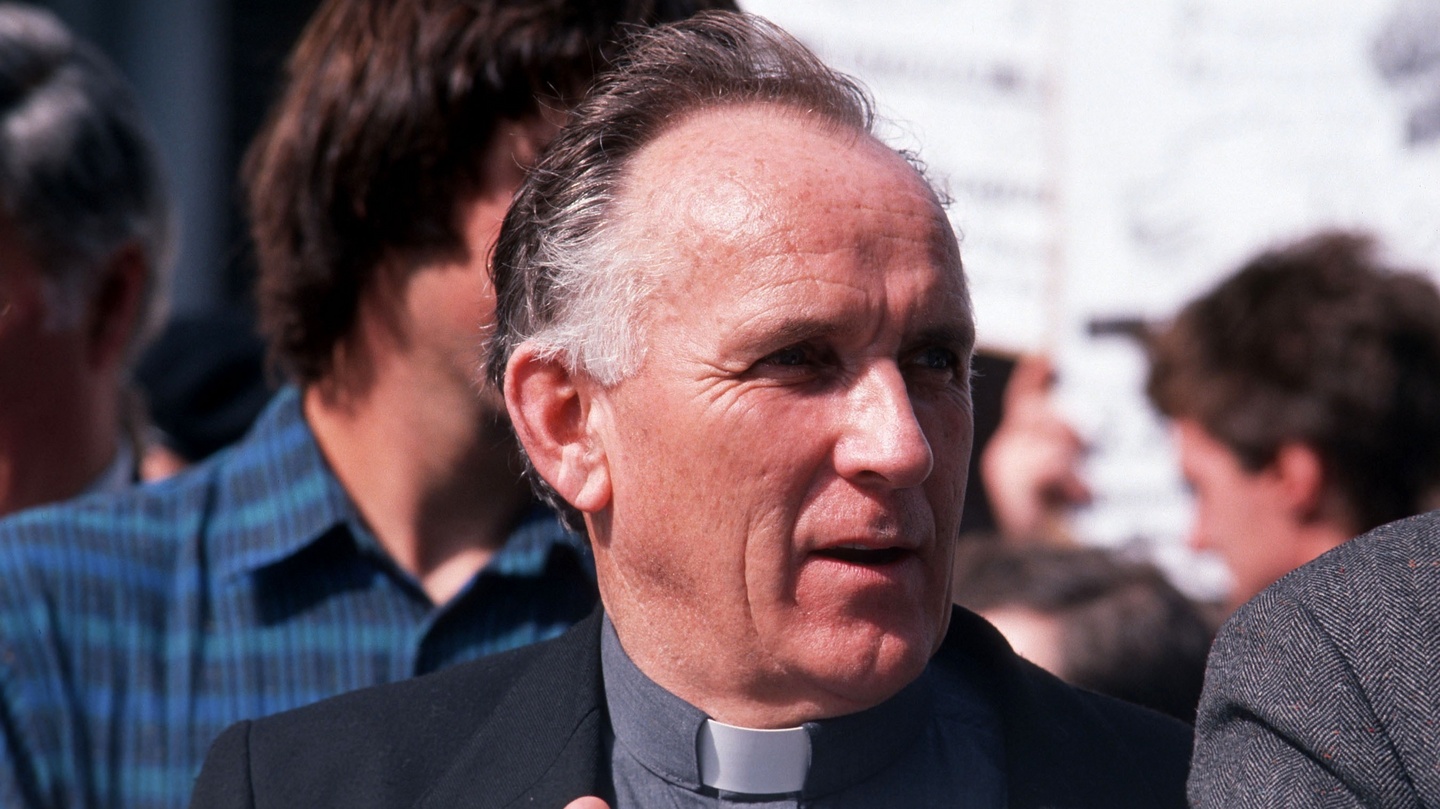
The name Patrick Ryan, for many, is a paradox. A priest, a man consecrated to God and peace, yet deeply intertwined with the brutal realities of one of Europe’s most enduring conflicts.
He was not just a supporter, but an admitted participant in the Provisional Irish Republican Army’s campaign, a figure who navigated the shadows of international arms dealing and the stark light of high-stakes political drama.
To understand Father Patrick Ryan is to peer into the soul of The Troubles, to confront the complexities of faith, patriotism, and the unyielding pursuit of a cause, no matter the cost.
Forget simple narratives. Father Ryan’s story is a compelling, almost cinematic, journey that defies easy categorization, a tale of conviction so profound it led him down a path few priests, or indeed any individual, would ever dare to tread.
The Seed of Discontent: From Rossmore to Rebellion
Born in 1930 into a farming family in Rossmore, County Tipperary, Patrick Ryan’s early life was steeped in rural Irish tradition. But it was his mother’s fervent Irish nationalism that truly ignited a spark within him. This wasn’t just abstract patriotism; it was a deeply ingrained sense of historical injustice, a narrative of occupation and resistance that resonated profoundly.
His path initially seemed conventional. Ordained in 1954 after studies at the Pallottine College in Thurles, he served as a missionary in Tanzania and later in London. These were years of pastoral care, of spiritual guidance. Yet, beneath the cassock, the nationalist flame continued to burn.
The Return to Ireland: A Shepherd Diverted
The late 1960s brought Father Ryan back to Ireland, just as the simmering tensions in Northern Ireland were boiling over. The Troubles, a period of intense sectarian and political conflict, were beginning to grip the island. Officially, Ryan was tasked with collecting donations for the Pallottine order. Unofficially, he was embarking on a far more perilous mission.
His clerical collar, ironically, became the perfect disguise. Moving across the country, seemingly on church business, Ryan allegedly began to divert funds, not to the needy of the church, but to the burgeoning Provisional IRA. It was a audacious act of betrayal against his vows, a stark illustration of where his true loyalties now lay. The priest was becoming the provisional.
The Libyan Connection: A Conduit of Chaos
Ryan’s audacity knew no bounds. Following the 1969 coup in Libya, he reportedly became the crucial link between Muammar Gaddafi’s regime and the IRA.
Picture this: a Catholic priest, meeting with the leader of a revolutionary Arab state, brokering deals for weapons and finance. It’s a scene ripped from a spy novel, yet it was Father Ryan’s alleged reality.
Gaddafi’s financial and material support was a game-changer for the IRA, significantly bolstering their capabilities. And the man who made it happen, the architect of this unholy alliance, was the seemingly unassuming Father Ryan. He wasn’t just passing messages; he was actively facilitating the flow of resources that would fuel a brutal campaign.
The Ingenuity of Destruction: A Timer’s Terrifying Transformation
Perhaps one of the most chilling aspects of Father Ryan’s alleged involvement was his macabre ingenuity. In 1975, in Switzerland, he encountered a simple memo timer. Most people would see a device for reminding them to pick up groceries. Ryan saw something else entirely.
He is credited with re-engineering this innocuous timer into a highly effective detonation device. These timers, more reliable than previous methods, became an insidious hallmark of IRA attacks.
Fragments of them were reportedly found at the Warrenpoint ambush in 1979, which killed 18 British soldiers, and at the infamous 1984 Brighton hotel bombing, a meticulously planned attack that narrowly missed assassinating Prime Minister Margaret Thatcher and her cabinet. Ryan wasn’t just supplying; he was innovating the tools of terror.
The Arrest, The Hunger Strike, The High-Stakes Extradition
The net finally tightened around Father Ryan in 1988. Following the killing of three off-duty British servicemen in the Netherlands, a tip-off led Belgian police to an IRA sympathizer’s home and to Ryan’s arrest. He was believed to be the quartermaster of an active IRA unit in Belgium, a crucial logistical figure. Bomb-making equipment, manuals, and a large sum of foreign currency were seized – damning evidence.
What followed was a diplomatic firestorm. Britain immediately sought his extradition to face charges. But Ryan, ever the defiant figure, launched a hunger strike.
The legal battles became a tug-of-war between Belgium and Britain, played out on the international stage. In the end, a court ruling, and perhaps political maneuvering, saw him deported not to Britain, but to the Republic of Ireland.
Thatcher’s Fury and The Political Cauldron
Margaret Thatcher, the “Iron Lady,” was incandescent with rage. Her government had failed to secure the extradition of a man she publicly branded a terrorist facilitator.
She railed against the European Court of Human Rights, against what she perceived as a lack of resolve from Belgium and Ireland. “It is no use governments adopting great declarations and commitments about fighting terrorism if they then lack the resolve to put them into practice,” she declared in the House of Commons.
The political temperature in Westminster soared. MP Michael Mates called for immediate extradition, and Thatcher echoed his frustration. But then, a voice of dissent: Labour MP Tony Benn accused Thatcher of prejudicing any potential trial by publicly labeling Ryan a “terrorist,” arguing it made a fair trial impossible.
It was a powerful moment, highlighting the ethical tightrope walked by politicians in the throes of such a conflict.
The Irish, for their part, held firm. Taoiseach Charles Haughey defended Ireland’s legal procedures, implying that Britain’s public accusations had poisoned the well for a fair trial in their courts.
He even, perhaps to diffuse the tension, described Ryan as a “mad priest careering around Europe.” The “Coventry Four” controversy, where Thatcher’s government had seemingly not pursued other extraditions with the same vigour, also played into the narrative of “double standards.”
Ultimately, the Director of Public Prosecutions in Ireland decided not to initiate proceedings against Ryan, effectively ending the extradition saga.
A Priest in Politics: An Unlikely Candidate
In a move that surprised many, Father Patrick Ryan decided to enter the political fray. In 1989, he became the first priest to contest an election in the Republic of Ireland, running as an Independent with Sinn Féin support for the European Parliament in the Munster constituency.
While he wasn’t elected, he garnered over 30,000 votes, a testament to a segment of the population that either sympathized with his cause or admired his defiance. It was another layer to the man: from clandestine operative to public political figure.
The Unrepentant Confession: “She Was Right”
Decades later, in a chillingly candid 2019 interview with BBC Spotlight, Father Patrick Ryan dropped the final, definitive piece of his puzzle. Asked if he was involved in the incidents Thatcher had accused him of, he responded: “I would say most of them. One way or another, yes I had a hand in most them – yes, she was right.”
And then, perhaps the most jarring statement of all, regarding the Brighton hotel bombing that killed five people: his only regret was that “I wasn’t even more effective… I would like to have been much more effective, but we didn’t do too badly.”
This was not the confession of a man seeking redemption or forgiveness. It was the unapologetic declaration of a man who believed in his cause, right or wrong, until the very end.
The Enduring Enigma
Father Patrick Ryan’s life is a testament to the fact that truth is rarely simple, and human motivations are often deeply complex. He was a priest who broke his vows for a political cause, a man of God who facilitated violence, a figure of international controversy who remained defiant until his last public breath.
His story is not just a footnote in the history of The Troubles; it is a vivid illustration of the forces that drove it: nationalism, deeply held beliefs, and an unyielding commitment to a vision of Ireland, even if it meant stepping into the darkest corners of human conflict.
Father Patrick Ryan remains an enigma, a figure who will continue to provoke debate, fascination, and introspection long after the echoes of The Troubles have faded. He was, undeniably, an unforgettable character in a conflict that shaped a nation.
About the Author
