Ireland is a land of stories. Not the gentle, sanitized ones you find in glossy history books, but the kind that crawl up from the dirt, soaked in blood and thunder.
The kind that whisper in the wind, hiding behind the mountains and drifting through the valleys. Some stories never die.
Some stories are carved so deeply into the land that you can still feel them beneath your feet, still hear them in the silence of the hills.
One of those stories is The March of O’Sullivan Beare—a tale of unimaginable endurance, of a people broken but unbowed, of a march not just through land, but through history itself.
A Last Stand Against the Tide
To understand the March, you must first understand the man. Dónal Cam O’Sullivan Beare, the last great Gaelic chieftain of Beara, a land that juts out into the Atlantic like a fist raised against fate. His people, the O’Sullivan clan, had ruled these rugged shores for centuries, standing defiant against the waves, the wind, and every invader who set foot on their land.
But then came Kinsale, 1601. A battle that should have saved Ireland but instead shattered it. The Irish, alongside their Spanish allies, stood against the might of Elizabethan England—and lost. The rebellion was crushed. The Gaelic world was burning. And in the embers of that fire, O’Sullivan Beare made a choice: he would not surrender.
Instead, he would march.
With 1,000 men, women, and children, he left the only home he had ever known and set out on a journey that would test the very limits of human endurance.
The O’Sullivans – A Dynasty Rooted in Battle
They came from the ancient line of the Eóganacht of Munster, warriors and kings before the word had even found meaning. The O’Sullivan clan had two main branches:
- O’Sullivan Mór – Lords of the Ring of Kerry, holding power over the lands that now stretch from Kenmare to Killarney.
- O’Sullivan Beare – The warriors of Beara and Bantry, whose name would be burned into history in the fires of the 16th century.
By the time Elizabeth’s armies cast their greedy eyes toward Ireland, the fate of the O’Sullivan Beare had already been sealed. The English didn’t conquer with swords alone; they used law, using the foreign rules of primogeniture to force chieftains into submission. When Domhnaill Cam Ó Súileabháin—known to the English as Daniel Cam O’Sullivan, Prince and 1st Count of Berehaven—took control in 1587, he wasn’t just inheriting a title. He was inheriting a war.
A war that would end in a march of suffering so brutal, so relentless, that it would sear itself into the soul of Ireland forever.
The Fall of Dunboy – A Kingdom in Flames
War was inevitable. By 1600, O’Sullivan Beare had allied with Hugh O’Neill and Hugh O’Donnell, standing against the tightening English noose. They believed Spain would save them, that their old Catholic allies would land an army large enough to drive Elizabeth’s forces back into the sea. But when the Spanish surrendered at Kinsale in 1601, Ireland was left alone.
Alone. But not broken.
The English, led by Sir George Carew, descended on Dunboy Castle in 1602. What followed was not a battle—it was butchery. The 143 defenders of the castle fought like animals, knowing full well what awaited them. Carew, ruthless as the empire he served, executed every last one of them.
Daniel O’Sullivan wasn’t there. He was at Ardea Castle, and when the fires of Dunboy turned the night sky red, he knew what came next. Death. Slaughter. Extermination.
But he refused to surrender.
And so, he marched.
The March of O’Sullivan Beare – A Journey Through Hell
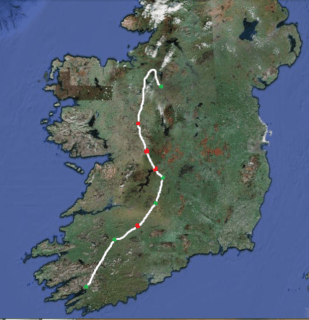
It began on December 31st, 1602.
1,000 men, women, and children. Warriors, wives, elders, and infants. 400 fighters. 600 innocents.
They carried with them one day’s worth of food.
They walked into a nightmare.
A Road Paved with Blood
The first attack came almost immediately. As they crossed a ford near Liscarroll, pro-English Barry forces ambushed the convoy, slaughtering four before being driven off. The English weren’t the only enemy; hunger sank its claws in quickly. O’Sullivan’s wife was forced to hand over her two-year-old son to a loyal servant, trusting him to flee to Spain, knowing the boy had a better chance of survival alone than among the doomed.
They pressed on, climbing through the frozen Galtee Mountains, skirting the villages of Tipperary, fighting off raiders and informers at every turn. Every day, they buried more of their own in the frozen ground.
By the ninth day, what remained of the convoy reached the Shannon River near Portland. But the English were waiting.
They had no boats.
They had no choice.
Using the skins of a dozen dead horses, they fashioned makeshift curraghs, rowing desperately across the icy river as Sheriff Donough McEgan and his forces descended upon them. He ordered his men to drown the women and children, to cut them down before they could reach the other side.
But O’Sullivan Beare would not let the English write his story. He killed the sheriff himself, sending the rest of the enemy scattering into the wind.
But there was no rest.
Through Fire and Ice – The Final Days
Their journey took them into O’Kelly lands, where the locals met them with hostility. They raided villages just to stay alive, eating whatever they could find.
At Aughrim, they faced a full English assault, led by Captain Henry Malby. They slaughtered his forces, killing him where he stood, but the cost was devastating.
More fell.
More starved.
More simply gave up.
Even the Irish turned against them. MacDavid Burke harried the convoy, refusing to let them rest on his land. They pressed onward into Diamrach, “The Place of Loneliness,” where the people finally showed them kindness, offering food, sanctuary—hope.
But it was too late for most.
The final stretch took them through the Curlew Mountains, where snow fell like a burial shroud. They carried the dying on their backs, trudging through blizzards and hunger, knowing that every step forward was a step away from annihilation.
The End of the March – A Legacy of Fire
Fourteen days after they left Beara, only 35 survivors walked into Leitrim Castle.
Thirty-five.
Of the 1,000 who had begun, a handful remained. More would drift in later, shattered remnants of what had once been a proud people.
The O’Rourkes of Breffney took them in, offered them protection. In time, O’Sullivan Beare secured passage to Spain, where he was welcomed as a prince. The Spanish king greeted him not as a refugee, but as a warrior. A chieftain in exile.
He never returned to Ireland. He died in Spain in 1618, a king without a throne.
The Road Never Ends
Today, the Beara-Breifne Way retraces his steps—a 500-kilometer pilgrimage through history, a reminder of what it means to endure.
The land has not forgotten.
The wind still sings their story.
The mountains still bear their footprints.
The rivers still whisper their names.
The March of O’Sullivan Beare is not just history. It is defiance made flesh. It is the proof that even in the face of slaughter, of betrayal, of merciless cold, some spirits will never bow.
And if you walk that road today, know that you are not alone.
The march never ended. It still lives.
More Info On The Route – A Trail of Suffering
The March of O’Sullivan Beare route stretched for 500 kilometers (roughly 300 miles), from Dunboy Castle in Beara to Leitrim, deep in the heart of Ireland. Through mountains, bogs, and bitter winter landscapes, they traveled, pursued relentlessly by English forces and hostile clans eager to curry favor with the crown.
Every mile was a war.
Every village was a gamble.
Every frozen morning was another chance for death to catch them.
Starvation gnawed at them. The weak fell behind, left to the mercy of wolves, both the four-legged and the two-legged kind. They crossed rivers thick with ice, trudged through forests where the only sound was the whisper of betrayal. The land itself conspired against them, offering no mercy, no shelter.
Of the 1,000 who set out, only 35 survived.
Thirty-five souls. Thirty-five ghosts of a kingdom that once was.
But O’Sullivan Beare himself lived. He reached Leitrim, where he sought sanctuary with the O’Rourkes, but exile was inevitable. He fled to Spain, where he died in 1618—a warrior without a battlefield, a king without a throne.
The Land That Remembers
The land does not forget. Even now, you can walk the Beara-Breifne Way, tracing the footsteps of those who bled, those who starved, those who died but refused to be erased.
How long is the Beara Breifne Way?
The modern Beara-Breifne Way stretches for 500 kilometers, making it one of Ireland’s longest historical walking routes. It is the very road that O’Sullivan Beare and his people took in 1603.
March of O’Sullivan Beare Map
For those seeking to walk this path, detailed maps exist, marking the places where battles were fought, where children were buried, where warriors made their final stand. It is a journey through time, a pilgrimage for those who wish to touch history.
The O’Sullivan Legacy – Blood, Betrayal, and Survival
What clan does Sullivan belong to?
The O’Sullivans are part of the ancient Eóganacht dynasty, descended from the legendary Milesians, the first rulers of Ireland according to myth.
Where are the O’Sullivans from in Ireland?
The O’Sullivans originated in Munster, primarily in Cork and Kerry, with strongholds along the Beara Peninsula.
What is the motto of the O’Sullivan clan?
“Lámh Foisteanach Abú”—Steady Hand to Victory.
A motto forged in war, a promise whispered through the ages.
What’s the difference between O’Sullivan and O’Sullivan Beare?
Not all O’Sullivans are the same. The O’Sullivan Beare line comes from the rulers of the Beara Peninsula, while the O’Sullivan Mór ruled in Kerry. Two branches of the same fierce bloodline, but each with its own destiny.
Philip Ó Sullivan Beare
One of the great chroniclers of this legacy, Philip Ó Sullivan Beare, a nephew of Dónal Cam, wrote extensively on the history of the clan from exile in Spain. His works are among the few surviving records of the time.
The Echoes of the March
The past is never truly past in Ireland. The ghosts of Dunboy Castle, where O’Sullivan Beare made his last stand, still linger in the ruins. The Ring of Beara, a spectacular coastal route, winds through the lands he once ruled.
Where is the Ring of Beara?
The Ring of Beara loops through West Cork and Kerry, offering some of Ireland’s most breathtaking landscapes, passing near places steeped in O’Sullivan history.
Where is the longest greenway in Ireland?
The Beara-Breifne Way is often considered Ireland’s longest historical trail, retracing the doomed march of O’Sullivan Beare’s people.
What is the population of Beara today?
Modern Beara is sparsely populated, home to just 5,000 people, but its landscape holds memories older than time.
The Song of the Lost Warriors
O’Sullivan’s March Song History
The March of O’Sullivan Beare isn’t just a tale—it’s a song, a lament, a melody carried through centuries. Irish traditional music remembers what history often tries to forget. Composed and passed down through generations, “O’Sullivan’s March” captures the pain and resilience of a people who refused to be broken.
Listen to it, and you can hear the footsteps in the frost, the cry of a mother for her lost child, the whispered prayers of those who knew they wouldn’t make it but marched on anyway.
Final Thoughts – The March Continues
Ireland is no stranger to suffering. No stranger to exile. No stranger to battles fought against impossible odds. The March of O’Sullivan Beare wasn’t just a desperate flight—it was a refusal to be erased.
Even today, centuries later, you can walk where they walked, feel what they felt. The wind still carries their whispers. The mountains still stand as silent witnesses. The rivers still run, remembering the ones who never reached the other side.
The story of the March of O’Sullivan Beare is not just history. It is Ireland itself. Unbroken. Unyielding. Eternal.
For more on Ireland’s forgotten warriors and wild landscapes, explore:
- Secret Ireland – Discover Ireland’s Hidden Stories
- The Irish Red Deer – A Majestic Icon of Ireland’s Wild Landscape
- The Irish Mountain Hare – A Mysterious Guardian of the Wild
- Irish Wolfhound – The Gentle Giant of Irish Heritage
The road is still there. The march never truly ended. Will you walk it?
About the Author
