Ireland is a land steeped in mythology, its rugged terrain home to creatures that blur the line between the natural and the supernatural. Among them is the elusive Irish mountain hare, a creature that has scampered across the island for millennia, surviving ice ages, deforestation, and even the encroachment of modernity. This is no ordinary hare; it is a symbol of ancient Ireland, a wild and untamed spirit that echoes through folklore and history.
But what makes the Irish mountain hare so unique? How does it differ from other hares and rabbits? Why does it rarely turn white in winter, unlike its Scottish cousins? Let’s dive deep into the world of this fascinating animal, exploring both its biology and the myths that have surrounded it for centuries.
Are There Mountain Hares in Ireland?
Yes, the Irish mountain hare (Lepus timidus hibernicus) is a native species found across the island. It is a subspecies of the mountain hare, but what sets it apart is that it has lived in Ireland since before the last Ice Age. Unlike other European hares, it has evolved distinct traits suited to Ireland’s varied landscape.
While closely related to the Scottish mountain hare, it has some unique adaptations that set it apart—chief among them being its reluctance to turn white in winter.
Irish Mountain Hare vs Hare: What’s the Difference?
The Irish mountain hare is often confused with the European brown hare (Lepus europaeus), a species introduced to Ireland in the 19th century. However, there are key differences:
- Size: The Irish hare size is generally smaller than the brown hare. It measures around 50–60 cm (19–23 inches) in length, with a tail of approximately 7–12 cm (3–5 inches).
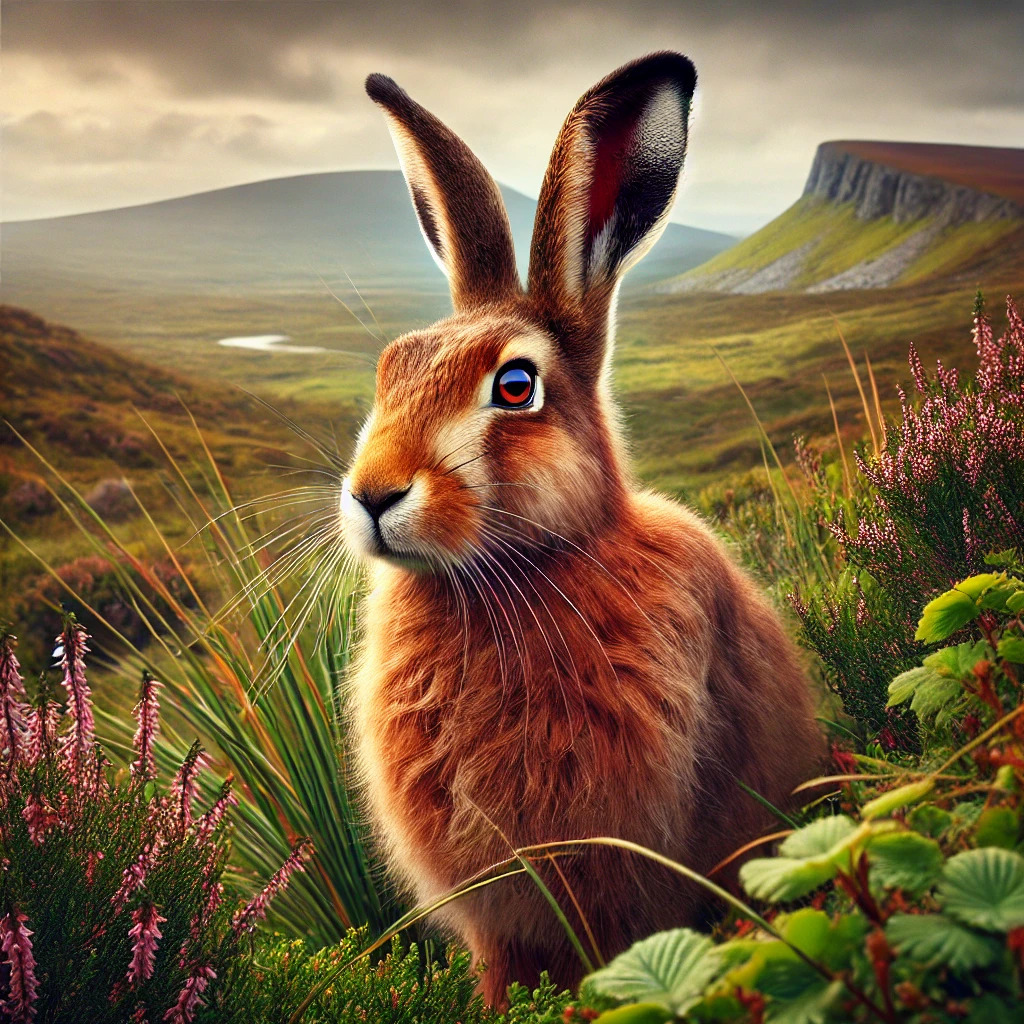
- Coloration: Unlike the brown hare, which has golden-brown fur, the Irish mountain hare has a more reddish-brown coat. Unlike its Scottish relatives, it rarely turns white in winter.
- Ears: The Irish mountain hare has shorter ears than the brown hare, with black tips.
- Speed & Behavior: Irish hares are more compact and agile, making them well-suited for the dense grasslands and heather-covered hills.
Irish Hare vs Rabbit: Spotting the Difference
Many people confuse the Irish hare vs rabbit, but they are distinct species:
| Feature | Irish Hare | Rabbit |
|---|---|---|
| Size | Larger, with longer legs | Smaller and stockier |
| Ears | Long, with black tips | Shorter, rounded |
| Movement | Runs fast in open spaces | Prefers to hop and burrow |
| Habitat | Open fields, mountains, and bogs | Underground burrows in woodland and gardens |
Unlike rabbits, hares do not burrow. Instead, they make shallow nests called forms, hidden in tall grass.
Irish Hare Habitat: Where Do They Live?
The Irish hare habitat spans across mountains, bogs, farmland, coastal grasslands, and sand dunes. Unlike the Scottish mountain hare, which is confined to uplands, the Irish hare thrives in lowland meadows and even near the coast.
They can be found all across Ireland, from Donegal’s rugged mountains to the barren limestone of the Burren, adapting to an ever-changing landscape.
How Many Hares Are in Ireland?
Estimating the population of Irish hares is difficult, but studies suggest that there are between 200,000 to 300,000 hares across the country. However, their numbers fluctuate due to habitat loss, hunting, and climate change.
Why Do Irish Hares Rarely Turn White?
Unlike their Scottish cousins, Irish hares seldom change color in winter. This is because Ireland has a milder climate, meaning they don’t need the camouflage that a white coat would provide in snowy conditions.
Occasionally, some Irish hares in upland areas develop a paler coat in winter, but a fully white Irish hare is extremely rare.
Where Do Irish Hares Sleep?
Irish hares do not burrow underground like rabbits. Instead, they sleep in shallow depressions in the grass called forms. These forms provide some shelter but leave the hare vulnerable to predators like foxes and birds of prey.
Do Mountain Hares Eat Grass?
Yes, the Irish mountain hare is primarily a herbivore, feeding on a diet of grasses, heather, herbs, and bark. In winter, when food is scarce, they will gnaw on twigs and roots to survive.
What Is the Myth of the Hare in Ireland?
The Irish hare folklore is as rich as the landscape it inhabits. In Irish mythology, the hare was believed to be a shape-shifter, capable of turning into a human or spirit. The Celts revered hares as creatures of the Otherworld, often associated with goddesses and druids.
One of the most famous myths tells of a witch who could transform into a hare. If a hunter wounded the hare, it would flee to a cottage, only for the hunter to find an old woman inside nursing a wound in the same spot where the hare was struck.
The hare was also considered bad luck if encountered at dawn, a belief that still lingers in rural Ireland.
Can You Shoot Hares in Ireland?
Hare hunting is legal but strictly regulated in Ireland. The hare is a protected species under the Wildlife Act 1976, but certain forms of hunting, such as hare coursing, are still practiced under a license.
However, conservation groups have called for stronger protections, as hare numbers are declining in some areas due to habitat destruction and hunting pressures.
Irish Hare Facts for Kids
Here are some quick and fun Irish hare facts for kids:
- They are fast! Irish hares can run up to 70 km/h (43 mph), making them one of the fastest animals in Ireland.
- They can swim! Irish hares have been known to cross rivers and lakes to escape predators.
- Their babies are called leverets. Unlike rabbit kits, leverets are born fully furred with open eyes and can hop around within hours.
- They have an excellent sense of hearing. Their large ears help them detect danger from far away.
- They are mostly nocturnal. Irish hares are most active at dusk and dawn.
The Irish Mountain Hare: A Living Relic of Ancient Ireland
The Irish mountain hare is more than just a species—it is a symbol of Ireland’s wild and untamed spirit. From its role in mythology to its resilience in an ever-changing world, the hare is a reminder of Ireland’s deep connection to nature.
Yet, with habitat loss and human interference threatening its survival, we must do more to protect this ancient guardian of the Irish landscape.
For more on Ireland’s incredible wildlife, check out our feature on the Irish Wolfhound: The Gentle Giant of Irish Heritage.
About the Author
