
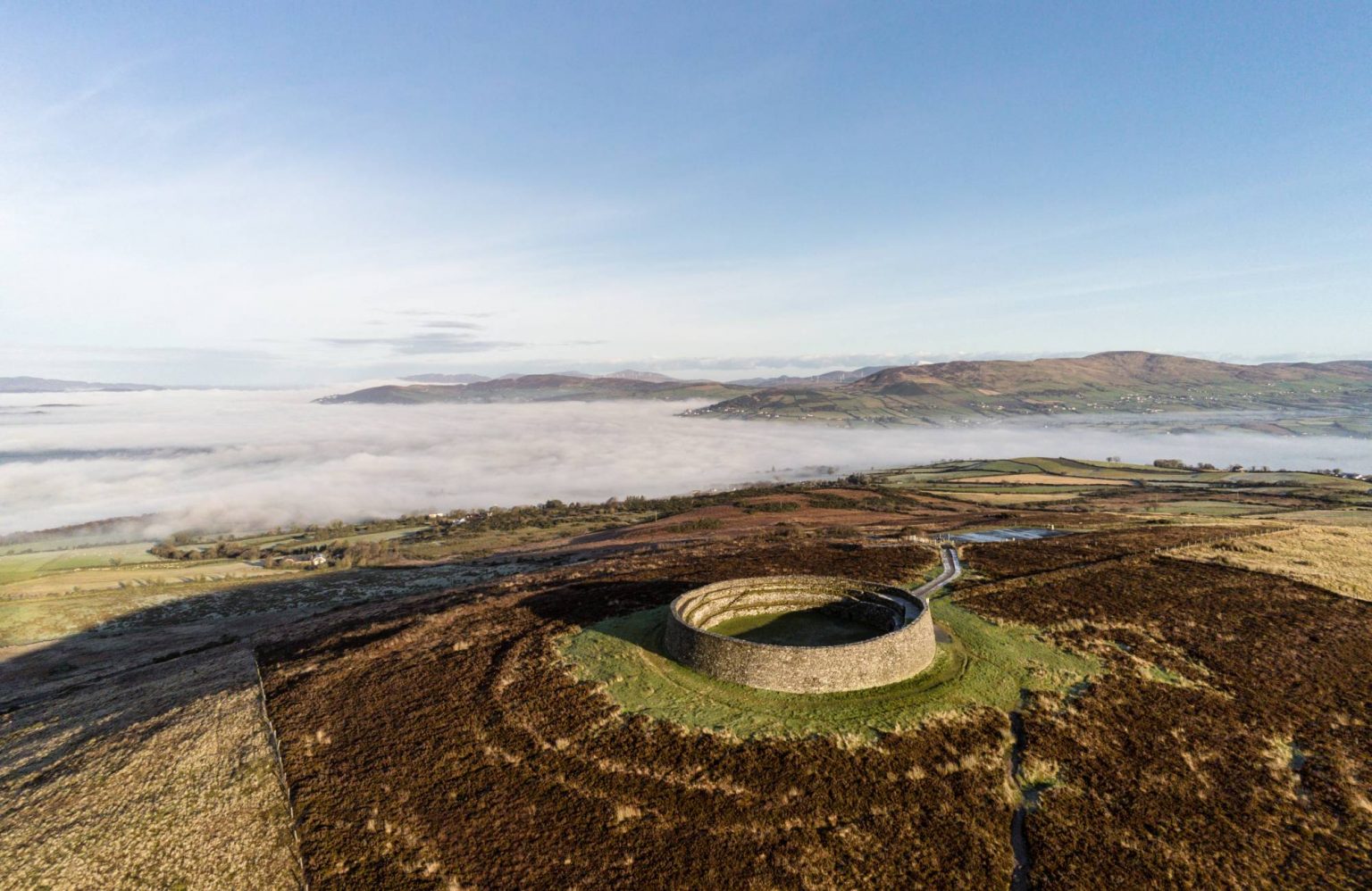
The Grianán of Aileach, a breathtaking stone fort in County Donegal, Ireland, stands as a testament to Ireland’s ancient past.
Perched atop Greenan Mountain, this historic site has roots in the Iron Age and served as a royal stronghold for the Northern Uí Néill dynasty.
In this article, we delve into the rich history of Grianán of Aileach, exploring its origins, royal connections, and enduring significance in Irish heritage.
Iron Age Origins
Grianán of Aileach, meaning “Stone Fort of the Sun,” is believed to date back to the Iron Age (circa 800 BCE–400 CE). Archaeological findings suggest it was initially a ceremonial or defensive site, possibly linked to the mythological Tuatha Dé Danann. Its strategic location, offering 360-degree views of Lough Foyle and Lough Swilly, made it a natural fortress. The fort’s massive stone walls, up to 4.5 meters thick, showcase advanced construction techniques for the period.
Explore the mythological legends surrounding Grianán to uncover its deeper cultural roots.
Northern Uí Néill Stronghold
By the 6th–7th century CE, Grianán of Aileach became the royal seat of the Northern Uí Néill, a powerful dynasty in Ulster. Associated with legendary kings like Niall of the Nine Hostages, the fort served as a political and ceremonial center. Historical records, such as the Annals of Ulster, document its role as a stronghold until the 12th century. Its terraced interior and stone passages suggest it hosted royal gatherings and defensive operations.
[Image: Grianán of Aileach stone fort – Alt Text: Aerial view of Grianán of Aileach stone fort in Donegal, Ireland]
Destruction and Restoration
In 1101, the fort was destroyed by Muirchertach Ua Briain, King of Munster, in a power struggle with the Uí Néill. The site fell into ruin for centuries, its stones scattered across Greenan Mountain. In the 1870s, Dr. Walter Bernard, a local antiquarian, spearheaded restoration efforts, rebuilding the walls to preserve its legacy. Today, Grianán is a protected national monument, drawing visitors worldwide.
Plan your visit with our Grianán of Aileach visiting guide for tips on exploring this historic site.
Historical Timeline of Grianán of Aileach
| Period | Event | Significance |
|---|---|---|
| 800 BCE–400 CE | Iron Age origins | Ceremonial or defensive site |
| 6th–7th Century | Northern Uí Néill stronghold | Royal seat of power in Ulster |
| 1101 | Destruction by Muirchertach Ua Briain | End of Uí Néill dominance |
| 1870s | Restoration by Dr. Walter Bernard | Preserved as a national monument |
Cultural Significance
Grianán of Aileach is more than a historic site; it’s a symbol of Ireland’s ancient heritage, connecting Iron Age traditions to medieval power dynamics. Its restored walls and stunning views make it a must-visit for tourists and historians. Learn more about its enduring legacy or explore nearby Donegal attractions. For a modern perspective, discover how figures like JP McManus shape Ireland today.
Ready to explore? Plan your visit to Grianán of Aileach and experience Ireland’s ancient history firsthand.
Frequently Asked Questions
What is the history of Grianán of Aileach?
Grianán of Aileach is an ancient stone fort in Donegal, Ireland, built around the 6th–7th century, linked to the Northern Uí Néill kings and possibly dating back to the Iron Age.
Who built Grianán of Aileach?
The fort is traditionally attributed to the Northern Uí Néill dynasty, though its origins may trace to earlier Iron Age inhabitants.
Why was Grianán of Aileach built?
Grianán of Aileach was likely built as a royal stronghold, defensive fort, and ceremonial site for the Northern Uí Néill kings.
About the Author
