
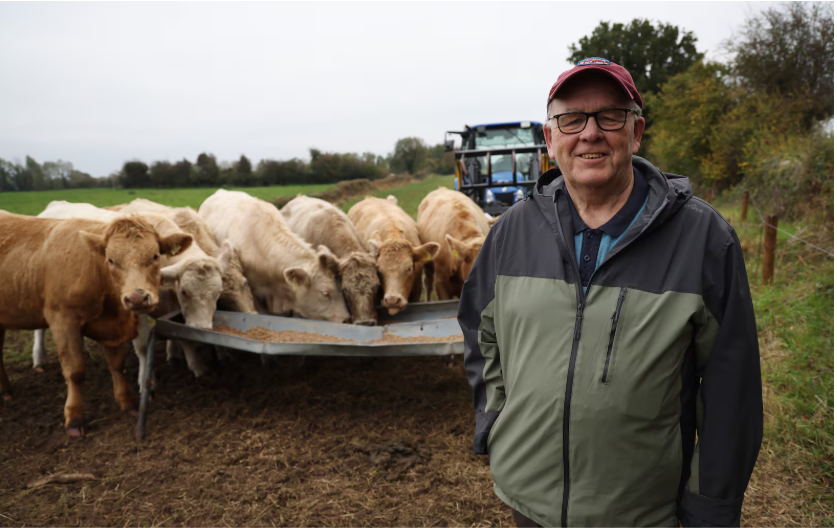
In one of the most inspiring Irish success stories of 2025, Séamus Boland—a 69-year-old farmer from County Offaly who left school at just 13—is set to become President of the European Economic and Social Committee (EESC). From the bogs of rural Ireland to high-level meetings with Ursula von der Leyen and Emmanuel Macron, Boland’s journey is a powerful reminder of the transformative impact of the European Union on ordinary lives.
Early Life: Leaving School at 13 to Save the Family Farm
Séamus Boland grew up in rural Offaly during a time when electricity was still a novelty and small farms struggled to survive. When his father fell seriously ill, 13-year-old Séamus had no choice but to leave school and take over the family’s modest five-hectare farm.
“I grew up experiencing poverty: the usual making ends meet, all of that on a small farm… I’m old enough to remember electricity coming in,” he told The Irish Times. “I know how grinding it is and I know how horrific it is, and I know how difficult it is.”
Despite the hardship, young Boland dreamed of becoming an actor. But as he entered his teenage years, those dreams seemed impossible. “From ‘the bogs of Offaly’, a young Boland had dreams of becoming an actor. All that suddenly seemed closed off to him,” the report noted.
“Frankly when I was 13½ and left school, every statistician would have said: ‘Well, he will never move beyond that level’.” – Séamus Boland
Macra na Feirme: His “Third-Level Education”
At just 15, Boland joined Macra na Feirme, the rural youth organization he credits as his true education. “That was my third-level,” he says. It was here that his passion for community activism and rural advocacy was born.
He began writing plays—one about a young priest leaving the priesthood, another about a Traveller girl falling in love with a farmer’s son. Though he hasn’t written in years, he jokes: “I keep saying when I grow up and settle down, I’ll go back to that.”
Boland later studied speech and drama and worked with the Traveller community, teaching literacy to adults who had never learned to read or write.
A Career in Community Leadership and Rural Advocacy
Boland’s career took him to the forefront of Ireland’s voluntary and community sector:
- Chief Executive of Irish Rural Link – campaigning for sustainable rural development
- Chairperson of The Wheel – Ireland’s national association of charities
- Chair of the Peatlands Council
- Chair of Pobal – the state body distributing community funding
For over 40 years, he has championed rural isolation, youth empowerment, disability rights, and ethnic minority inclusion.
How the EU Changed Ireland – And Boland’s Life
When Ireland joined the EEC (now EU) in 1973, Boland was still “eking out a living” on the family farm. But EU membership transformed Ireland.
“It changed everything,” he says. “It made a massive change in Ireland… turning a peasant society into a modern, western country.”
From rural electrification to agricultural supports, the EU lifted generations out of poverty. Boland warns that younger Irish people risk taking this progress for granted.
From Irish Rural Link to the EESC: A Seat at Europe’s Table
In 2011, Boland was appointed to the European Economic and Social Committee (EESC) as Ireland’s representative for the voluntary sector. The EESC, founded in 1958, gives civil society a voice in EU policymaking.
Over the past 13 years, he has:
- Chaired study groups on minimum wage, migration, and sustainable development
- Served as rapporteur on agriculture, energy, and Brexit
- Led the EESC’s Diversity Europe Group (2020–2022)
- Been re-elected President of the Civil Society Organisations’ Group (2022–2025)
In December 2024, he was elected EESC President-designate for the 2025–2028 term—the second Irish person ever to hold the role.
Meetings with Von der Leyen, Macron, and EU Leaders
Today, Boland sits across from Europe’s most powerful figures:
“In the last few years I’m sitting at meetings with the [European Commission] president Ursula von der Leyen, with [Emmanuel] Macron, with a whole range of European leaders. It’s quite amazing. This is not where I came from.”
His presidency will focus on:
- Reforming the Common Agricultural Policy (CAP) – opinion due in 2026
- Reducing bureaucratic burdens on small farmers
- Promoting sustainable rural development
- Combating populism by ensuring politicians listen to citizens
A Grounded Voice in Brussels: Still Chairing a Graveyard Committee
Despite his Brussels office, Boland remains deeply rooted in Offaly. He still chairs the Killickfeehan graveyard extension committee.
“If that isn’t future rural development, nothing is,” he laughs.
About the Author
