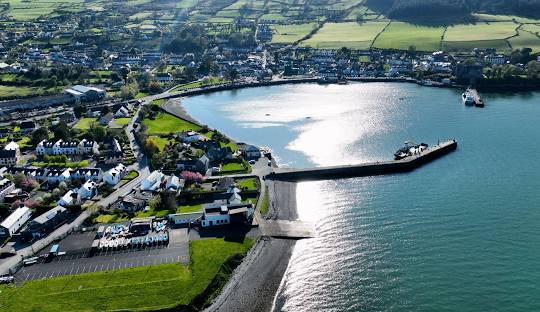
Carlingford. A name born from Old Norse, Kerlingfjǫrðr—the narrow sea-inlet of the hag. A town that refuses to fade into the background, standing defiantly on the edge of Carlingford Lough, its Slieve Foy Mountain towering behind it like a silent sentinel.
This is Cairlinn, as the Irish call it. A town where past and present collide, where the ghosts of Vikings and Normans whisper through the mist, where the sea and sky bleed into each other in an ever-changing dance of grey and gold.
For local government purposes, it belongs to Dundalk Municipal District, but Carlingford answers to no one but time itself.
It’s the beating heart of the Cooley Peninsula, perched along the R176/R173 roads, a stone’s throw from Greenore and Omeath, just 27 km northeast of Dundalk, 90 km from Dublin, and a mere 11 km from the Northern Ireland border.
In 1988, it won the Irish Tidy Towns Competition, but Carlingford has never been about tidiness—it’s about character, defiance, and the weight of history pressing down on its narrow streets.
A Medieval Skeleton Wrapped in a Modern Pulse
Carlingford has kept its bones medieval, no matter how much the modern world tries to creep in. The narrow lanes, the stone-walled passages, the whispers of old battlements—they all tell the story of a town that once stood on the edge of empires.
Tholsel Street is home to the last standing medieval town gate, The Tholsel, which once doubled as a gaol, its thick walls absorbing the cries of the damned. Walk further and you’ll stumble upon Carlingford Mint, a 16th-century townhouse that still holds echoes of commerce, power, and intrigue.
A History Etched in Stone and Blood

The Vikings came first, crashing onto Irish shores in the 9th century, their longships slicing through the dark waters of Carlingford Lough like blades through flesh. This secure bay became their refuge, their launching point for plunder and conquest. They came, they took, they left their mark.
Then came the Normans, brutal, ambitious, relentless. Hugh de Lacy, a name carved into the bones of Irish history, laid claim to this land in the 12th century, staking his dominance with a fortress of cold, unforgiving stone. A castle, built on a jagged outcrop of rock, a warning to all who dared defy the iron grip of Norman rule. Around this fortress, a settlement grew—Carlingford, the town of warriors, merchants, and survivors.

They call it King John’s Castle now, after the English king who graced its halls in 1210. But titles mean nothing to stone. It remains as it always was—an extensive ruin, its foundations bitten by the relentless sea, its walls rising above the narrow pass below, once a lifeline, now a scar. Behind it, the mountains loom, a natural fortress in their own right, watching over the town as they have for a thousand years.
Carlingford is not just a town. It is a wound that never closed, a fortress that never fell, a story that refuses to be forgotten.
Carlingford was never meant to be forgotten. It was built in the jaws of history, carved out by the sea, battered by war, and tempered by resilience. This strategic outpost on Ireland’s east coast, alongside Carrickfergus and Drogheda, made it more than just a picturesque settlement—it made it a target.
In its 14th, 15th, and early 16th-century heyday, Carlingford thrived as a trading port, its position on Carlingford Lough turning it into a gateway to wealth and influence. Ships filled with oysters, herring, and fine goods came and went, leaving prosperity in their wake.
The medieval streets pulsed with merchants, sailors, and traders, the stone buildings rising as testaments to success. The remains of Taffe’s Castle and The Mint still stand today, ghosts of a golden age that nearly didn’t survive the fire.
Fire, Conquest, and the Scots Raid of 1388
Power invites war, and Carlingford, in its prime, had more than its fair share.
1388. The town burns. Not by accident. Not by rebellion. But by the hands of Sir William Douglas of Nithsdale, a Scots warlord with vengeance in his heart and fire in his wake. This was no mindless act of destruction—this was retribution, a punitive raid against Irish forces who had attacked Galloway, home of Douglas’s father, Archibald the Grim. The flames rose high, swallowing homes, businesses, and the very walls of Carlingford itself.
But the town did what it always did. It survived.
By 1410, the wounds were still fresh, and the town was granted a remission from payment of tallage—a heavy tax on towns. It was an acknowledgment that Carlingford had suffered but endured. More royal charters followed, five in total, from Edward II in 1326 to James I in 1619, each a testament to the town’s importance.
But history has a cruel sense of humor. No matter how many times Carlingford rebuilt, war always came knocking.
The War That Took Everything
Carlingford’s trading ships carried oysters, fish, and prosperity across Britain and Europe, its green-finned oysters renowned in distant lands. But war does not care for trade, tradition, or stability.
The 1641 Rising—an armed rebellion of the Irish against English rule—sent shockwaves through Ulster. This was no isolated conflict. It was the spark before the wildfire of the Cromwellian Conquest of 1649, when Oliver Cromwell and his New Model Army swept across Ireland with ruthless efficiency, crushing resistance and leaving towns like Carlingford in ruin.
The town reeled, its economy crippled, but it wasn’t over yet. The Williamite Wars of the 1690s—fought between the forces of Protestant King William III and Catholic King James II—brought more destruction, bloodshed, and economic collapse. By 1744, Isaac Butler, in his journal, described Carlingford as in a “state of ruin”.
But the final, most brutal wound was not war, but silence.
The herring shoals that had fed the town for centuries, that had kept its economy afloat even when war raged, vanished into open water by the early 18th century. Carlingford had survived fire. It had survived battle. But could it survive starvation?
A Town Left in the Past—Until the Railways Came
Heavy industry never found a home in Carlingford. No factories, no coal smoke, no industrial revolution. And for that, we should be grateful. Because while other towns grew modern and forgot their past, Carlingford remained medieval, untouched by the grime of progress.
Then came the 1870s, and with it, the Dundalk, Newry, and Greenore railway. The iron rails stretched through Carlingford, opening the town to a new kind of visitor—not merchants, but tourists. For the first time in centuries, people weren’t coming to Carlingford to fight or trade—they were coming to marvel. The town, with its unchanged medieval layout, crumbling castles, and views of Carlingford Lough, became a place where people could step into the past without ever leaving the present.
But nothing lasts forever. The railway closed in 1951, and once again, Carlingford had to reinvent itself.
Oysters, Festivals, and a New Future
Tourism, fishing, and the sea. That is what kept Carlingford alive. The Carlingford Oyster Festival, held every August, became a celebration of the town’s most famous export.
Even in the modern era, fishing remained its lifeline, particularly the oysters and crabs harvested from its lough. And though the town lost its railway, it found another connection to the world through the passenger ferry at Greenore, linking Carlingford to Northern Ireland during the summer months.
Carlingford in the Irish War of Independence
Carlingford did not escape the political chaos of 1918. On the day of the Irish general election, the Camlough Company of the Irish Volunteers arrived by train from Newry, expecting a town full of fellow nationalists. Instead, they were met with Union Jacks and hostility.
The Royal Irish Constabulary (RIC) officers were ordered by the Volunteers to stay in their barracks, while conflicts broke out on the streets between Unionist mobs and Irish nationalists. The polling clerk, Seamus Lyang from Dundalk, had to be escorted out of Carlingford under Volunteer protection, as the pubs and shops refused service to the nationalist fighters.
When the votes were cast and the polling booths closed, the Volunteers marched back to Camlough, leaving behind a town deeply divided, mirroring the fractured Ireland that was about to emerge.
Carlingford in Music and Myth
Carlingford is more than a town. It is a story, and stories find their way into songs, myths, and memories.
- Tommy Makem, the legendary Irish singer-songwriter, penned “Farewell to Carlingford”, a hauntingly beautiful song of loss and longing, immortalized by The Clancy Brothers and The Dubliners.
- The Dublin Penny Journal once claimed that St. Patrick’s second landing in Ireland was here in 432 AD, a moment that, if true, would make Carlingford one of the most significant religious sites in the country.
A Town That Refused to Die
Fire couldn’t take it. War couldn’t take it. Even the sea abandoned it, but Carlingford still stands.
It is a town built on legend, loss, and resilience, a place where Vikings once landed, where merchants once ruled, where soldiers once bled, and where visitors now walk through history as though it never left.
It is a place where the medieval meets the modern, where the mountains watch over a town that should have faded but never did.
Carlingford is not just a place. It is proof that some stories never truly end.
King John’s Castle: A Fortress on the Edge of the World
Before Richard the Lionheart’s brother King John ever set foot in Carlingford in 1210, this place was already a battleground. The western walls of this stronghold were commissioned by Hugh de Lacy before 1186, but it was John’s visit that gave it its name. Over the centuries, the castle grew, the eastern section rising in the 13th century, the fortifications expanding in the 15th and 16th centuries.
By the 1950s, the Office of Public Works (OPW) stepped in, stabilizing the ruins to ensure that history wouldn’t be lost to time. Today, the castle itself remains closed for safety, but from its eastern viewing area, you can still see the north pier and Carlingford Lough, the same waters that once brought invaders and traders alike.
For a deeper dive into Carlingford’s violent and storied past, explore the ruins of Termonfeckin Castle here.
Taaffe’s Castle: A Merchant’s Dream or a Noble’s Lie?
Taaffe’s Castle, or more accurately, Taaffe’s Merchant House, stands as a fortified relic of Carlingford’s trading legacy. According to local legend, the Taaffe family, who rose to become Earls of Carlingford in 1661, once ruled this towering structure. But history tells a different story—there’s no proof the Taaffes built it, or even lived here.
What is certain is that this building, sitting right next to the harbor, was likely a trading depot, where merchants stored goods below and lived above. The main tower was built in the early 1500s, with an extension added later—but its real owners remain a mystery, lost in time.
The Tholsel: A Gate, a Prison, and a Death Sentence
Carlingford’s Tholsel, or town gate, is one of the last of its kind in Ireland. A fortified tax station, it was where goods and wealth were counted—but it was also a place of control and punishment.
Walk past its thick walls, and you’ll see the murder holes—dark slits through which defenders could rain hell down on anyone trying to force their way through. By the 18th century, it had become a town gaol, its cold stone walls holding prisoners, rebels, and criminals alike.
The Mint: A Lie Cast in Stone
The Mint is a three-story fortified townhouse, a symbol of wealth and power—but the name is misleading. While Carlingford was granted the right to mint coinage in 1467, this building was likely never used for that purpose. Instead, it was home to a merchant family, adorned with five heavily decorated limestone windows, their motifs reflecting the influence of the 16th-century Celtic Renaissance.
A reminder that not all wealth was built on truth—but all history leaves its mark.
The Dominican Friary: Where Faith Met Fire
Established in 1305 by the Dominican Order, thanks to their patron Richard Óg de Burgh, 2nd Earl of Ulster, this friary was dedicated to St. Malachy. But faith was never enough to protect it.
When Henry VIII dissolved the monasteries in 1540, the friary was left to rot and ruin. In the 1670s, a bitter struggle broke out between the Dominicans and Franciscans over who had the right to reclaim it. The dispute was settled in favor of the Dominicans, thanks to Oliver Plunkett, but by the 18th century, the friars abandoned it altogether, relocating to Dundalk.
Today, the remains of the nave, chancel, and a crumbling tower still stand, the silent remnants of faith, conflict, and time’s relentless march.
The Town Wall: A Barrier Between Gael and Norman
When Edward II granted a charter in 1326, Carlingford gained the right to build defensive walls. These weren’t just to keep out invaders—they were meant to control trade. Goods had to pass through the town gates, ensuring taxes could be collected.
Now, only fragments of the wall remain, but what’s left tells a story. The musket loops built into its splayed exterior hint at a later era—the arrival of firearms in Ireland in the late 15th century.
Ghan House: Ghosts, Passageways, and Monks Who Never Spoke
Built in 1727 by William Stannus, Ghan House is a Georgian masterpiece, a place where old-world elegance meets whispered secrets.
🔹 The drawing room’s rococo plasterwork—floral garlands and sculpted busts, said to be of Stannus’s female relatives.
🔹 Two underground passageways (now blocked)—one leading to the Heritage Centre, the other to a bakery, once used by a silent order of monks who supplied the town without ever uttering a word.
Today, Ghan House thrives as a guesthouse, wine bar, ballroom, and cookery school, where past and present share the same space.
Holy Trinity Church: A Church, A Museum, A Time Capsule
Once a Church of Ireland place of worship, Holy Trinity Church now serves as Carlingford’s Heritage Centre, a living museum where history is not just remembered but experienced.
Inside, exhibits trace Carlingford’s story from the Viking age to the present, while outside, the graveyard holds the final resting places of those who lived, fought, and died within the town’s walls.
Market Square: The Beating Heart of Carlingford
What is now the town’s main street was once the site of a bustling medieval market, where records date back as far as 1358. The heart of commerce, power, and daily life, it remains a place where history and modernity collide.
Carlingford’s Lost Railway and the Buses That Replaced It
For a brief moment, Carlingford was connected to the world by iron and steam. The Dundalk, Newry, and Greenore railway opened in 1876, bringing a new wave of visitors to the town. But by 1952, it was gone, another relic of a changing world.
Today, Bus Éireann’s route 161 and Local Link 701 keep Carlingford connected to Dundalk and Newry, while a passenger ferry from Greenore ensures that even now, Carlingford remains a place worth the journey.
Carlingford Marina: A Modern Gateway to the Sea
While Carlingford’s golden age of maritime trade has long passed, its marina remains a vital part of the town, welcoming modern sailors to a place where time has refused to move on too quickly.
Carlingford: A Town That Refuses to Fade
A castle built for kings, walls built for war, a friary built for faith, and a market built for trade—Carlingford has lived through centuries of change, destruction, and rebirth.
But what remains is more than stone—it’s a testament to endurance, a place where history is not just remembered, but still breathes.
For more on Ireland’s timeless past, explore Secret Ireland’s legendary sites.
About the Author
