
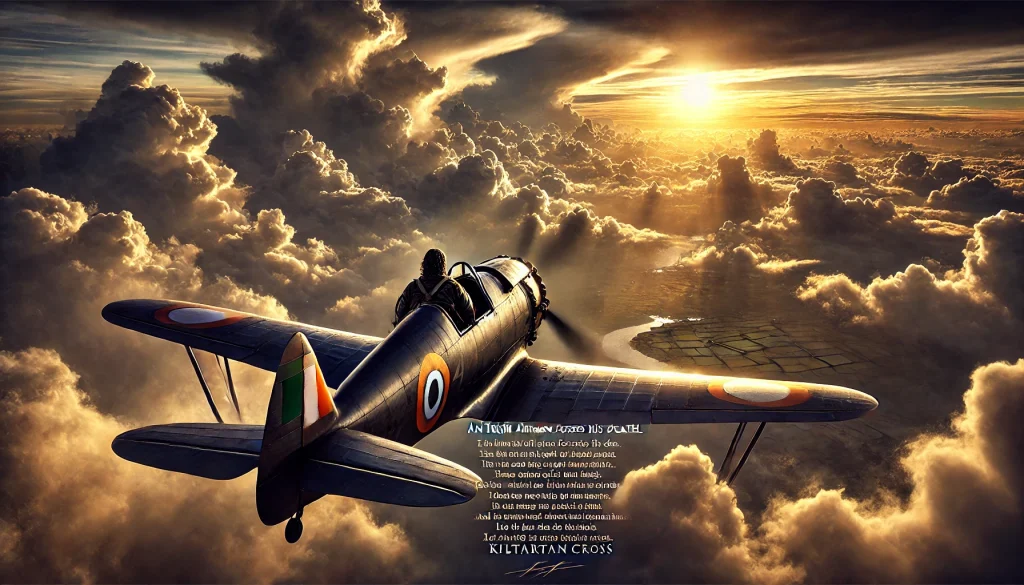
In the annals of poetry, few verses capture the quiet, resolute courage of a soldier like William Butler Yeats’ “An Irish Airman Foresees His Death.” Written in 1918, it is more than just a war poem—it is a meditation on identity, duty, and the human condition. Through the voice of the airman, Yeats delves into the psyche of someone standing on the precipice of mortality, grappling with the contradictions of life, loyalty, and death.
This blog explores the profound meaning of the poem, its metaphors, and the timeless story it tells of an Irishman who flies into the tumult of war, not for hate or love, but for something far deeper—an unwavering sense of personal resolve.
The Story Behind the Poem
“An Irish Airman Foresees His Death” is Yeats’ tribute to Major Robert Gregory, the son of Lady Augusta Gregory, Yeats’ close friend and a key figure in the Irish Literary Revival. Major Gregory was an Irish pilot who served with the Royal Flying Corps during World War I and was tragically killed in action in 1918.
Yeats uses the persona of an airman to reflect on Gregory’s death, crafting a poem that is both deeply personal and universally resonant. In just 16 lines, Yeats weaves a tapestry of existential clarity, cultural complexity, and poetic brilliance.
What Is the Main Message of “An Irish Airman Foresees His Death”?
At its core, the poem conveys the airman’s stark realization of his impending death. However, it is not despair or fear that defines him—it is a profound acceptance of his fate. The airman does not fight out of hatred for his enemies or love for his allies. Instead, he is driven by a sense of personal duty, detached from the grand narratives of war and empire.
The main message is one of individualism and self-determination. The airman’s choices are not dictated by external forces but by an inner conviction. He flies not for politics, patriotism, or glory, but for the fleeting joy of flight and the existential balance it brings to his life.
The Metaphors of the Poem
Yeats’ use of metaphor elevates the poem beyond a simple reflection on war. One of the most striking metaphors is “a lonely impulse of delight,” which encapsulates the airman’s motivation. This impulse is not driven by rationality or ideology but by a visceral, almost instinctual pull toward the skies.
“Drove to this tumult in the clouds”
This metaphor paints the airman’s journey into war as a chaotic and turbulent experience. The “tumult in the clouds” symbolizes not just the physical dangers of aerial combat but also the emotional and existential storms he faces. The airman is propelled by forces beyond logic, finding purpose in the chaos.
Why Does the Airman Say He Doesn’t Hate Those He Fights Nor Love Those He Guards?
This line highlights the airman’s detachment from the typical motivations of war. Unlike soldiers driven by nationalism or hatred, the airman is neither consumed by enmity toward his enemies nor bound by affection for those he protects.
Instead, his relationship with war is deeply personal. He acknowledges that the political and territorial stakes of the conflict mean little to him as an Irishman fighting for the British Empire. His allegiance lies not with empire or nation but with his own sense of purpose.
The Airman’s Inner Conflict
The airman’s reflection on his life and death reveals an intense inner conflict. He weighs the balance of his existence—the joys and sorrows, victories and losses—and finds equilibrium. His life, like his death, is not marked by grand gestures or dramatic swings but by a quiet, stoic acceptance of what is.
In the airman’s own words:
“I balanced all, brought all to mind,
The years to come seemed waste of breath,
A waste of breath the years behind
In balance with this life, this death.”
The airman’s clarity is both haunting and inspiring. He sees the futility of past and future but finds meaning in the present moment, in the act of flying.
The Irish Context
The poem’s context is particularly poignant when viewed through the lens of Irish history. Written during a time of political upheaval, it reflects the complexity of being an Irishman fighting for the British in World War I.
For many Irish soldiers, the war represented a conflict between loyalty to their homeland and service to the empire. Yeats captures this tension through the airman’s voice, acknowledging the broader political struggles while focusing on the deeply personal.
The Timeless Appeal of the Poem
“An Irish Airman Foresees His Death” continues to resonate because it speaks to universal themes of identity, purpose, and mortality. It reminds us that even in the face of death, there can be clarity and freedom in choosing one’s path.
Whether seen as a reflection of wartime courage or a meditation on life’s fleeting nature, the poem remains one of Yeats’ most powerful works.
FAQs About the Poem
1. What Is the Main Message of the Poem?
The poem emphasizes individual choice and existential clarity, exploring how the airman faces death with acceptance and purpose, driven not by external forces but by an inner resolve.
2. What Metaphor Is Used in the Poem?
The key metaphor is “a lonely impulse of delight,” symbolizing the airman’s intrinsic motivation to fly and embrace the chaos of life and war.
3. Why Does the Airman Say He Doesn’t Hate Those He Fights Nor Love Those He Guards?
This line reflects the airman’s detachment from typical wartime motivations. He fights not out of hatred or allegiance but for personal reasons that transcend politics and ideology.
4. What Does “Drove to This Tumult in the Clouds” Mean?
This metaphor represents the airman’s journey into the chaos of war, propelled by an impulse that is both thrilling and tumultuous, capturing the duality of his experience.
Final Thoughts
In “An Irish Airman Foresees His Death,” Yeats distills the human experience into a few powerful lines, exploring themes of purpose, mortality, and identity with unparalleled grace. The airman’s story is not just one of war but of life itself—a reminder that even in the face of death, we can find meaning in our choices and the fleeting beauty of existence.
May we all find the courage to face our own tumult in the clouds, guided by our own lonely impulses of delight.
Sláinte.
An Irish Airman Foresees His Death
I know that I shall meet my fate
Somewhere among the clouds above;
Those that I fight I do not hate,
Those that I guard I do not love;
My country is Kiltartan Cross,
My countrymen Kiltartan’s poor,
No likely end could bring them loss
Or leave them happier than before.
Nor law, nor duty bade me fight,
Nor public man, nor cheering crowds,
A lonely impulse of delight
Drove to this tumult in the clouds;
I balanced all, brought all to mind,
The years to come seemed waste of breath,
A waste of breath the years behind
In balance with this life, this death.
— W.B. Yeats
About the Author
