– Because exile doesn’t end with the ship. It echoes through generations.
There’s a strange, haunting poetry in being Irish. It’s not just blood or heritage—it’s a memory encoded in the bones, passed down like a family secret, whispered from one generation to the next. And perhaps nowhere is this more alive—more stubbornly clung to—than in the United States of America.
Walk into any bar from Boston to Butte, from Chicago to Savannah, and you’ll hear it. Not just in accents, not just in surnames—but in the soul.
Irish Americans still say they’re Irish. Not out of pretension. Not out of fantasy. But because some roots run so deep, they refuse to die, no matter how far from home they grow.
WHY DO SO MANY AMERICANS IDENTIFY AS IRISH?
Because being Irish in America isn’t just a lineage—it’s a legacy.
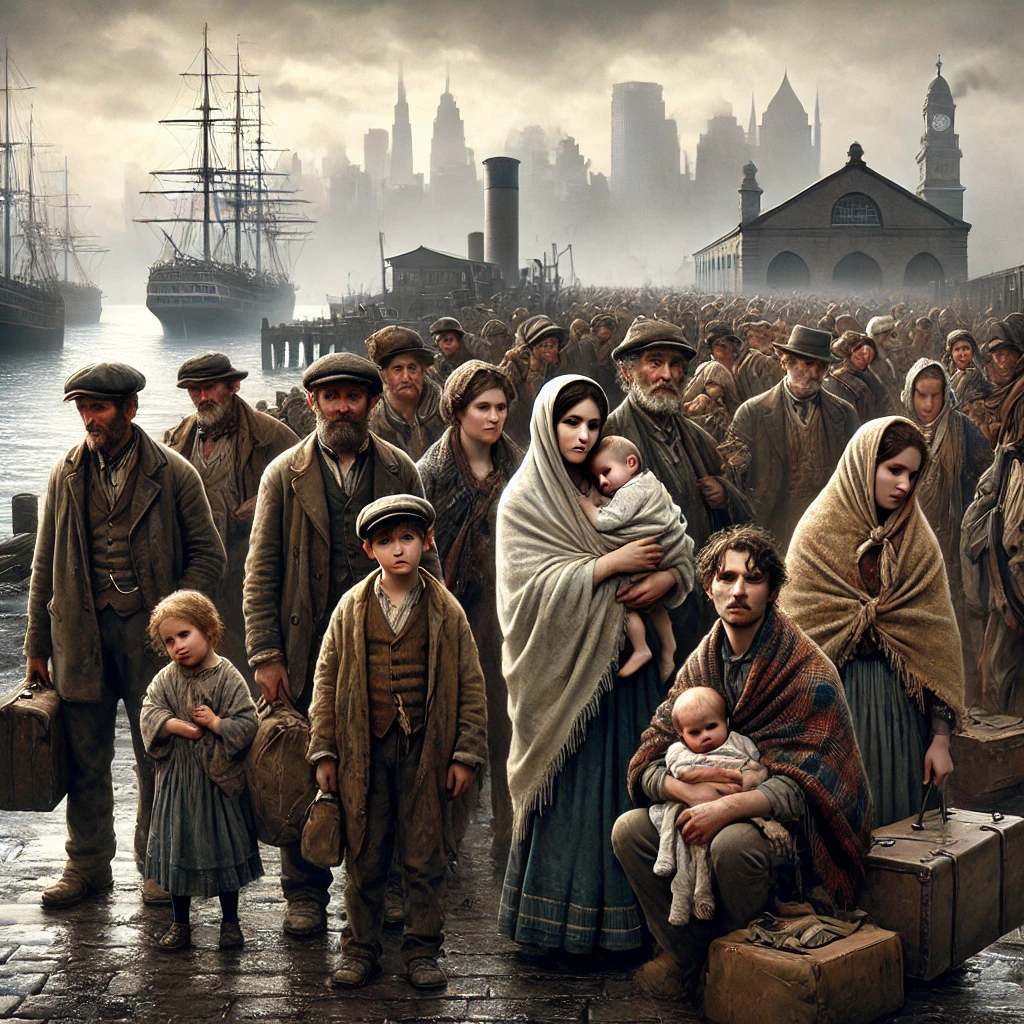
When the Irish first arrived on American shores, they weren’t welcomed. They weren’t praised for their grit or their storytelling or their faith. They were spat on, ridiculed, starved, and shoved to the bottom of every social ladder.
But they survived. They built cities. They filled coal mines and firehouses and tenements. They became the backbone of labor movements, the soul of the Democratic Party, the heartbeat of American Catholicism.
And they remembered.
Remembered where they came from. Remembered who they were. And they passed it on to their children—not just in names or prayers or recipes, but in identity.
“We are Irish.” Even if it was their great-grandparents who sailed from Cobh. Even if they’d never set foot in Dublin or Donegal.
Because what those ancestors endured, what they built, became a badge of resilience, defiance, and unbreakable pride.
CAN AMERICANS CALL THEMSELVES IRISH?
Yes. And not because it’s trendy or sentimental. But because diaspora isn’t just displacement—it’s cultural survival.
When your ancestors were ripped from their homeland by famine, poverty, or persecution, their memory doesn’t vanish with their accent. It lingers. It weaves into family stories, into surnames and lullabies, into how you see the world.
Can Americans call themselves Irish?
Absolutely.
It’s a form of cultural reclamation, not appropriation. It’s the soul of exile refusing to fade.
WHAT PERCENTAGE OF AMERICANS HAVE IRISH DNA?
It’s estimated that over 30 million Americans claim Irish ancestry, roughly 9–10% of the U.S. population. In states like Massachusetts, that number skyrockets. Boston alone wears its Irishness like armor.
And it’s not just identity on paper. Genetic studies show that a significant portion of Americans, especially in the Northeast, have Irish DNA. The bloodlines are there. The legacy is real.
WHO ARE THE IRISH CLOSEST TO GENETICALLY?
Genetically, the Irish are closest to Scots, Welsh, and other Celtic groups. But Irish DNA is also found woven into the genetics of Americans, Canadians, Australians, and even some Caribbean populations—like the Irish of Montserrat.
Ireland’s DNA has scattered across the globe like seeds from a storm. But it always remembers its soil.
IS AMERICA THE MOST IRISH COUNTRY IN THE WORLD?
In some ways, yes.
There are more Irish in America than there are in Ireland. While Ireland has about 5 million people, over 30 million Americans claim Irish heritage.
Are there more Irish in America than Ireland? Statistically, yes. Spiritually? The debate rages on.
But in terms of culture, identity, and impact—America may be the second Ireland.
WHO CAME TO AMERICA FIRST, IRISH OR ITALIANS?
The Irish came first.
The major waves of Irish immigration to America began in the 1700s, but it was the Great Famine (1845–1852) that sent the flood.
Italian immigration peaked later, in the late 1800s and early 1900s. So yes, the Irish were already digging canals, laying tracks, and building tenements before Italians arrived en masse.
HOW WERE IRISH IMMIGRANTS TREATED?
With suspicion. With cruelty. With disdain.
They were portrayed as drunken, violent, unintelligent, untrustworthy. Signs on windows read, “No Irish Need Apply.” They were lynched in the South, starved in the North, and shoved into ghettos in every major city.
They were Catholic in a Protestant nation, poor in a land of wealth, foreign in a country that wanted to believe in purity.
But they endured. And they fought back—not with bullets, but with ballots, unions, and sheer will.
IRISH IMMIGRATION TO AMERICA IN THE 1900s
By the 1900s, the Irish had begun to climb. Political machines like Tammany Hall gave them power. Fire departments, police forces, city councils, and church pews filled with Irish names.
They’d gone from being hated to being the face of American grit. And they never forgot the climb.
WHAT WAS LIFE LIKE FOR IRISH IMMIGRANTS IN AMERICA?
Hard. Cold. Dirty. Often deadly.
Tenements infested with rats. Factories filled with smoke and mangled limbs. Coal mines that collapsed. Streets soaked with whiskey and desperation.
But also: Music. Laughter. Dance. The smell of soda bread. Mass on Sundays. The sounds of bodhráns and ballads in the back rooms of pubs.
They turned suffering into strength. They turned slums into neighborhoods, neighborhoods into communities, communities into cities.
WHERE DID THE IRISH SETTLE IN AMERICA?
Boston. New York. Philadelphia. Chicago. Baltimore. Savannah. San Francisco. Butte, Montana.
Wherever there was work, the Irish went. And wherever the Irish went, they built foundations that still stand today.
HOW MANY IRISH IMMIGRANTS CAME TO AMERICA DURING THE POTATO FAMINE?
Over 1.5 million Irish fled Ireland during the Great Famine, with over a million heading to the United States.
Many died on the voyage. The ships were called “coffin ships” for a reason. But those who survived carried Ireland in their hearts.
And they passed it on.
WHY DID THE IRISH COME TO AMERICA IN THE 1800s?
Because they had no choice.
The famine wasn’t just a crop failure. It was an engineered genocide through British negligence and greed. Families starved while grain was exported. Villages died while landlords raised rents.
The only way out was across the ocean. The Irish didn’t come for the American Dream. They came because Ireland became a nightmare.
THE IRISH AMERICANS: A LEGACY OF DEFIANCE
You don’t stop being Irish just because you cross the Atlantic. You don’t forget the famine, or the rebellion, or the language that was beaten out of your grandfather. You don’t forget the names etched in Ellis Island stone, or the way your mother said grace, or the rebel songs your father sang when he thought no one was listening.
That’s why Irish Americans still call themselves Irish.
Because history doesn’t die. It whispers. It survives.
And so do we.
CONTINUE EXPLORING THE LEGACY OF IRISH ICONS
Read more about Irish legends and their impact on history here.
Discover the fearless outlaw, Ned Kelly.
Explore the fighting spirit of Jack Dempsey.
Learn about the Irish revolutionary who freed Chile, Bernardo O’Higgins.
Uncover the journey of John Boyle O’Reilly.
The Irish of Montserrat: Exile, Identity, and Legacy
The warrior legend of Audie Murphy and his Irish bloodline
About the Author
