Some men fight for power. Some fight for glory. And then there are those who fight because they know they must—because history calls them, because their people demand it, because to do anything less would be a betrayal of who they are.
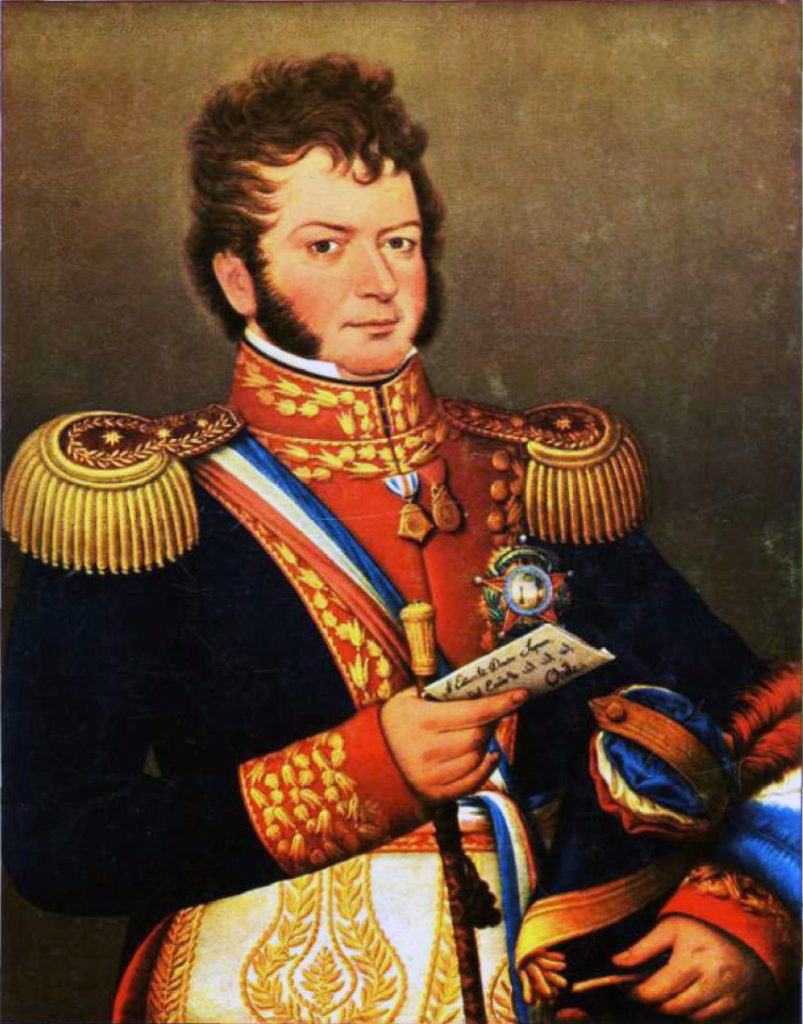
That was Bernardo O’Higgins, a man who carried the fire of Irish rebellion in his veins and used it to set Chile free.
Before he became a revolutionary, before he became the founding father of Chile, before his name was etched into history, he was something else—a son of exile, the product of two worlds colliding.
THE IRISH ROOTS OF A LIBERATOR
Yes, O’Higgins is an Irish name—as Irish as rebellion, as Irish as defying the odds. His father, Ambrose O’Higgins, was a man from County Sligo who left Ireland behind and made his name in the Spanish Empire. He rose to power, eventually becoming the Viceroy of Peru, a powerful colonial ruler.
But Bernardo? He was different.
Born Bernardo O’Higgins Riquelme in 1778, he was the illegitimate son of an Irish father and a Chilean mother. That alone set him apart, placing him in a strange social class—not quite noble, not quite common.
He was raised away from his father, sent to Peru, then England, then Spain, always an outsider, always searching for his place. But it was in London that everything changed.
There, under the influence of Francisco de Miranda, a Venezuelan revolutionary, he was introduced to the idea of independence. The idea that the Spanish colonies of South America didn’t have to be ruled by a distant king. The idea that Chile could be free.
He took that fire back with him, and the rest is history.
WHAT DID BERNARDO O’HIGGINS DO?
If you ask, “What did Bernardo O’Higgins do?”, the answer is simple: he gave Chile its freedom.
He didn’t do it alone. No revolution ever belongs to just one man. But O’Higgins was the leader Chile needed when the time came.
In 1810, the first calls for independence began. At first, O’Higgins wasn’t the dominant figure. That was José Miguel Carrera, another revolutionary leader. But over time, as battles were fought, alliances made and broken, O’Higgins rose.
The war was brutal. At times, it seemed like Chile would never be free. In 1814, after a devastating loss at the Battle of Rancagua, O’Higgins and his forces were forced to flee to Argentina.
But that wasn’t the end.
From exile, O’Higgins met José de San Martín, the great Argentine general who had the same dream of Spanish America free from colonial rule. Together, they plotted, they fought, they marched back over the Andes, and in 1818, at the Battle of Maipú, Chile’s independence was secured.
O’Higgins didn’t just fight for independence. He built Chile into a nation. He introduced reforms, modernized the army, promoted education. He was not just a general—he was a leader.
But revolutions are never clean. Power is never stable.
And in 1823, just five years after Chile became free, O’Higgins was forced to step down. His enemies had grown too strong, his reforms too radical, his vision too bold.
WHAT HAPPENED TO O’HIGGINS AFTER THE WAR?
After resigning, O’Higgins went into exile in Peru, the land his father had once ruled. He never returned to Chile.
For years, he lived a quiet life, watching from a distance as the country he had freed continued to change.
He died in 1842, far from home, in Lima. How did Bernardo O’Higgins die? He suffered from heart problems, but in truth, he died an exile—forgotten by some, revered by others.
Years later, Chile brought him home. Today, Bernardo O’Higgins is buried in the Altar of the Fatherland in Santiago, a national hero forever.
BERNARDO O’HIGGINS FUN FACTS
- He never married – There was no Bernardo O’Higgins wife, though he had a son, Demetrio, from an affair.
- He fought alongside Argentina – His most important victories came with the help of José de San Martín, known as the father of Argentina.
- He was educated in London – There, he became influenced by the revolutionary ideas that would later shape him.
- He didn’t start as a soldier – He was a landowner first, a politician second, and only later a military leader.
- He was exiled twice – Once in 1814 after losing to the Spanish, and again in 1823 after his own people forced him out.
WHY DID CHILE WANT INDEPENDENCE FROM SPAIN?
Chile, like much of Latin America, was tired of being ruled by a king who lived an ocean away. Spanish rule was oppressive, favoring European-born elites over those born in the colonies. The people of Chile wanted to govern themselves—they wanted a future that was their own.
O’Higgins didn’t just fight a war. He helped create that future.
BERNARDO O’HIGGINS QUOTES
Like all revolutionaries, O’Higgins left behind words that still echo through time:
- “Lucharemos hasta vencer o morir.” (We will fight until we win or die.)
- “Si vamos a perder la patria, que se pierda con honor.” (If we are going to lose the homeland, let it be lost with honor.)
And his most famous:
- “O vivir con honor o morir con gloria.” (Either live with honor or die with glory.)
THE LEGACY OF A REVOLUTIONARY
Bernardo O’Higgins is not just a name in history books. He is Chile’s father, its liberator, its first leader.
But he was also an exile, a man who gave everything for his country and was forced to watch from afar as it moved on without him.
His story is one of triumph, of sacrifice, of an Irish heart that beat in the chest of a South American revolutionary.
And though he died far from home, Chile never forgot.
Read more about Irish legends and their impact on history here.
Discover the fearless outlaw, Ned Kelly.
Explore the fighting spirit of Jack Dempsey.
THE ENDURING LEGACY OF BERNARDO O’HIGGINS
Some revolutionaries become legends because they die in battle, their names immortalized in blood and sacrifice. Others, like Bernardo O’Higgins, shape history not only through war but also through the painful burden of governance. He was not just a man who fought for Chile’s independence—he was the one who tried to build a nation from the ashes of colonial rule.
O’Higgins did not have the luxury of being a simple warrior. Once the Spanish were defeated, once the dream of freedom became reality, the harder battle began. A nation needed laws, institutions, order. It needed leadership.
And leadership is never easy.
BERNARDO O’HIGGINS ACCOMPLISHMENTS
Once Chile was independent, O’Higgins took charge as Supreme Director, effectively the first leader of the new nation. His time in power was short, but his impact was immense.
- Abolishing the Nobility – One of his first actions was to eliminate the titles and privileges of the Spanish aristocracy. There would be no kings, no viceroys, no noble lords in Chile.
- The Chilean Navy – O’Higgins understood that true independence meant securing Chile’s coastline. He laid the foundation for the Chilean Navy, ensuring that the new nation could defend itself.
- Public Education – He established the National Institute of Chile, promoting education and literacy, ensuring that the new republic would not be ruled by ignorance.
- Encouraging Immigration – He welcomed foreign expertise, hoping to modernize Chile through new ideas and knowledge from Europe.
- Roads, Bridges, and Infrastructure – He invested in the country’s development, knowing that a free Chile needed to be a strong Chile.
He had the vision of a modern, self-sufficient country, free from the corruption and stagnation that had plagued colonial rule.
But not everyone agreed with his vision.
THE DOWNFALL OF A REVOLUTIONARY
Power is a dangerous thing, and those who lead revolutions often find themselves caught in their own. O’Higgins made enemies, both among the old Spanish elite who resented him and among the new Chilean leaders who felt he ruled with too strong a hand.
By 1823, he was forced to resign. His former allies turned against him, and rather than risk a civil war, he stepped down and went into exile in Peru.
He had given Chile everything—his youth, his energy, his vision. And in the end, the country he helped free sent him away.
He never set foot in Chile again.
DEATH IN EXILE: HOW DID BERNARDO O’HIGGINS DIE?
O’Higgins lived nearly twenty years in exile. He never stopped thinking about Chile. He wrote letters, he gave advice, he dreamed of returning. But the years wore on, and his health declined.
In 1842, at the age of 64, he died in Lima, Peru. Officially, he died from heart failure, but in reality, he died as many revolutionaries do—a man whose country had outgrown him, whose name had become history before he was even gone.
Years later, Chile realized its mistake. His body was brought back to Santiago, where he was buried in the Altar of the Fatherland, his rightful place among the greatest figures in Chilean history.
WHY DOES BERNARDO O’HIGGINS MATTER TODAY?
In Chile, O’Higgins is not just a historical figure. His name is everywhere—streets, cities, institutions, military bases. He is the symbol of the nation’s independence, Chile’s George Washington, a man who built a country from nothing.
His Irish blood, his revolutionary spirit, his refusal to accept injustice—all of it made him the leader Chile needed at the most crucial moment in its history.
Even in Ireland, his name is remembered. He stands among the great figures of the Irish diaspora, part of the long tradition of Irishmen who fought for freedom—not just for their homeland, but for the lands where fate had taken them.
BERNARDO O’HIGGINS: THE MAN WHO COULD NOT BE FORGOTTEN
Some revolutionaries die in battle, their stories ending in a blaze of glory. Others live long enough to see their own people turn against them.
O’Higgins lived in exile, but he never lost his place in history. The world forgot him for a time, but Chile did not. In the end, they brought him home. They gave him the honor he deserved.
He was not a perfect man. No great leader ever is.
But he was a man who fought for freedom, who built a nation, and who left behind a legacy that still stands today.
He was Chile’s father.
And his name will never be erased.
CONTINUE EXPLORING THE LEGACY OF IRISH ICONS
Read more about Irish legends and their impact on history here.
Discover the fearless outlaw, Ned Kelly.
Explore the fighting spirit of Jack Dempsey.
About the Author
