
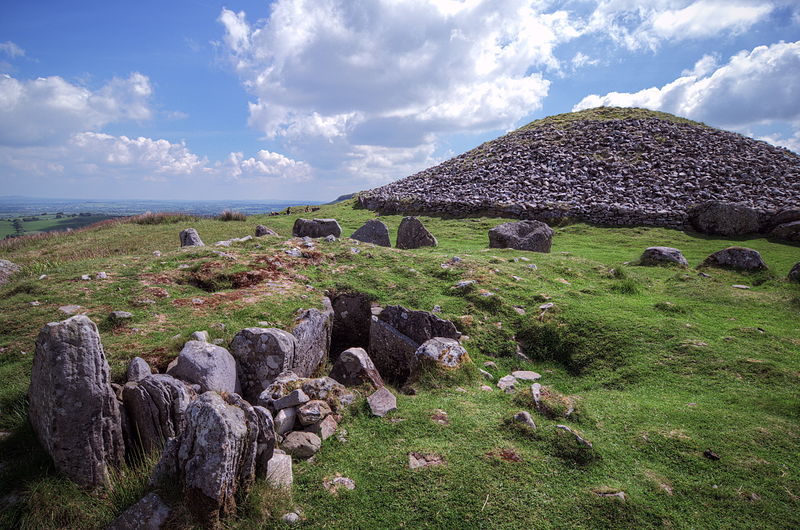
There’s something about Loughcrew. Something primal. Something eternal.
It’s not just another ancient site with a visitor center, a gift shop, and a tour guide trained to recite historical factoids like a schoolboy cramming for an exam. No, Loughcrew is raw, untamed, and impossibly old—so old that it predates recorded history, standing as one of the great sentinels of Ireland’s past, whispering secrets into the howling wind.
Loughcrew Cairns, or Sliabh na Calliagh (the Mountain of the Witch), sits atop a rolling hill in County Meath, its weathered stones holding stories older than empires. It’s a place of power, of spirits, of ancient celestial alignments. It’s where the sun and stone dance a sacred waltz during the equinox, illuminating carvings crafted by hands that have long since turned to dust.
If Newgrange is the polished crown jewel of Ireland’s prehistoric past, Loughcrew is its wilder, forgotten sibling—untamed, mysterious, and dripping in folklore. For those willing to listen, its silence speaks louder than any textbook ever could.
Is Loughcrew Older Than Newgrange?
Yes. And no.
Loughcrew and Newgrange belong to the same world—the Neolithic era, that misty time when humanity was just beginning to understand the cosmos and its place within it. But Loughcrew may be even older than Newgrange, dating back over 5,200 years. That’s before the Egyptian pyramids, before Babylon, before logic dictated that people shouldn’t move multi-ton stones up a hill just to mark the passage of the sun.
Loughcrew’s cairns, including the famous Cairn T, are part of a passage tomb complex similar to Newgrange but more weathered by time. The structures at Newgrange have been reconstructed, their white quartz façade gleaming with a manicured perfection that almost feels too new for something so ancient. Loughcrew, on the other hand, stands as it always has—battered, broken, but enduring.
So, while both sites were crafted by the same prehistoric minds, it’s Loughcrew that likely came first, paving the way for the grander, more well-known monuments at Brú na Bóinne.
Can You Go Inside Loughcrew?
Yes—if you dare.
Unlike Newgrange, where entrance is tightly controlled, Loughcrew still allows visitors to step into the heart of the past, though it requires a little effort. There are no tour buses dropping off lines of tourists here. To reach the inner chamber of Cairn T, you have to climb. And not just a polite stroll up a hill—this is a steep, windswept ascent that will test your legs, your lungs, and perhaps even your resolve.
But once you reach the summit, a reward awaits. The entrance to Cairn T is open, a darkened passage leading into the chamber where sunlight only reaches twice a year—during the spring and autumn equinoxes. If you arrive at the right moment, you’ll witness the golden rays illuminating the ancient carvings, just as they have for over 5,000 years. If not, well, you’ll still feel the weight of history pressing down upon you, whispering that you are standing in a place where time itself bends.
Who Owns Loughcrew?
Loughcrew doesn’t belong to anyone. It belongs to time. To the spirits. To the endless sky above and the land stretching far below.
Technically, the site is managed by the Office of Public Works (OPW) in Ireland, which oversees its preservation and maintenance. The surrounding Loughcrew Estate, however, is privately owned by the Naper family, who have resided there for generations. Their estate includes Loughcrew House and Gardens, a charming retreat offering accommodations, gardens, and even adventure activities.
The estate is beautiful, but the cairns themselves are something else entirely—free from modern ownership in any real sense. They are claimed only by the elements, by the passage of time, by the countless souls who have stood before them and wondered, Who were the people who built this? And why?
What Was Loughcrew Used For?
To answer that, you have to understand the mindset of the people who built it.
Loughcrew isn’t just a burial site—though that’s part of its story. Like Newgrange, Knowth, and Dowth, Loughcrew is a passage tomb complex, meaning it was designed to house the remains of the dead. But that was just the beginning.
It was also a ceremonial center, a celestial observatory, and a sacred site where the cycles of the sun dictated rituals and rites. Cairn T’s alignment with the equinox suggests an understanding of astronomy that shouldn’t have been possible for people of the Neolithic age—but was.
Legends also tell of the Cailleach, the Hag Goddess who leaped from hill to hill, creating Loughcrew’s cairns as she traveled. If she made a successful jump, she lived forever. If she failed, she died. Her presence lingers in the Hag’s Chair, a carved stone where druids, kings, and priests may have once sat in contemplation or ceremony.
Loughcrew was a temple. A guidepost in the cycle of life and death. A place where the living and the dead met beneath the unblinking gaze of the stars.
Is Stonehenge or Newgrange Older?
Newgrange is older. Much older.
Stonehenge, the iconic ring of standing stones in England, dates back to around 3,000 BCE, with some elements added later. Newgrange, on the other hand, predates Stonehenge by nearly 1,000 years. And if Loughcrew is even older than Newgrange, that means this quiet, overlooked site in Meath might just be among the very first monumental structures of human civilization.
When Stonehenge’s builders were stacking their first stones, the passage tombs of Loughcrew had already been standing for centuries.
How Many Counties Can You See from Loughcrew?
On a clear day, standing atop Slieve na Calliagh, you can see up to 18 counties stretching out before you.
Eighteen.
That’s not just a number—it’s a panoramic testament to the vastness of the Irish landscape, to the grandeur of the land the ancient builders once surveyed. From here, the entire heart of Ireland unfolds beneath your feet—rolling fields, distant mountains, villages nestled in the valleys, the ghostly outlines of other sacred sites whispering from afar.
It’s easy to understand why this place was chosen for something sacred. From here, you can see forever.
Loughcrew: A Place Beyond Time
Loughcrew isn’t for those who want a sanitized historical experience with neatly packaged brochures. It’s for explorers. For seekers. For those who want to touch something truly ancient, to feel the wind howl around them as they step inside a tomb older than empires.
It’s a place of whispers and wind, of stone and sky, of light and shadow.
And it’s waiting for you.
For those planning to visit, pair your trip with other nearby wonders:
History, myth, and eternity await. Are you ready?
About the Author
