Gaze out across the wild Atlantic from Ireland’s ragged west coast, with the salt wind whipping your face like a rebel’s lash, and you just feel it—the ghost of Hy Brasil Ireland, Ireland’s Atlantis calling from the mist-shrouded waves.
This isn’t some sanitized fairy tale for tourists; it’s the raw, defiant heartbeat of Irish myth, a phantom island that mocks the maps and defies the skeptics.
Hy Brasil, or Hy-Brasil as the old tongues twist it, has haunted sailors’ dreams and cartographers’ inks for centuries, a land of eternal youth and hidden wisdom that appears once every seven years, only to vanish like a lover’s promise in the dawn.
From the cliffs of Connemara to the shores of Kerry, whispers of this enchanted isle stir the blood, reminding us that Ireland’s soul is woven from threads of the impossible. If you’re chasing the unfiltered truths of our emerald heritage, the kind that cut deep and linger long, then plunge into the depths at Secret Ireland—where the myths breathe and the secrets roar.
For over 500 years, Hy Brasil Ireland history has tantalized explorers, poets, and fools alike. Marked on medieval charts as a real place, west or southwest of our shores, it was no mere fancy but a beacon for the bold.
Yet today, it’s gone—or is it? Dive with me into the storm-tossed tales, the Hy-Brasil maps that lied and lured, the evidence that teases from beneath the waves, and the modern quests like Hy Brasil Ireland tours that seek to recapture its magic.
We’ll unravel the FAQs that burn in every curious heart: What happened to Hy-Brasil? Is it the fabled Tir na nOg? Who dwells on its misty shores? What does its name even mean? Buckle up, lads and lasses; this is Ireland unbowed, her legends alive and kicking.
The Phantom Island: Roots in Irish Myth and Fable
Let’s strip it bare—no sugarcoating the ancient fire. Hy Brasil Ireland emerges from the mists of our elder faiths, a spectral land that defies the cold grip of reality.
As Anthony Murphy once delved, drawing from the antiquarian W.G. Wood-Martin’s “Traces of the Elder Faiths of Ireland” in 1902, this phantom isle slots into a chapter on ‘Phantom Lands.’ Wood-Martin paints Hy-Brasil as a fabled speck in the Atlantic, west or southwest of our rugged coast, etched on medieval maps yet absent from the world we tread.
In the 17th century, Roderick O’Flaherty claimed it was “often visible,” a tease that inspired poets to weave ballads of aching beauty.
Recall Gerald Griffin’s verse: “On the ocean that hollows the rocks where ye dwell, A shadowy land has appeared, as they tell: Men thought it a region of sunshine and rest, And they called it Hy-Brasil, the isle of the Blest.”
Year after year, this dim spectre loomed on the blue rim, curtained in golden clouds, an Eden far away. Attempts to claim it were legion.
Leslie of Glaslough, that wise scholar, begged a grant from Charles I, so convinced of its flesh-and-blood existence. Even Edmond Ludlow, the republican firebrand, fled in a vessel from Limerick, chartered to hunt Hy-Brasil. Belief ran so deep that the captain sailed unchallenged.
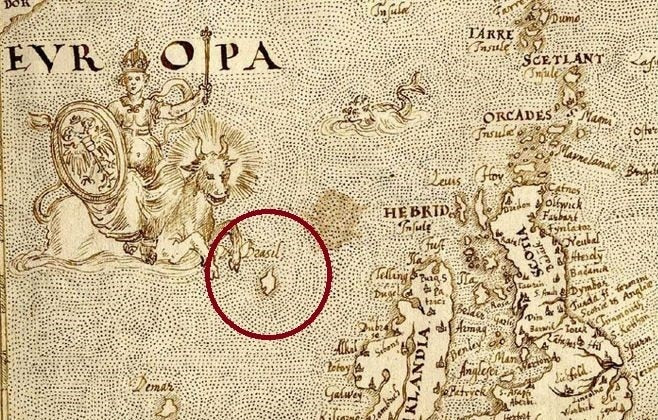
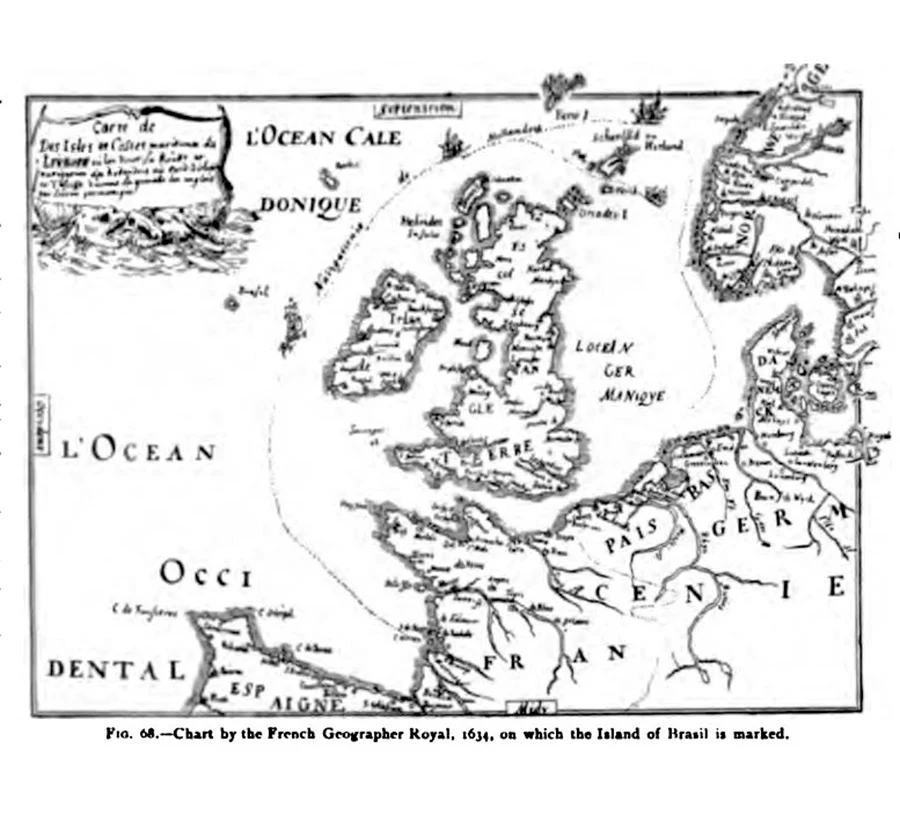
A rare tome, “La Navigation l’Inde Orientale” from Amsterdam in 1609, sports a map with Brasil and Brandon marked off our coast. Another chart from 1634 by the French Geographer Royal pins Hy Brasil distinctly.
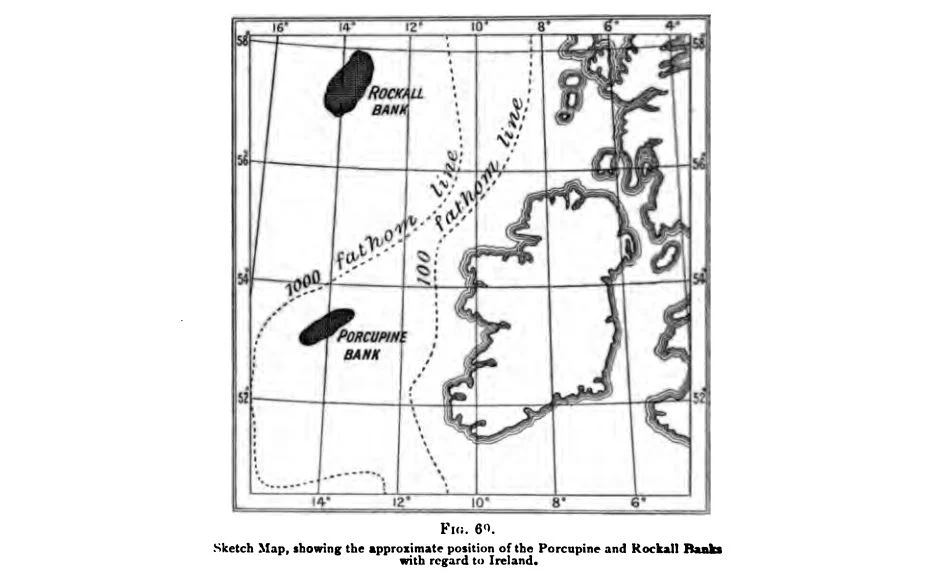
Wood-Martin nods to the Porcupine and Rockall Banks, suggesting Rockall as the last shard of Brandon, and Porcupine as Hy-Brasil’s sunken throne—a danger to ships, a remnant of myth turned menace.
Then there’s the tale of Captain Nesbett on March 2, 1674—mark the date, for precision cuts through fog. He discovered, disenchanted, and landed on Hy-Brasil, exploring its secrets by kindling a fire that broke the spell. Godly ministers followed, vanishing into silence.
Two centuries of hush hint at temporary disenchantment; perhaps they’re trapped like Ossian, awaiting release with tales to shatter worlds.
The lure of youth-restoring lands was universal, spurring discoveries that unveiled hidden realms. Before Columbus, maps showed a vast Brasil south of Scandinavian Vineland echoes. O’Flaherty spoke of fantastical ships in Galway harbor in 1161, sailing against wind—mirages, perhaps, like Hardiman’s 1798 vision of Admiral Warren’s fleet reflected as supernatural.
Hy Brasil, simply ‘Brasil’ on old parchments, birthed St. Brendan’s transatlantic voyage, the Navigator’s seven-year odyssey to a distant isle. His exploits gripped minds, making his discoveries treaty fodder. Not improbable that they fired later navigators across the western ocean. St. Brendan sailed on a rock, beaching it in Donegal—St. Declan’s Rock, three tons heavy, self-navigating from Rome with bells for Mass.
A curious manuscript in the Royal Irish Academy, on medical lore, hails from a Connemara native spirited to Hy-Brasil for cures and treatments. As late as 1753, “The Ulster Miscellany” satirized a voyage to O’Brazal, a submarine isle off our shores.
O’Flaherty in 1684 pondered: “From the isles of Aran… often appears that enchanted island called O’Brasil… whether real land hidden by God, or illusion of clouds, or evil spirits’ craft.” Rev. Luke Connolly in 1816 described Fata Morgana off the Giant’s Causeway—castles, ruins, spires darting across seas, birthing enchanted island tales. Peasants dreamed of stabilizing it with Irish sod, but boats failed.
Belief stemmed from optical illusions, not rare as thought. A correspondent recalled a mirage half a century prior, a veritable city on the bay. In 1885, Hy-Brasil reappeared off Sligo, foretelling trouble. Atmospheric bends make distant visible, like looming Snowdon from Dublin Bay.
P.W. Joyce noted Gaelic tales of underwater lands, Tír-fa-tonn, the land beneath the wave. Heroes like Maildun glimpsed beauties below. This delusion spans mythologies, a paradise behind us in humanity’s fiction.
Classic and Irish traditions align: a western ocean country under various names, the primitive Irish elysium, Land of the Saints for Christians, Land of the Living for Pagans. Departure westward to the blessed isle, a land of youth free from sorrow.
Hy Brasil Ireland History: From Maps to Mystery
Hy Brasil Ireland history isn’t confined to dusty tomes; it’s etched in the ink of explorers’ charts, a defiant mark against the unknown. The first whisper comes from 1325, Angelino Dulcert’s map labeling it “Bracile,” a round enigma in the Atlantic. By 1375, the Catalan Atlas fleshed it out, placing it where waves swallow secrets. Positions shifted—west of Ireland, sometimes near North America—but the allure endured for five centuries, until 1872’s final cartographic sigh.
Names morphed: Brasil, Brazil, Breasil, Hy-Brasil, O’Brasil. Expeditions chased it relentlessly. In 1480, John Jay Jr. sailed from Bristol, returning empty-handed. Yet in 1497, Pedro de Ayala reported to Spanish royals of a Bristol ship discovering “the island of Brasil.” Captain John Nisbet’s 1674 landing stands out: fog parted, revealing a civilized land with castles and hospitable folk. He returned with silver tokens, but revisits found only ocean.
Thomas Jefferys in 1753 labeled it “imaginary Isle O’Brazil,” a skeptic’s jab. By 1865, it faded from maps, dismissed as myth. But Hy Brasil Ireland history pulses with real quests, like those inspired by St. Brendan, whose voyages may predate Columbus by centuries.
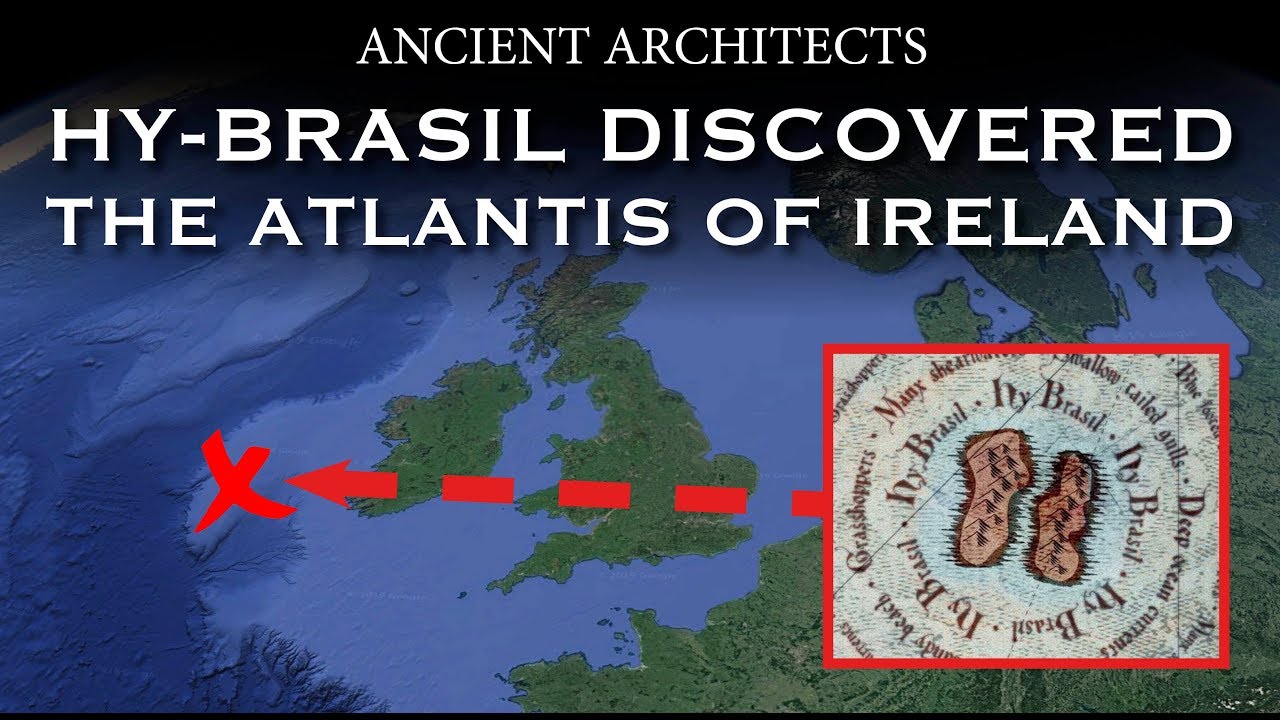
Modern eyes turn to Hy-Brasil evidence beneath the waves. The Porcupine Bank, a submerged plateau 200km west of Ireland, echoes ancient descriptions—perhaps a remnant of a lost land, flooded post-Ice Age. Rockall, a jagged rock pinnacle, hazards ships, linked to Brandon’s last fragment. Seismic surveys hint at ancient structures, fueling speculation.
Hy Brasil Ireland Map: Charting the Unseen
No tale of Hy Brasil is complete without poring over a Hy Brasil Ireland map, those ancient parchments that dared to pin the phantom. Abraham Ortelius’s 1595 Europe map shows Brazil west of Ireland, a circular sentinel. Earlier, the 1375 Catalan Atlas depicts it strikingly round. These Hy-Brasil maps varied in location, sometimes southwest, others due west, but consistently round or divided by channels.
Scan a Hy Brasil Ireland map from 1609’s “La Navigation,” and Brasil neighbors Brandon off our coast. The 1634 French chart marks it boldly. Even pre-Columbian maps hint at vast Brasil near Vineland. Today, overlay these with modern charts, and eyes drift to Porcupine Bank—submerged, yet matching coordinates where Hy-Brasil once floated.
For the intrepid, digital Hy-Brasil maps abound online, blending old ink with GPS. But true seekers know: no map captures the mist-veiled truth; it’s felt in the soul, chased on windswept cliffs.
Hy-Brasil Satellite Images: Modern Eyes on Ancient Secrets
In this age of satellites piercing veils, Hy-Brasil satellite images tease with underwater ghosts. Scan the Atlantic via Google Earth or NASA feeds, and the Porcupine Bank emerges—a shallow submarine plateau, 200-400 meters deep, sprawling 45,000 square kilometers. Bathymetric maps reveal ridges and canyons, perhaps echoes of ancient islands eroded by time.
Hy-Brasil satellite images of Rockall show a lonely granite outcrop, 17 meters high, battered by waves—a navigational peril, maybe Hy-Brasil’s last stand. Seismic data from oil explorations hint at geological anomalies, fueling theories of sunken lands. No castles or rabbits, but the depths hold Hy-Brasil evidence: cold seeps, coral mounds, signs of life where myth meets ocean floor.
Conspiracy whispers of UFO bases or Atlantis remnants, but science points to post-glacial floods submerging what was once dry land. Gaze at these Hy-Brasil satellite images, and feel the pull—the island may be gone, but its shadow lingers in pixels and waves.
What Does Hy-Brasil Mean?
Peel back the layers: What does Hy-Brasil mean? Rooted in Gaelic “Í Breasail,” it whispers “Isle of Breasal,” Breasal a high king or god of the world.
“Hy” from “Uí,” denoting descent, or simply “island of.” Some tie it to “Breasal,” meaning beautiful or blessed. Not linked to Brazil the country—that’s from pau-brasil wood—but Casement argued Ireland named both, from ancient legends.
In myth, it’s the Isle of the Blest, a paradise of sunshine, rest, eternal youth. A name evoking wonder, sorrow-free lands where music flows and feasts never end. Hy-Brasil means defiance against oblivion, a call to dream beyond horizons.
Who Lives on Hy-Brasil?
Who lives on Hy-Brasil? Legends paint a tapestry of the extraordinary. Priests guarding universal secrets, advanced beyond mortal ken. Gods cloaked in mist, sorcerers with giant black rabbits. Inhabitants of eternal youth, wise and welcoming—Nisbet met civilized folk in grand castles, offering hospitality and treasures.
Tuatha Dé Danann echoes, the fairy folk or ancient gods. Heroes, magicians, beings from the Otherworld. Some tales whisper of giants or enchanted animals.
No mortals, but timeless souls in a land where age withers not. Who lives there? The dreams we dare not wake from.
Is Hy-Brasil Tir na nOg?
Is Hy-Brasil Tir na nOg? Ah, the threads intertwine like Celtic knots. Tir na nOg, the Land of Youth, is the quintessential Celtic Otherworld—eternal summer, no sickness, feasts of immortality. Hy-Brasil mirrors this: mist-hidden, visible every seven years, a paradise of bliss.
Some equate them outright, Hy-Brasil as a name for Tir na nOg’s island form. Both westward, both elysiums. St. Brendan’s Promised Land parallels both.
Yet distinctions: Tir na nOg often underground or across seas, reached by invitation; Hy-Brasil more phantom, tied to specific sightings.
In broader myth, they’re kin—Otherworld realms like Emain Ablach, Mag Mell. Avalon, Fiddler’s Green echo similar paradises. Hy-Brasil may be a facet of Tir na nOg, the land behind the sunset where heroes rest.
What Happened to Hy-Brasil?
What happened to Hy-Brasil? The raw truth: it likely never was, yet persists in spirit. Born of mirages—Fata Morgana lifting distant lands or icebergs into illusory isles. Sailors’ tales grew, maps enshrined the myth.
Geology offers clues: Post-Ice Age sea rise submerged coastal lands. Porcupine Bank, once above water? Rockall, a volcanic remnant. Expeditions failed, sightings waned as navigation sharpened. By 1872, maps erased it, labeling it phantom.
Yet echoes: 1885 Sligo sighting, modern UFO reports. What happened? It sank into legend, but Ireland’s west coast still scans horizons for its return.
Hy Brasil Ireland Tour: Chasing the Phantom Today
For the bold, a Hy Brasil Ireland tour isn’t about finding land—it’s evoking the myth on our wild coasts. West Ireland boat trips from Galway or Kerry scan Atlantic horizons, weaving tales of Hy-Brasil. Hike Aran Islands, where O’Flaherty saw visions. Visit Giant’s Causeway for Fata Morgana spots.
Guided folklore tours in Connemara or Sligo chase mirages, blending history with hikes. Virtual tours via apps overlay old Hy-Brasil maps on modern views. Or self-drive the Wild Atlantic Way, pausing at cliffs to ponder the waves. Secret Ireland offers bespoke journeys into such mysteries at secretireland.ie—raw, real, relentless.
Conclusion: The Enduring Call of Hy Brasil
Hy Brasil Ireland isn’t just a faded dot on a map; it’s the unquenchable fire in our collective soul, a reminder that beyond the seen lies the sacred unseen.
From its mythical roots to modern Hy-Brasil satellite images hinting at submerged truths, this phantom isle challenges us to dream fiercely, to question the waves’ secrets.
Whether remnant of Atlantis, mirage-born, or gateway to Tir na nOg, Hy-Brasil endures because Ireland endures—defiant, poetic, raw. For more untamed tales, dive into Secret Ireland. The mist parts every seven years; will you be watching?
About the Author
