
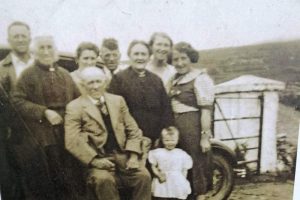
In January 1922, amid the turbulent birth of the Irish Free State, a simple farmer in a remote corner of County Mayo sat down to write a letter that would change his family’s destiny forever. Andrew Staunton, a father of 14 living in a tiny two-room cottage in Feenone, near Louisburgh, penned a heartfelt plea to his cousin in Boston — begging for help to send his two eldest daughters to America.
The Staunton Family Emigration Story
This powerful letter, preserved for over a century, offers a rare and emotional glimpse into the harsh realities of Irish emigration in the 1920s — a time when thousands of Irish families made the painful decision to leave their homeland in search of a better life.
A Father’s Desperate Plea from the Doolough Valley
Andrew Staunton was a subsistence farmer trying to support his large family in one of the most beautiful yet unforgiving landscapes in Ireland. With six sons and eight daughters ranging from age 4 to 26, all living under one small roof, he faced an impossible situation. There simply wasn’t enough work or opportunity in rural Mayo to sustain them all.
In his eloquent letter dated January 25, 1922, Andrew wrote to his Mayo-born cousin, Michael Ruane, who had successfully become a lawyer in Boston:
“Dear Cousin, I have 6 sons and 8 daughters, all are at home. I was thinking of sending one or two of the girls to America this year. I hope you will be good enough to send a passage to me for them. I cannot keep them all at home. If I had one out there, she could bring out the rest. The eldest girl is the most anxious to go, her name is Sara the other girls name is Mary.”
This letter is remarkable not only for its clarity and dignity, but for the deep love and responsibility it reveals. Andrew was not asking for charity — he was asking for a chance for his children to build a future he could not provide in Ireland.
The Compassionate Reply from Boston
Michael Ruane responded with kindness and practicality. On February 18, 1922, he wrote back assuring Andrew that passage would be sent for his daughter Sara, though he advised waiting until June due to difficult economic conditions in America at the time.
In a follow-up letter on May 3, 1922, Michael enclosed a second-cabin passage ticket for Sara on the Cunard Line, sailing from Queenstown (now Cobh) on June 15th. He also wrote a touching note to Sara’s mother, Alice:
“Dear Cousin Alice, I suppose you will be lonesome after your daughter… Do not make any noise… This is the best country in the world. You may depend that I will see your daughter is all right. Do not worry about your daughter, remember I have sent for her.”
He gave Sara practical advice for the journey — what clothes to bring, how to prepare, and who to contact upon arrival in East Boston.
The Long Journey Begins
On June 15, 1922, Sara Staunton left Ireland for America, accompanied by her brother Patrick to Queenstown. The journey from their remote home involved a pony and trap to Westport, followed by multiple train connections to reach the port.
Three years later, her sister Mary followed. This marked the beginning of a chain migration that would eventually bring many Stauntons to the United States. By 1932, ten years after Andrew’s original letter, seven members of the family were living in the Greater Boston area.
Success, Tragedy, and Resilience
Life in America was far from easy. The Stauntons arrived during the economic hardship following the Wall Street Crash. Tragedy struck early — Catherine Charlotte died in childbirth in 1932, and Annie passed away from tuberculosis at just 26 years old.
Back in Mayo, Andrew and Alice faced their own hardships. Ireland was descending into Civil War, and three of their sons had been active in the War of Independence. Despite these challenges, the family showed remarkable resilience. Several more children eventually emigrated to England and America, building new lives while staying connected to their roots in Mayo.
A Living Legacy
Today, the descendants of Andrew and Alice Staunton continue to thrive on both sides of the Atlantic. Ciaran Staunton, who shared these precious letters, is one of those descendants. In 1982 — exactly 60 years and one day after Sara’s departure — he arrived at the door of his great-aunt Mary in Dorchester, Boston.
The story of the Staunton family is both deeply personal and universally Irish. It captures the heartbreak of emigration, the hope of new beginnings, and the enduring bonds that tie families across oceans and generations.
Andrew Staunton’s simple but powerful letter stands as a testament to a father’s love and the difficult choices faced by millions of Irish families a century ago. His words remind us that behind every emigration statistic is a human story filled with sacrifice, courage, and quiet dignity.
This article is based on original family letters shared by Ciaran Staunton. A heartfelt thanks to Aunty Wynne and her daughter Anna for preserving this precious piece of family and Irish history.
About the Author
