
The day the Irish Republic was born in blood and fire – Easter Monday 1916. What really happened outside Dublin’s GPO? The full Easter Rising summary, Proclamation, executions, and why this date still sets the soul on fire.
Raw. Unfiltered. The truth they tried to bury.
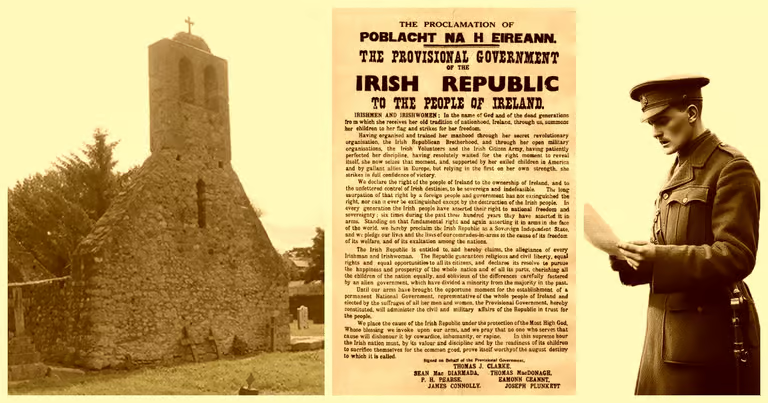
The Proclamation of the Irish Republic – read aloud on 24 April 1916 outside the GPO. The spark that lit a revolution.
Picture it. Easter Monday, 24 April 1916. Dublin wakes up to sunshine and the distant clang of church bells. Families are out for the bank holiday stroll – 24 April Easter Monday holiday in full swing. Then, without warning, the city explodes. Men and women in ill-fitting uniforms seize buildings. Rifles crack. A flag no one has ever seen before snaps in the breeze above the General Post Office. And a schoolteacher with the voice of a prophet steps forward to read words that would change Ireland forever.
This is the story of 24 April Easter Monday Rising Ireland – the Easter Rising that turned a quiet public holiday into the bloody birthplace of a nation. If you’re searching for the real Easter Rising summary, the Easter Rising facts, the Easter Rising Proclamation, or the grim truth of the Easter Rising executions, you’re in the right place. No sugar-coating. No revisionist bollocks. Just the raw, gut-wrenching truth from Secret Ireland.
What Happened on Monday, 24 April 1916? The Easter Rising Begins
The plan was simple on paper, suicidal in practice. A secret Military Council of the Irish Republican Brotherhood – Pearse, Clarke, Connolly, MacDiarmada, Plunkett and the rest – had decided enough was enough. Home Rule was a joke. World War I had turned Irishmen into cannon fodder for the British Empire. It was time to strike.
On 24 April Easter Monday, while the rest of Ireland enjoyed the 24 April Easter Monday holiday, roughly 1,200 Volunteers and Irish Citizen Army members mustered across Dublin. They didn’t wait for the full Volunteer force – Eoin MacNeill had countermanded orders the day before. These men and women went anyway.
By midday they had seized the GPO, the Four Courts, Jacob’s Biscuit Factory, St Stephen’s Green, Boland’s Mill and more. Patrick Pearse stepped out onto the steps of the GPO, flanked by James Connolly and the others, and read the Easter Rising Proclamation aloud to a stunned crowd of shoppers and passers-by.
“Irishmen and Irishwomen: In the name of God and of the dead generations from which she receives her old tradition of nationhood, Ireland, through us, summons her children to her flag and strikes for her freedom…”
That single document – printed in secret, signed by seven men who knew they were signing their own death warrants – declared the Irish Republic. It promised equality, religious freedom, and the right to own the land. It was the first time those words had been spoken in public since 1798. And it changed everything.
What Happened Outside Dublin’s General Post Office on Monday 24th April 1916?
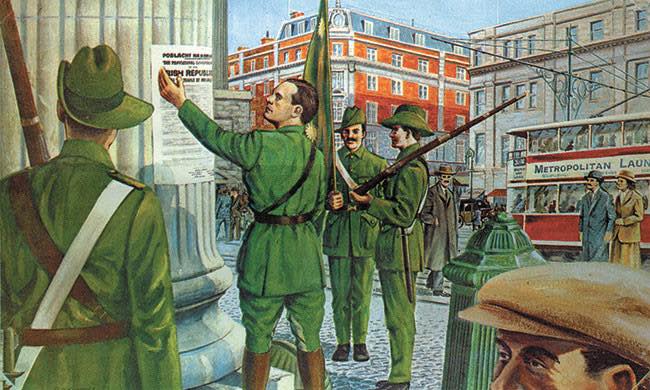
The GPO on O’Connell Street – headquarters of the Easter Rising on 24 April 1916. British artillery would reduce it to rubble by week’s end.
Outside the GPO, the atmosphere was electric and terrifying. Crowds gathered. Some cheered. Most just stared in disbelief. Pearse’s voice carried across the street as he finished the Proclamation. Two flags were hoisted: the green-and-gold harp flag and the tricolour. Volunteers barricaded windows with sacks of mail and furniture. James Connolly barked orders like the old trade unionist he was.
Within hours, British troops were rushing into the city. The first shots rang out near the Liffey. By evening, the Rising had spread. But the real fighting – the brutal street-by-street slaughter – was only beginning. That first 24 April Easter Monday saw the rebels dig in, waiting for the hammer to fall. It would fall hard.
Easter Rising Summary: Six Days That Shook an Empire
Here’s the Easter Rising summary in plain language: a handful of idealists took on the might of the British Empire with rifles, homemade bombs and sheer bloody-minded courage. They held out for six days against 20,000 British soldiers and artillery. Dublin’s city centre was shelled into ruins. Over 500 people died – civilians, rebels and soldiers. The rebels surrendered on 29 April to prevent further civilian slaughter.
But militarily it was a failure. Politically? It was the spark that lit the fuse for the War of Independence and, ultimately, Irish freedom. As W.B. Yeats wrote: “A terrible beauty is born.”
Easter Rising Facts That Still Shock in 2026
- The Rising was deliberately timed for Easter Monday because it was a public holiday – fewer British troops on alert, and the element of surprise.
- Women played vital roles: Constance Markievicz commanded troops at St Stephen’s Green; Cumann na mBan carried messages and ammunition under fire.
- German arms were meant to arrive on the Aud – the ship was intercepted, forcing the rebels to go ahead anyway.
- The Proclamation was the first public declaration of an Irish Republic since the United Irishmen.
- Over 3,500 people were arrested in the crackdown that followed.
Easter Rising Executions: The British Turned Defeat into Martyrdom

Kilmainham Gaol – where the British executed 16 leaders of the Easter Rising in 1916. Their blood became Ireland’s rallying cry.
Here’s the part that still makes the blood boil: the Easter Rising executions. Between 3 and 12 May 1916, the British court-martialled and shot 16 leaders in the stonebreaker’s yard of Kilmainham Gaol. Patrick Pearse, Thomas Clarke, Thomas MacDonagh, Joseph Plunkett (married in the chapel hours before his death), Seán MacDiarmada, James Connolly (too badly wounded to stand – they tied him to a chair), and the rest.
Who was executed in 1916? The full list of the sixteen:
- Patrick Pearse
- Thomas Clarke
- Thomas MacDonagh
- Joseph Plunkett
- Éamonn Ceannt
- Seán MacDiarmada
- James Connolly
- William Pearse
- Edward Daly
- Michael O’Hanrahan
- John MacBride
- Michael Mallin
- Seán Heuston
- Con Colbert
- Roger Casement (hanged later in London)
These executions turned public opinion in Ireland overnight. What had been a minority rebellion became a national cause. The British had handed the rebels their greatest victory – martyrdom.
Is Easter Monday a Holiday in Ireland? And Why Is Easter Monday Celebrated in Ireland?
Yes – Easter Monday is a public holiday and bank holiday across the Republic of Ireland. In 2026 it falls on 6 April, but the date moves every year. Shops and many businesses close. Families gather. It’s a day off – but for many, it’s also a quiet reminder of 24 April 1916.
Why is Easter Monday celebrated in Ireland? Officially it’s a Christian feast day following Easter Sunday. But in modern Ireland, the 24 April Easter Monday celebrations and 24 April Easter Monday events often blend holiday relaxation with Rising commemorations. Parades, wreath-layings at the GPO, talks, and documentaries run across the country. The 24 April Easter Monday holiday now carries a double meaning: rest for the living, remembrance for the dead.
What Did Napoleon Say About Ireland? The Foreign Eye on Our Struggle
Long before 1916, another great power saw Ireland for what she was: the Achilles heel of the British Empire. Napoleon Bonaparte, plotting invasions from France, confided in exile on St Helena that had the United Irishmen sent him “honest men,” he would have invaded. He planned to separate Ireland from England and make her “an independent republic.”
“I would have separated Ireland from England, the former of which I would have made an independent republic.” — Napoleon Bonaparte
He understood what the British feared most: a free Ireland would shatter their empire. The men and women of 1916 proved him right. The Easter Rising was the echo of every failed rising before it – and the beginning of the one that finally succeeded.
Explore more hidden chapters of Ireland’s fight for freedom →
Frequently Asked Questions – 24 April Easter Monday Rising Ireland
What happened on Monday, 24 April 1916?
On Easter Monday 1916, Irish rebels launched the Easter Rising. They seized key buildings in Dublin, including the GPO, and Patrick Pearse read the Proclamation of the Irish Republic. It was the first day of a six-day revolt against British rule.
Is Easter Monday a holiday in Ireland?
Yes. Easter Monday is a statutory public holiday and bank holiday in Ireland. In 2026 it falls on 6 April. Many use the 24 April Easter Monday holiday to reflect on the Easter Rising that began on the same day in 1916.
Who was executed in 1916?
The 16 leaders of the Easter Rising were executed by firing squad in Kilmainham Gaol (plus Roger Casement by hanging in London). They include Patrick Pearse, James Connolly, Thomas Clarke and 13 others. Their deaths turned public opinion against Britain.
Why is Easter Monday celebrated in Ireland?
Officially as the day after Easter Sunday, but in practice it’s also tied to national remembrance. The 24 April Easter Monday celebrations and events often include Rising commemorations alongside family time and bank holiday rest.
What happened outside Dublin’s General Post Office on Monday 24th April 1916?
Patrick Pearse read the Easter Rising Proclamation to a crowd on O’Connell Street. Rebels raised the Irish Republic flag and the tricolour. It was the dramatic public birth of the Irish Republic on Easter Monday.
What did Napoleon say about Ireland?
In exile, Napoleon said he would have separated Ireland from England and made it an independent republic. He saw Ireland as the key to destroying the British Empire – a view the 1916 leaders proved correct.
The Legacy: Why 24 April Still Matters
The Easter Rising didn’t win immediate freedom. But it proved ordinary Irish people could stand against empire and win the moral war. It led directly to Sinn Féin’s 1918 landslide, the War of Independence, the Civil War, and the eventual Republic. Every time you see the tricolour or hear the Proclamation read at a commemoration, you’re hearing the echo of that Easter Monday in 1916.
At Secret Ireland we tell these stories because forgetting is surrender. The rope may have snapped, the shells may have fallen, but the fire they lit still burns.
Share this if you believe Ireland’s past still shapes our future. And come back next Easter Monday – or any Monday – for more truths they tried to bury.
The Republic was declared on 24 April 1916. It was born in 1949. But the soul of it was born that Easter Monday outside the GPO.
Back to Secret Ireland → More dark truths, more Irish history
About the Author
