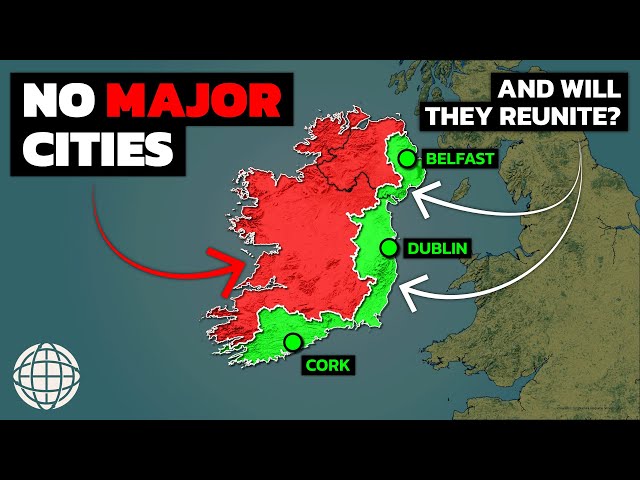
Ireland is a land of contrasts—rugged cliffs against rolling plains, ancient stone circles beside modern skyscrapers, poetry in the pub and politics in the street. But one of its starkest divides isn’t just cultural or political—it’s geographical.
The East of Ireland is heavily populated, bustling with cities, suburbs, and commuter towns. Meanwhile, the West remains sparse and wild, its hauntingly beautiful landscapes punctuated by scattered villages and empty roads.
This is no accident. There is a story behind every divide, and the population imbalance between Eastern and Western Ireland is the result of centuries of history, economic forces, and political decisions.
So, why does the East thrive while the West lingers on the fringes?
1. Geography and Terrain: The Land Shapes the People
The first and most obvious factor is the land itself.
- Eastern Ireland is defined by fertile lowlands, rolling hills, and access to the Irish Sea, making it historically ideal for agriculture, trade, and urban development.
- The West, on the other hand, is wild, mountainous, and bog-ridden. Counties like Mayo, Galway, and Donegal are stunning, but they’re also less hospitable for farming and difficult to develop on a large scale.
For most of history, survival depended on farming. And farming in the West has never been easy.
- The Burren in Clare—a striking limestone landscape—was described by a 17th-century English official as “a savage land, yielding neither water enough to drown a man, nor a tree to hang him, nor soil enough to bury him.”
- The Connemara bogs stretch for miles, making large-scale agriculture impossible.
- Rain and Atlantic winds batter the West, making it a harsher place to live than the relatively mild East.
So while Western Ireland remained rugged and underpopulated, the East became the economic and cultural heart of the island.
2. The Pull of Dublin: Ireland’s Beating Heart
Dublin dominates Ireland. It’s the capital, the economic hub, the cultural center.
- Dublin alone accounts for nearly 30% of Ireland’s population, with over 1.4 million people in its metro area.
- If you include the commuter belt (counties like Kildare, Meath, and Wicklow), that figure is even higher.
- By contrast, entire counties in the West—like Leitrim and Roscommon—have populations smaller than a single Dublin suburb.
Why? Because Dublin is where the jobs are.
The Irish government has long centralized power, industry, and opportunity in Dublin, leaving the West reliant on tourism and small-scale industries.
If you want to work in tech, finance, or media, Dublin is your best bet. The West simply doesn’t have the same level of infrastructure, investment, or economic pull.
This isn’t a new trend—it’s been happening for centuries. Even during British rule, Dublin was the administrative and economic hub of Ireland. The tradition continued after independence, as successive governments failed to truly invest in regional development.
3. The Great Famine: A Death Blow to the West
If you really want to understand why the West of Ireland remains underpopulated, you have to talk about the Great Famine (1845-1852).
- The famine was most devastating in the West, where subsistence farming was the norm.
- In counties like Mayo and Galway, entire communities were wiped out through starvation, disease, and emigration.
- Many of those who survived fled, either to Dublin or across the ocean to America, Britain, or Australia.
Before the famine, Ireland’s population was over 8 million. Today, it’s barely 5 million.
The famine didn’t just kill people—it broke entire regions. Whole villages in the West were abandoned, leaving ghost towns that have never recovered.
Meanwhile, Dublin and the East, though affected, had better access to relief efforts, trade, and economic opportunities, allowing them to rebound faster.
4. Infrastructure and Investment: Where the Money Goes
Look at a map of Ireland’s motorways. Notice something?
- Dublin is the center of the entire road network.
- Almost all major motorways—M1, M3, M4, M7, M9—radiate out of Dublin like spokes on a wheel.
- Meanwhile, the West has far fewer motorways, and large parts of counties like Mayo, Clare, and Donegal remain difficult to reach by modern standards.
This isn’t an accident. For decades, investment in infrastructure has been concentrated in the East.
- New factories? Built near Dublin.
- Tech hubs? Dublin and Cork.
- Major airports? Dublin, with some secondary use of Cork and Shannon.
The West, by contrast, has been left largely dependent on tourism and agriculture, which simply don’t generate the same population growth.
5. The East-West Divide: A Political Blind Spot
Every few years, a government will announce a “regional development plan” promising to revitalize the West. And yet, the population imbalance remains.
Why? Because Dublin-centered policies are deeply ingrained in how Ireland operates.
For example:
- Jobs and housing are concentrated in the East, so people move there for work.
- Public transport is far better in Dublin, making it easier to live there without a car.
- Government services and major institutions are mostly in the East, creating a cycle where people have little choice but to relocate.
It’s a vicious circle—Dublin gets bigger, the West stays stagnant.
6. The Celtic Tiger and the Housing Crisis
During the Celtic Tiger boom (1995-2008), Ireland saw rapid economic growth, and the population began to rise again. But instead of spreading evenly across the country, most of the boom happened in Dublin and the East.
- Dublin property prices skyrocketed, forcing people into commuter towns.
- Meanwhile, in the West, many rural areas continued to see declining populations, with young people leaving for jobs in Dublin, the UK, or further abroad.
- Even today, rural depopulation remains a huge issue, with schools, post offices, and services closing in parts of the West.
So, What’s the Most Populated Part of Ireland?
Dublin, hands down. But if you’re looking for population density, then it’s the commuter belt around Dublin—Kildare, Meath, and Wicklow—where thousands of people live while working in the capital.
Meanwhile, the counties with the lowest population densities—Mayo, Roscommon, and Leitrim—are almost all in the West.
Final Thoughts: Can the West Be Saved?
The truth is, Ireland’s population imbalance isn’t going to change overnight.
- The West is stunning, historic, and culturally rich, but without serious investment, it will continue to lag behind the East.
- Unless there’s a major decentralization effort, the pull of Dublin will remain too strong for most people to resist.
The West of Ireland is a land of poets, musicians, and dreamers—but if something doesn’t change, it might also become a land of ghosts.
For more insights on Ireland’s challenges, check out these articles:
- Things That Ruined Ireland for Me: A Candid Exploration of the Emerald Isle’s Challenges
- The Shamrock: History, Symbolism, and Cultural Significance
About the Author
