Let’s cut through the sanctimonious drivel and get to the meat of it: What is an Irish Goodbye? You’ve heard the phrase whispered in the corners of pubs or flung around online like some half-arsed meme on Reddit.
Maybe you’ve Googled it, stumbled across an Urban Dictionary entry, or seen some smug git on X pontificate about it.
But here’s the truth, unvarnished and unbowed: an Irish Goodbye is the art of slipping out the back door of life’s tedious circus without kissing the ring of anyone’s fragile ego. I
t’s a vanishing act, a middle finger to the performative guff of social niceties. And it’s bloody glorious.
Why Do They Call It an Irish Goodbye?
Why the hell do they call it that? Because the Irish, God love us, have spent centuries perfecting the art of survival under the boot of oppression, famine, and sanctimonious overlords.
When you’ve got nothing left to give—when the landlord’s at the door, the priest’s wagging his finger, or the English are stealing your spuds—you don’t hang around to say, “Cheers, lads, it’s been grand.” You leg it. Silent. Swift. No apologies.
The phrase stuck because it’s us: a nation of poets, rebels, and ghosts who know when to leave the stage before the curtain falls on our dignity.
Some say it’s tied to the diaspora, those millions who fled the Great Hunger in the 1840s, disappearing into the New World without a backward glance.
No tearful farewells, no grand speeches—just gone. Others reckon it’s the stereotype of the Irish drunk, stumbling out of the pub before the barman cuts him off. Either way, it’s not just a goodbye; it’s a statement. Why is it called an Irish Goodbye? Because we’ve got form, and we don’t owe you an explanation.
What is the Irish Goodbye Method?
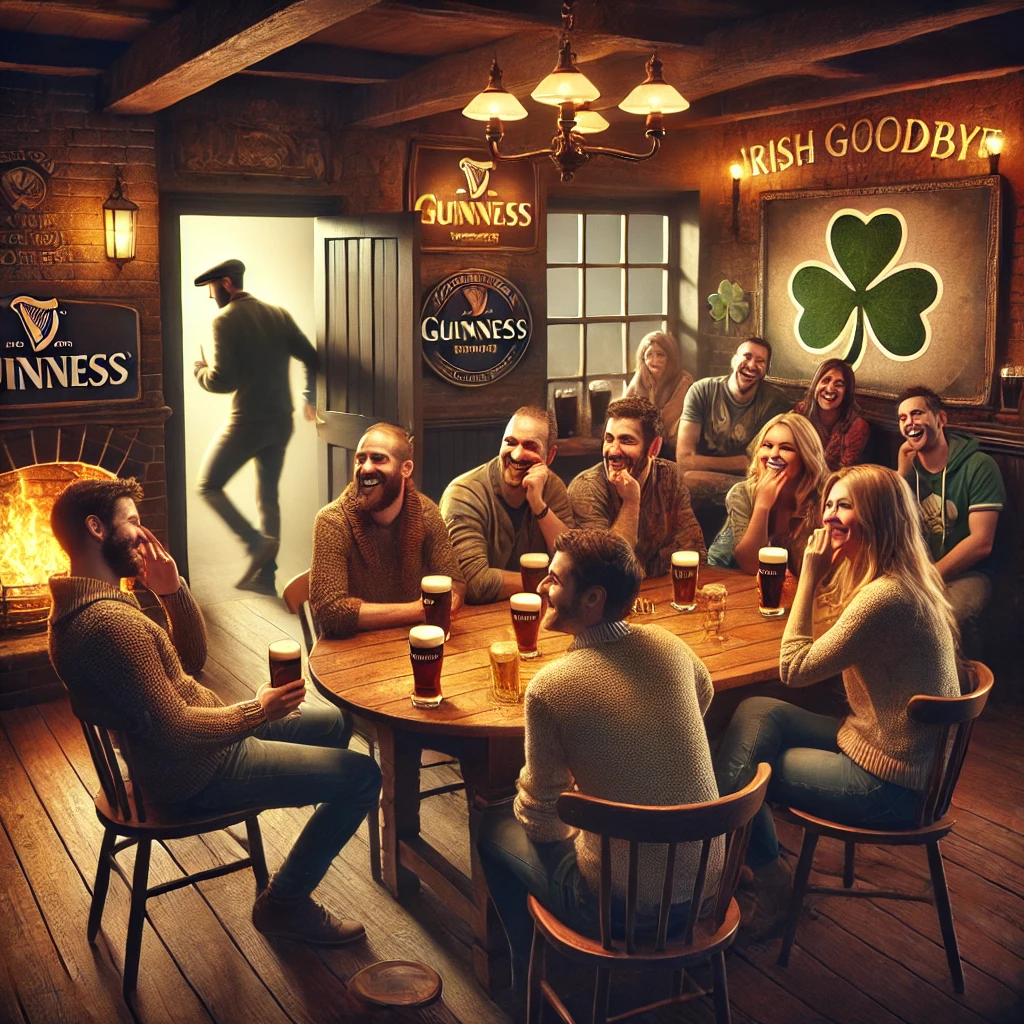
The method? Simple, brutal, effective. You’re at some soul-crushing shindig—fake smiles, small talk about mortgages, someone banging on about their gluten intolerance—and you decide you’ve had enough. You don’t announce it. You don’t wave like a prat or mumble some excuse about an early start. You finish your pint, set it down, and evaporate. Door shuts behind you, and they’re left wondering if you were ever there. That’s the Irish Goodbye method: no fuss, no fanfare, just the clean break of a guillotine.
It’s not cowardice, mind you—it’s strategy. You’re not dodging confrontation; you’re rejecting the whole charade. The method’s beauty lies in its economy. Why waste breath on people who’ll forget you by morning? It’s the opposite of an Irish Goodbye that lingers like a bad smell—think of the clingy eejit who won’t leave the party till they’ve hugged everyone twice.
What is a Common Irish Goodbye?
A common Irish Goodbye isn’t some rare unicorn—it’s the default for anyone with a shred of self-respect. Picture it: a mate’s wedding reception, the DJ’s playing “Sweet Caroline” for the third time, and the bride’s aunt is slurring about her bunions. You’re not making a scene or storming out in a huff. You just… drift. One minute you’re nodding along to some bollocks about Brexit, the next you’re halfway down the road, lighting a fag, free as a bird. That’s the common Irish Goodbye—quiet, unpretentious, and gloriously anti-social.
The Psychology Behind the Irish Goodbye
Now, let’s get into the headspace, the psychology behind the Irish Goodbye. Why do it? Because humans are exhausting. We’re wired for connection, sure, but we’re also drowning in it—every interaction a transaction, every goodbye a performance. The Irish Goodbye says, “I’m done playing.” It’s not about rudeness; it’s about self-preservation. You’ve given your pound of flesh—laughed at their shite jokes, nodded through their tedious yarns—and now you’re reclaiming your soul.
Psychologists might call it avoidance or introversion, but that’s bollocks. It’s liberation. The Irish know the weight of expectation—centuries of it—and the Goodbye is our way of shrugging it off. It’s polite in its own savage way: I won’t burden you with my exit, and you won’t burden me with your neediness. Why the Irish Goodbye is polite? Because it spares us all the awkward dance of insincere promises to “catch up soon.”
Is It OK to Do an Irish Goodbye?
Is it OK? Christ, it’s more than OK—it’s a moral imperative. You don’t owe anyone your presence beyond what you’re willing to give. The world’s full of vampires who’ll suck you dry with their “Just one more drink” or “Don’t go yet!” guilt trips. The Irish Goodbye is your shield, your sword, your right to say, “I’m out.” Anyone who calls it rude can shove their etiquette manual where the sun doesn’t shine. Life’s too short for obligatory encores.
Now, some snowflakes might clutch their pearls and cry, “Is ‘Irish Goodbye’ offensive?” No, you daft bastards, it’s not. It’s a badge of honour, a nod to a people who’ve mastered the art of knowing when the party’s over. If you’re offended, that’s your problem—go cry into your quinoa.
What is an Irish Goodbye in a Relationship?
In a relationship? Oh, that’s where it gets juicy. An Irish Goodbye in love isn’t just walking out—it’s the emotional vanishing act. One day you’re there, the next you’re a ghost, no note, no row, just silence. It’s the lad who stops texting, the lass who moves out while you’re at work. Harsh? Maybe. But honest. Why drag out the corpse of a dead romance with “we need to talk” bollocks? The Irish Goodbye in a relationship says, “You’ll figure it out when you notice I’m gone.” It’s not for the faint-hearted, but it’s pure.
What is a Scottish Goodbye?
And what about a Scottish Goodbye? Well, our cousins up north don’t mess about either, but their exit’s got a different flavour. Where the Irish slip away like shadows, the Scots might leave with a parting shot—a “See yous later, ya bunch o’ bawbags!” before slamming the door. It’s less subtle, more theatrical, but just as final. Think of it as the Irish Goodbye’s louder, kilt-wearing brother—same spirit, different swagger.
The Irish Goodbye Meme, Reddit, and the Rest
The internet’s obsessed, isn’t it? Scroll through Reddit, and you’ll find Irish Goodbye threads galore—half the posters praising it as genius, the other half whining it’s rude. The Irish Goodbye meme game’s strong too: a lad disappearing in a puff of smoke mid-conversation, captioned, “When you’ve had enough of their shite.” It’s folklore now, a cultural export that’s gone global, and fair play to it.
Urban Dictionary nails it: “Leaving a social event without saying goodbye, often associated with the Irish.” Straight, no chaser. But the chatter on X and beyond—debating if it’s polite, offensive, or just bloody brilliant—proves it’s more than a phrase. It’s a movement.
The Opposite of an Irish Goodbye
The opposite? That’s the clingy gobshite who won’t leave—hugging everyone, promising to call, turning a goodbye into a feckin’ opera. It’s the anti-Irish Goodbye: loud, needy, and desperate for validation. Spare us.
| Term | Country/Language | Literal Translation | Cultural Context |
|---|---|---|---|
| Irish Goodbye | English (U.S., U.K.) | Leaving without saying goodbye | Possibly tied to stereotypes of Irish rudeness or drunkenness; used humorously today. |
| French Leave | English | To take French leave | Originated in the 18th century as an English jab at French social habits. |
| Filer à l’anglaise | French | To leave like the English | French retort to “French leave,” implying English sneakiness. |
| Andarsene alla francese | Italian | To leave the French way | Adopted from English “French leave,” reflecting European rivalries. |
| Einen polnischen Abgang machen | German | To make a Polish exit | Emerged post-Berlin Wall, tied to stereotypes about Polish behavior. |
Final Word: Why the Irish Goodbye Rules
So, what is an Irish Goodbye? It’s freedom. It’s defiance. It’s the refusal to let the world dictate your exit. Call it what you want—rude, polite, offensive, genius—it’s ours, and we’re not apologising. Next time you’re trapped in some hellhole of small talk, don’t explain, don’t grovel—just vanish. Leave them clutching their pint, wondering where you went, and let the legend of the Irish Goodbye live on.
Now, if you’ll excuse me—or even if you won’t—I’m off. No handshake required.
About the Author
