
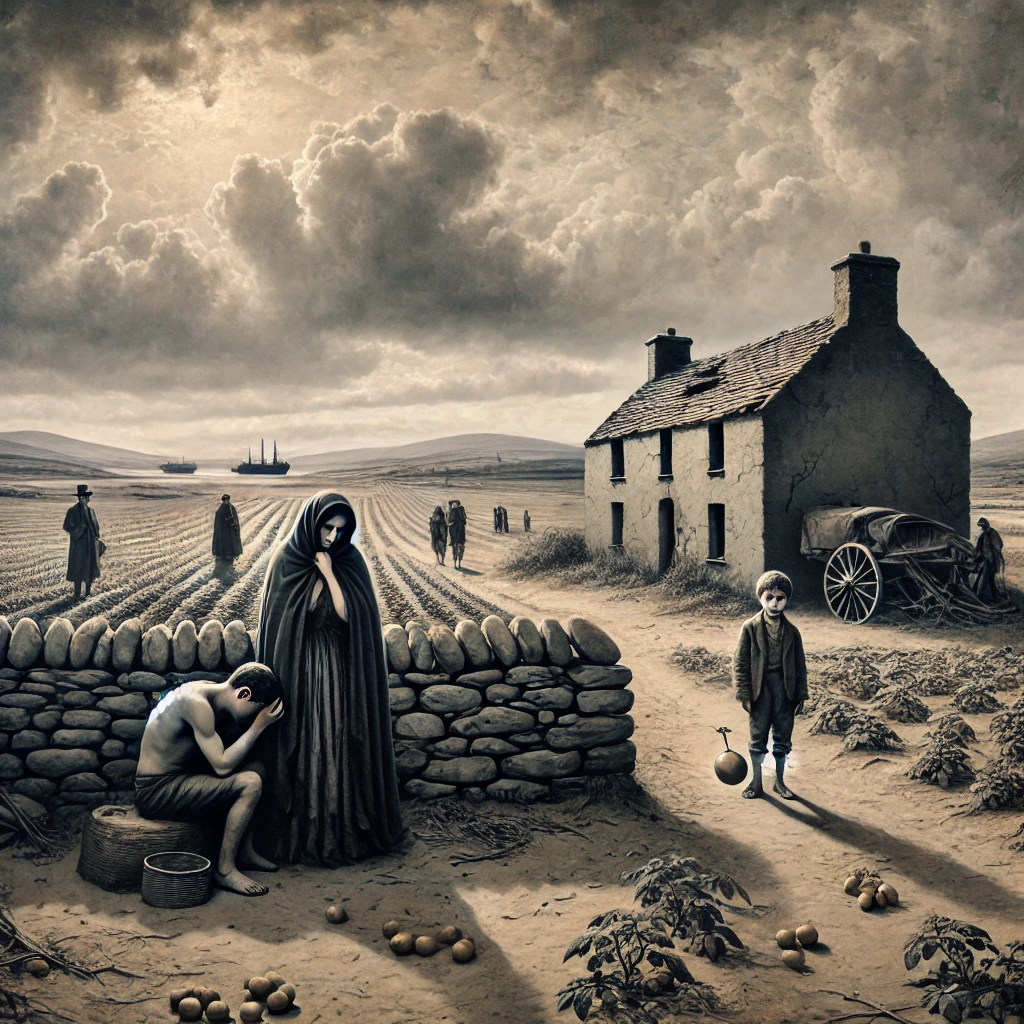
The Great Famine wasn’t just a tragedy—it was a rupture. Between 1845 and 1852, Ireland was gutted, its soul hollowed out by a relentless specter of hunger and despair. Over a million people died, another million fled, and the land that once hummed with life fell into a haunting silence. But the famine wasn’t just a moment in history—it was a cataclysm that reshaped Ireland forever, carving scars into its landscape, its people, and its very identity.
You can still feel its echoes. In the abandoned villages swallowed by brambles. In the winds that sweep through emigration ports like Cobh. In the sorrow that lingers in songs, in stories, in the very soil itself. The Great Famine isn’t something Ireland left behind—it’s something Ireland carries, a wound that never truly healed.
A Perfect Storm of Catastrophe
The Great Famine wasn’t just about a potato blight—it was about a society pushed to the brink by a brutal combination of political negligence, economic exploitation, and environmental disaster. The Phytophthora infestans fungus destroyed the potato crop, the staple food for millions of Irish tenant farmers. But the true devastation came not from nature, but from a colonial system that valued profit over human lives.
The Land System: Seeds of Inequality
Ireland’s tenant farmers lived under a system that was as fragile as it was cruel. Landlords, often absentee and British, owned vast estates, leasing plots to tenants who lived hand-to-mouth. When the potato failed, eviction became a death sentence. Entire families were cast out onto the roads, their homes reduced to rubble.
British Response: Indifference and Ineptitude
The British government’s response was a toxic mix of bureaucratic indifference and ideological cruelty. Relief efforts were hamstrung by a belief in laissez-faire economics, with officials insisting the market would resolve the crisis. Food continued to be exported from Ireland, even as its people starved.
Death and Diaspora
The famine killed over a million people, but its impact extended far beyond those who perished. For every death, there was an emigration—a desperate flight to escape starvation. The Irish diaspora spread across the globe, from America to Australia, creating new communities but leaving behind a hollowed-out homeland.
The Coffin Ships
The journeys were harrowing. Packed into overcrowded, disease-ridden “coffin ships,” many emigrants died before ever reaching their destinations. But those who survived carried Ireland with them, planting seeds of Irish culture in foreign soil.
The Lost Generation
The famine decimated Ireland’s population, which dropped by 25% in less than a decade. Entire villages were wiped out, their fields abandoned, their stories lost. The demographic impact was staggering, and the psychological toll even greater.
Cultural Impact: A Nation Transformed
The famine didn’t just change Ireland’s population—it changed its soul. It left behind a legacy of grief, resilience, and a burning desire for justice that would fuel Ireland’s fight for independence.
The Silence of Grief
For generations, the famine wasn’t spoken of openly. The trauma was too raw, the memories too painful. But in that silence, a collective sorrow took root, shaping the Irish identity in profound ways.
Rebellion and Resistance
The famine laid bare the injustices of British rule, fueling nationalist movements that demanded self-determination. Organizations like the Irish Republican Brotherhood and Sinn Féin found fertile ground in a population scarred by suffering but unwilling to endure it again.
Art and Memory
The famine left an indelible mark on Irish art and literature. Writers like John Mitchel and poets like W.B. Yeats channeled the anguish into words that refused to let the world forget. Today, works like The Hunger by Cecil Woodham-Smith and Angela’s Ashes by Frank McCourt keep the memory of the famine alive.
Economic and Social Shifts
The famine uprooted the traditional way of life in Ireland, reshaping its economy, land ownership, and social structures.
Decline of the Irish Language
As families emigrated or perished, so too did the language they spoke. Irish, once the dominant tongue, began a sharp decline, replaced by English in a society increasingly anglicized by necessity and survival.
Land Reforms
The famine exposed the inequities of Ireland’s land system, leading to eventual reforms like the Land Acts. But these changes came too late for those who had already been lost.
Urbanization and Industrialization
With rural areas devastated, cities like Dublin, Cork, and Belfast became hubs of survival and opportunity. This shift set the stage for Ireland’s gradual transformation from an agrarian society to a more urbanized one.
The Global Irish: A Diaspora Born of Desperation
The Great Famine marked the beginning of modern Irish emigration on a massive scale. Today, the Irish diaspora numbers over 70 million, with communities around the globe tracing their roots to those who fled famine’s grip.
Cultural Exchange
From Irish pubs in New York to St. Patrick’s Day parades in Sydney, the diaspora has spread Irish culture far and wide, turning tragedy into a shared identity celebrated across the globe.
Political Influence
Irish emigrants didn’t just survive—they thrived, becoming political leaders, activists, and innovators in their adopted countries. Figures like John F. Kennedy in the United States and Mary Robinson in Ireland itself stand as symbols of the resilience born from adversity.
Legacy of the Famine
The Great Famine wasn’t just a historical event—it was a turning point, a moment that reshaped Ireland’s trajectory and left a shadow that still looms over the nation today.
Commemoration
Sites like the Famine Memorial in Dublin and the Dunbrody Famine Ship in Wexford serve as poignant reminders of the lives lost and the resilience of those who survived. Annual events like National Famine Commemoration Day ensure that the famine is never forgotten.
Lessons Learned
The famine is a stark reminder of the consequences of inequality, indifference, and mismanagement. It underscores the importance of compassion, community, and the power of collective action in the face of crisis.
A Scar and a Strength
The Great Famine left Ireland wounded, but it also left it strong. Out of the ashes of despair came a people who refused to be broken, who turned sorrow into song and grief into grit. The famine didn’t define Ireland, but it shaped it—its history, its identity, its soul.
To walk the land today is to feel its echoes. To see the ruins of an old village, to touch the stone of an emigrant’s memorial, is to remember not just the suffering but the survival. Ireland carries the famine in its bones, its blood, its breath. And in remembering, it honors those who were lost—and those who refused to lose hope.
For more stories of Ireland’s past and its enduring spirit, explore Secret Ireland, where the voices of history still speak, and the soul of Ireland endures.
The Emotional Landscape: A Nation in Mourning
The Great Famine isn’t just written in history books; it’s etched into the psyche of the Irish people. Even today, it’s a wound that throbs beneath the surface, shaping the way Ireland sees itself and the world.
A Generational Shadow
For those who remained in Ireland, the famine became an unspoken grief passed down through generations. Grandparents whispered stories of hunger, of losing entire families, of fields that once promised life reduced to barren wastelands. This shadow shaped the Irish character—a mix of resilience, melancholy, and an unbreakable sense of community.
A Source of Strength
Yet, from this sorrow came strength. The famine forged a national consciousness that would later fuel Ireland’s fight for independence. It taught the Irish to value solidarity, to fight for justice, and to honor those who came before by building something better.
The Famine and the Irish Diaspora: An Enduring Bond
The famine wasn’t just a local tragedy—it became a global story. The millions who fled Ireland carried their pain and resilience to new lands, where they built communities that kept their heritage alive.
The Irish in America
For many, the United States was a land of hope, but the journey was brutal. Coffin ships claimed countless lives, and those who survived arrived penniless, often greeted with hostility. Yet, the Irish persevered, carving out lives in cities like Boston, New York, and Chicago. They built railroads, churches, and unions, rising from destitution to prominence.
Australia’s Irish Legacy
For others, Australia became a place of exile and opportunity. Sent there as convicts or emigrants, the Irish brought their culture and traditions, leaving an indelible mark on the nation’s identity.
A Global Family
Today, the Irish diaspora spans the globe, with over 70 million people claiming Irish ancestry. The famine may have driven them apart, but their shared history and heritage bind them together, creating a global family united by resilience and pride.
The Landscape of Memory
Ireland’s landscape is its memory. The fields, the stone walls, the ruins of famine-era cottages—they all tell the story of a people who endured unimaginable suffering. These physical reminders serve as both a testament and a warning, ensuring that the lessons of the famine are never forgotten.
National Famine Memorials
- Doolough Valley: This hauntingly beautiful valley in County Mayo is the site of the infamous Doolough Famine Walk, where starving families died in search of aid. Today, it’s a place of reflection, where visitors can walk in their footsteps and honor their memory.
- The Famine Memorial in Dublin: Overlooking the River Liffey, these bronze sculptures of gaunt figures carry the weight of a nation’s grief, their haunting expressions reminding all who pass of the famine’s cost.
- Strokestown Park and National Famine Museum: This restored estate and museum offer a deep dive into the famine’s history, giving voice to those who lived—and died—through it.
The Famine in Art and Literature
The Great Famine has inspired some of Ireland’s most poignant art and literature. From poetry to plays, it remains a powerful subject, a way for the nation to process its grief and ensure the famine’s stories are never silenced.
Poetry of the Famine
- Seamus Heaney’s work often echoes the famine’s legacy, exploring themes of loss, survival, and the connection between the land and its people.
- Eavan Boland’s “Quarantine” is a haunting depiction of love and suffering during the famine, a poem that captures the quiet heroism of ordinary people.
Fiction Rooted in History
- The Famine Trilogy by Liam O’Flaherty tells the harrowing story of famine-stricken Ireland through the eyes of its most vulnerable.
- Joseph O’Connor’s “Star of the Sea” paints a vivid picture of a famine-era emigrant ship, blending mystery, tragedy, and historical detail.
Contemporary Memorials in Music
Irish music, too, carries the weight of the famine. Songs like “The Fields of Athenry” and “Skibbereen” tell stories of heartbreak and resilience, keeping the memory alive in every note.
The Famine’s Echo Today
The Great Famine isn’t just a chapter in Ireland’s past—it’s a lens through which the country sees its present and future. It has shaped Ireland’s approach to issues like immigration, social justice, and food security, ensuring that the lessons learned are never lost.
Compassion for Refugees
Ireland’s own history of emigration and suffering has made it a vocal advocate for refugees and migrants. The memory of the famine drives a national empathy for those fleeing conflict and poverty today.
Food Security and Sovereignty
The famine’s devastation underscored the dangers of dependency on a single crop and external markets. Today, Ireland is a leader in sustainable agriculture, ensuring that its people are never again at the mercy of outside forces.
Cultural Pride
The famine was a turning point in Ireland’s history, but it didn’t break the nation. Instead, it became a source of strength, fueling the cultural revival that would follow and giving rise to a global celebration of Irish heritage.
A Legacy of Resilience
The Great Famine left scars, but it also left a legacy. It’s a story of unimaginable loss, yes, but also one of survival, resilience, and renewal. The famine shaped Ireland’s identity, its diaspora, and its spirit, turning tragedy into a foundation for growth and solidarity.
To walk through Ireland today is to feel the echoes of that time—to stand in fields that once saw starvation, to touch stones that once sheltered the hungry, and to know that, despite it all, the Irish endured. They carried their grief, their hope, and their stories into the future, ensuring that the famine’s lessons will never be forgotten.
For more on Ireland’s history and its enduring spirit, visit Secret Ireland. Because in every story of loss lies a story of survival—and in every scar, a symbol of strength.
About the Author
