

Picture this: you’re clinging to a narrow path carved into the sheer basalt cliffs of Islandmagee, County Antrim, with the Irish Sea snarling below, spitting salt in your face.
This is the Gobbins Cliff Path, a lunatic’s dream of a walk that’s been thrilling souls since 1902. It’s not just a stroll—it’s a punch in the gut, a love letter to the wild, a middle finger to the tame.
Conceived by Berkeley Deane Wise, an Irish railway engineer with a poet’s heart and a madman’s vision, this path snakes across bridges, through tunnels, and past caves, daring you to keep up.
This blog rips the veil off the Gobbins Cliff Path walk, its history, its raw beauty, and its place in Ireland’s untamed soul. Strap on your boots, because this ain’t no Sunday ramble.
Where Is the Gobbins Cliff Face Path?
The Gobbins Cliff Path is a jagged scar along the eastern coast of Islandmagee, County Antrim, Northern Ireland, part of the Causeway Coastal Route. It stretches from Whitehead to Portmuck Harbour, a 3-mile (5km) gauntlet of cliffs, caves, and bridges that make your heart pound like a bodhrán.
Located just 32km from Belfast—a 40-minute drive or an hour’s train ride to Ballycarry station—it’s close enough for a day trip but feels like another planet. The Gobbins Cliff Path map starts at the Visitor Centre in Ballystrudder (Middle Road, Islandmagee, BT40 3SX), where you’ll board a shuttle to the trailhead.
This is no manicured park; it’s a raw, elemental beast, with the North Channel’s waves crashing below and Scotland’s coast winking on clear days. For a deeper dive into Ireland’s coastal wonders, explore Rotten Island’s wild history.
Why Are the Gobbins Called the Gobbins? What Does the Word Gobbins Mean?
Some say it evokes the jagged points of rock that stab into the sea, others that it’s a poetic shorthand for the wild, untamed spirit of the place. Whatever the etymology, it’s a name that sticks in your craw, like a shot of poitín.
The Gobbins isn’t just a place; it’s a state of mind, a challenge to face the raw edge of the world.
A History Forged in Iron and Madness
The Gobbins Cliff Path was born from the fevered brain of Berkeley Deane Wise, a Wexford-born engineer who cut his teeth on the brutal coastal railways of Bray Head.
By 1888, as Chief Engineer for the Belfast and Northern Counties Railway Company, Wise saw the potential to turn Islandmagee’s cliffs into a tourist magnet.
Opened in 1902, the path was a marvel of Edwardian engineering—bridges, tunnels, and galleries hand-carved into the basalt, costing visitors a mere sixpence to experience what newspapers called a “perfect marvel” that “baffles all description.”
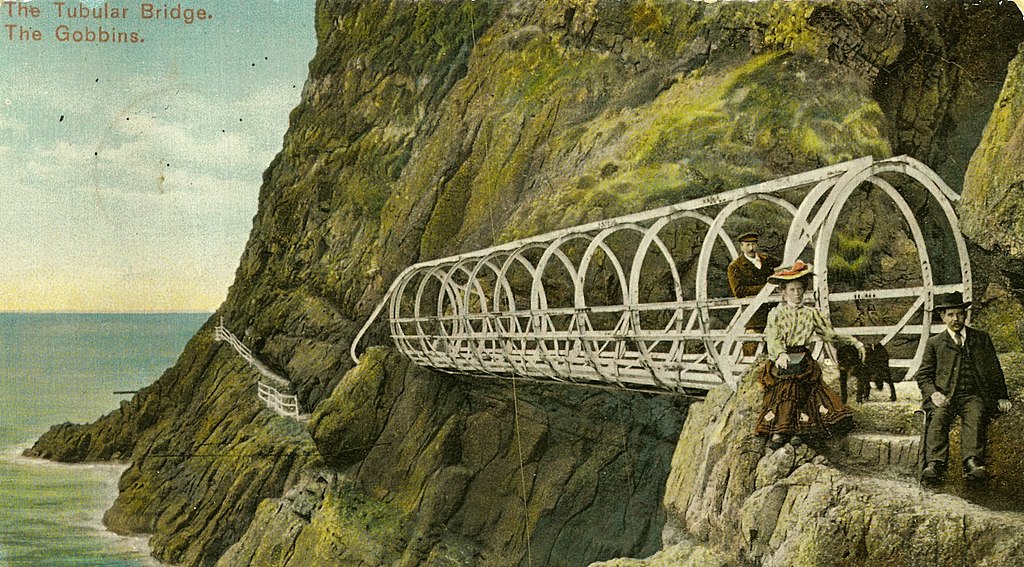
Thousands flocked to it, outshining even the Giant’s Causeway, with posters plastered on Belfast trams and steamers bringing thrill-seekers from Britain. Wise’s masterpiece, including the iconic Tubular Bridge, was a testament to human audacity, hugging cliffs where puffins nest and waves roar.
But the Gobbins wasn’t built to last forever. The 1930s Depression and World War II starved the railway company of funds, and by 1936, maintenance faltered. The path closed during the war, briefly reopened in 1950, then shut for good in 1954 after landslides and neglect took their toll.
The Tubular Bridge collapsed into the sea in 1981, a sad end to Wise’s dream. Climbers and daredevils still braved the ruins, but not without risk—14-year-old James Kerr fell to his death in 1892 collecting seagull eggs, a grim reminder of the cliffs’ danger, and others needed rescuing in the decades that followed.
In 2011, Larne Borough Council, fueled by £7.5 million from the EU’s Interreg IVA Programme, the North East Partnership, and Ulster Garden Villages, set out to resurrect the Gobbins. From 2014 to 2015, 15 new bridges and six galleries were built, including a new Tubular Bridge craned into place at 5.4 tonnes.
The path reopened in August 2015, only to face storm damage in 2016 and 2017. As of 2025, the Gobbins Cliff Path has been closed 46% of the time since 2015 due to rockfalls, storms, and inspections, a testament to the wild forces it battles.
Is the Gobbins Cliff Path Open? When Will the Gobbins Reopen?
As of August 2025, the Gobbins Cliff Path is open, but its history of closures—46% of the time since 2015—means you should check the official website before planning.
Recent rockfalls and storm damage have forced temporary shutdowns, with the latest closure noted in February 2025 for maintenance. The Visitor Centre and café remain open, offering a virtual reality experience for those who can’t tackle the path. When will the Gobbins reopen?
If closed, updates are posted regularly on the official site, with reopenings typically swift once safety is assured. Book your guided tour in advance to avoid disappointment—this is no walk-in attraction.
How Long Does the Gobbins Cliff Walk Take?
How long is The Gobbins cliff walk? The full experience, including a safety briefing and shuttle ride, lasts about 2.5 to 3 hours.
The Gobbins Cliff Path walk itself covers roughly 3 miles (5km) round trip, an out-and-back route with 50 flights of uneven steps, equivalent to climbing a 10-story building.
You’ll cross bridges, navigate tunnels, and pause for your guide’s tales of smugglers, geology, and wildlife. It’s not a race—expect frequent stops to soak in the views and stories, making it feel longer but richer.
Is The Gobbins Walk Difficult?
Is The Gobbins walk difficult? Hell yeah, it can be. This isn’t a gentle meadow stroll—it’s a rugged, narrow path with steep inclines, declines, and over 100 hand-carved steps. The initial descent to the path and the final climb back are the toughest bits, with reviewers calling the return ascent a “lung-buster.”
You need decent fitness, no serious heart, lung, or joint issues, and a height of at least 1.2 meters (4 feet). Hard hats are mandatory due to rockfall risks, and proper hiking boots with ankle support are non-negotiable (rentals available). That said, guides pace it slowly, and railings keep you secure. If you’ve got moderate fitness and a taste for adventure, it’s manageable but not a cakewalk.
Is the Gobbins Cliff Path Worth It?
Is the Gobbins Cliff Path worth it? Damn right it is. For £21.50 per adult, you get a guided tour that’s half hike, half history lesson, half communion with nature’s raw power (yeah, that’s three halves—deal with it). The Gobbins Cliff Path route takes you across the Tubular Bridge, through Wise’s Eye tunnel, and past caves like Sandy Cave, once a smugglers’ haunt.
You’ll see puffins, kittiwakes, and maybe dolphins if luck’s on your side. The views—craggy cliffs, the Seven Sisters caves, Belfast Lough—are jaw-dropping, and the engineering is a bloody miracle.
Reviewers rave about the guides’ stories and the thrill of walking 10 meters above the crashing sea. Sure, peak-season crowds and weather can be a drag, but this is a bucket-list experience that’ll leave you buzzing.
How Much Is the Gobbins Walk?
The Gobbins Cliff Path cost is £21.50 for adults, £14.50 for students, seniors (65+), and children under 16, with family tickets at £42 (two adults, two kids).
This includes a guided tour, safety gear, and shuttle from the Visitor Centre. Book online to secure your spot—tickets sell out fast, especially in summer. It’s a small price for a walk that’s been called “Europe’s most dramatic.”
Is the Gobbins National Trust?
No, the Gobbins Cliff Path is not managed by the National Trust. It’s operated by Mid and East Antrim Borough Council, with funding from the EU, Larne Borough Council, and other partners. The Visitor Centre, with its café, gift shop, and exhibition, is the hub for this council-run attraction. Don’t expect National Trust branding—this is a local endeavor with a fierce community spirit.
Who Built the Gobbins Cliff Path?
The Gobbins Cliff Path was the brainchild of Berkeley Deane Wise, a visionary engineer born in New Ross, Wexford. Wise, who honed his craft on Dublin’s coastal railways, became Chief Engineer for the Belfast and Northern Counties Railway Company in 1888.
His knack for tourism-driven projects—think Glenariff’s paths and Whitehead’s resort makeover—led to the Gobbins, opened in 1902. Wise’s design, with its hand-carved tunnels and bridges like the Tubular Bridge, was a daring feat that drew global praise.
Though a 1908 landslip and his death in 1909 halted his plans, his legacy endures in the path’s modern revival.
How to Get to the Gobbins from Belfast Without a Car?
How to get to the Gobbins from Belfast without a car? Take the train from Belfast’s Great Victoria Street or Lanyon Place to Ballycarry on the Larne Line (about 1 hour 10 minutes). From Ballycarry, it’s a 20-minute signposted walk to the Gobbins Visitor Centre.
Alternatively, catch Bus 256 from Europa Bus Centre to Larne Bus Station, then a taxi or local bus to Islandmagee. The journey’s straightforward, and combining it with a walk to Blackhead Lighthouse (visible from the Gobbins) makes for a cracking day out. Check Translink schedules for times, and book your tour in advance.
Has the Gobbins Cliff Path Been Closed 46% of the Time Since Opening in 2015?
Yes, the Gobbins Cliff Path has been closed for roughly 46% of the time since its 2015 reopening, due to a relentless battering from nature. Storms in 2016 and 2017 caused damage, delaying openings, while rockfalls and safety inspections have forced frequent closures.
As of 2025, the path’s battle with the elements continues, with recent closures noted in February 2025. This statistic underscores the challenge of maintaining a cliffside path against the Irish Sea’s fury, but when it’s open, it’s worth every second of waiting.
The Gobbins Cliff Path Route: A Wild Ride
The Gobbins Cliff Path route is a 3-mile out-and-back trail, starting at Wise’s Eye—a tunnel bored through the rock. You’ll cross 15 bridges, including the 5.4-tonne Tubular Bridge, suspended 10 meters above the sea, and navigate a 22-meter tunnel below sea level.
The path hugs basalt cliffs, passing caves like Sandy Cave and the Man O’War sea stack. Expect over 100 steps, some carved by hand, and a cantilevered platform with views of Belfast Lough and Ailsa Craig.
The Gobbins Cliff Path map highlights stops like the Seven Sisters caves and Kraken Cave, with guides pointing out puffins, kittiwakes, and geological wonders. It’s a raw, immersive plunge into nature’s chaos.
Hotels Near Gobbins Cliff Path
Need a place to crash? Hotels near Gobbins Cliff Path include the Arbor Hills, 2km away in Islandmagee, with pod-like rooms and hot tubs offering views of Larne.
The Harbour View in Carrickfergus (12km) is a sea-facing apartment with a cozy vibe. For a classic stay, the Derrin Guest House in Larne (15km) serves a hearty breakfast near the Antrim Coast Road.
All are close enough for a pre- or post-walk pint and a bed to collapse into.
The Gobbins in Context: Ireland’s Wild Edges
The Gobbins isn’t alone in its rugged glory. For more of Ireland’s untamed coast, check out basking sharks off Achill Island or the emerald beauty of Keem Beach. For another dose of Atlantic madness, Rotten Island off Donegal offers a lighthouse-guarded solitude. The Gobbins shares their defiant spirit, a reminder of Ireland’s unpolished edges. To understand the broader tapestry of Ireland’s islands, dive into The Irish Isles Explained.
The Terry McMahon Take: Why the Gobbins Matters
Fuck the sanitized tourist traps. The Gobbins Cliff Path is Ireland at its most feral—a place where you feel the earth’s pulse, where the sea screams and the cliffs don’t give a damn about your Instagram.
It’s Berkeley Deane Wise’s middle finger to the ordinary, a path that dares you to walk where only the brave or the mad would tread. It’s not just about the views or the puffins or the bloody Tubular Bridge—it’s about standing on the edge of the world and feeling alive. The Gobbins doesn’t care if you show up, but if you do, it’ll carve itself into your soul. Go. Get wet. Get windblown. Get real.
Conclusion: Embrace the Wild
The Gobbins Cliff Path is more than a walk—it’s a battle with nature, a nod to human ingenuity, and a pilgrimage to Ireland’s raw heart. From its Edwardian origins to its storm-battered modern revival, it’s a testament to the madness of dreaming big.
Whether you’re crossing the Tubular Bridge, peering into smugglers’ caves, or gasping at the North Channel’s fury, the Gobbins delivers.
Check if the Gobbins Cliff Path is open, book your tour, and brace for a 3-hour, 3-mile adventure that’ll leave you changed. For more of Ireland’s wild soul, explore Ireland’s forgotten isles. Now, what are you waiting for? Go walk the edge, you mad bastard.
About the Author
