
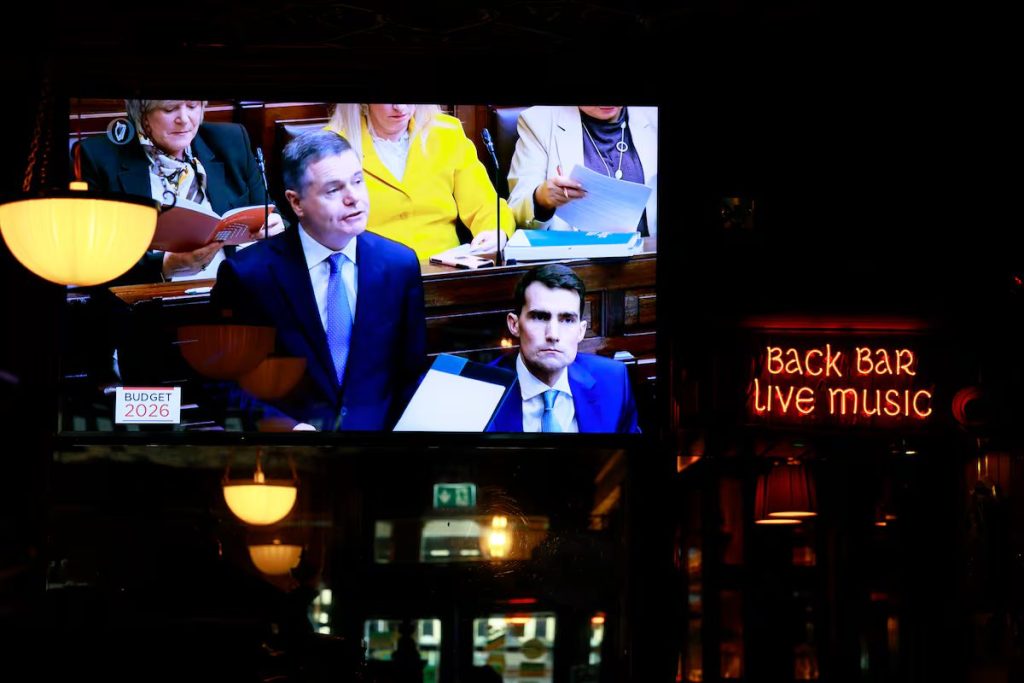
Ireland’s public finances are technically in a position that most European finance ministers can only dream of. With a projected multi-billion euro surplus crossing the €9 billion mark this year, the look of the state’s balance sheet suggests massive leeway for popular fiscal maneuvering. However, as the government prepares to publish its pivotal pre-budget blueprint—the Summer Economic Statement—a major internal battle is brewing behind closed doors.
The core of this friction rests between political desires ahead of an upcoming electoral cycle and the cold, mathematical reality presented by the state’s independent financial watchdog: the Irish Fiscal Advisory Council (IFAC). While ministers point to the swelling exchequer returns, IFAC has sounded a clear, foundational warning: when you account for the true cost of simply maintaining public services at their current baseline alongside the inevitable price of a new public sector pay deal, the room for additional, unbacked giveaways vanishes rapidly.
The Structural Sandbox: Breaking Down the Package
The blueprint for this autumn’s definitive budget package relies heavily on how the Government balances higher infrastructure and departmental spending against competitive personal taxation relief. Last year’s framework allocated a total of €9.4 billion—splitting €8.1 billion into expanded public expenditure and reserving €1.3 billion for the tax package. Minister for Finance Simon Harris has signaled a clear intent to execute a total package that matches or exceeds that baseline, but with a fundamentally different internal architecture.
The primary pivot for Budget 2027 centers on an aggressive expansion of the tax relief element. Minister Harris has repeatedly emphasized a desire to cushion middle-income earners from the effects of tax creep. However, every euro diverted into widening tax bands directly reduces the capital available to scale public services or permanently increase core welfare rates, exposing the exact trade-offs that IFAC cautions against.
Income Tax Restructuring: What It Means for Middle Earners
For the typical Irish worker, the ultimate test of Budget 2027 will be its direct impact on their monthly take-home pay. The primary mechanism under review is the entry point for the higher 40% marginal rate of income tax, which currently stands at €44,000 for single individuals and €53,000 for couples.
Because these boundaries remained unchanged in the previous fiscal cycle, wage growth has pulled thousands of workers into the top tax tier by stealth—a phenomenon known as fiscal drag. To offset general inflation across the economy next year, that entry point would need an upward correction to roughly €45,300. To fully remedy the cumulative inflation built up through this year, it must push past €46,800, targeting a clean €47,000 baseline.
The Ready Reckoner: Calculating Your Net Gains
Based on initial fiscal assessments from the Revenue Commissioners, shifting the standard rate income tax band costs the exchequer approximately €230 million for every €1,000 adjustment. For individual workers, the arithmetic translates to a direct net change in disposable income:
- €1,000 Band Extension: Worth €200 annually to a single worker earning enough to maximize the band.
- €2,000 Band Extension: Yields a €400 annual gain for single individuals above €46,000, or married couples over €55,000.
- Dual-Income Households: If both individuals earn enough to clear the revised threshold, these net gains effectively double.
To ensure fairness for lower earners who fall outside the scope of higher-rate adjustments, accompanying alterations to tax credits and the Universal Social Charge (USC) are likely to be integrated, bringing total potential single-income household relief to the €600 range, and dual-income households near €1,200 annually.
The Cost-of-Living Matrix: Childcare, Energy, and Infrastructure
Beyond the direct modifications to personal taxation, multiple structural costs will dictate how the final budget affects household income. The upcoming choices represent a multi-faceted challenge spanning social policy, climate legislation, and targeted welfare initiatives.
Table 1: Strategic fiscal decisions and target categories defining the Budget 2027 framework.
| Policy Pillar | Current Status & Structural Pressures | Key Decisions for Budget 2027 |
|---|---|---|
| Childcare Provisions | A €183.70 weekly full-time fee cap takes effect this September, alongside revised subsidy thresholds. However, numerous private providers argue that the State scheme’s underlying fee limits are financially unviable. | Determining further steps toward the commitment to reduce average monthly costs to a €200 ceiling, while addressing demands for structural State-led provision in under-resourced regions. |
| Energy & Fuel Subsidies | Temporary excise cuts (worth 27c/litre on petrol and 32c/litre on diesel) are scheduled for a phased removal between September and December. Universal energy credits were dropped in the previous budget. | Deciding whether to allow full excise restoration if global fuel prices face renewed volatility, and assessing if further carbon tax hikes will proceed to raise an estimated €120 million for green retrofitting. |
| Capital & Inheritance Taxation | The Category A parent-to-child tax-free inheritance threshold sits at €400,000. However, rules for other blood relatives (€40,000) and unlinked beneficiaries (€20,000) attract criticism for being overly restrictive. | Addressing intense backbench and independent pressure to expand the lower inheritance allowances, particularly to ease tax burdens on households without direct descendants. |
| Social Welfare & Disability | Core welfare rates experienced a €10 weekly adjustment previously. Advocacy platforms like Social Justice Ireland are currently pressing for a €15 per week baseline upgrade. | Securing the final weekly increase format, determining if jobless benefits will be decoupled from other rate changes, and implementing a new, non-means-tested support framework for individuals managing disabilities. |
The Macro View: Navigating Volatility and Windfalls
The true undercurrent governing all of these debates is the structural nature of Ireland’s multi-billion euro surplus. The Irish Fiscal Advisory Council has continuously warned that a significant portion of this capital is driven by hyper-concentrated corporation tax receipts from a small selection of multinational firms. Treating these highly volatile, potentially transient windfalls as a permanent foundation for ongoing daily spending presents a clear structural hazard to the medium-term health of the state.
Simultaneously, major investment challenges continue to affect the domestic economy. The housing market remains a persistent pressure point, with the state actively avoiding policies that could inadvertently stimulate demand-driven inflation while working to reinforce real supply metrics. Compounding this is the introduction of structural long-term commitments, such as the *My Future Fund* auto-enrolment pension infrastructure, which alter the underlying cost landscape for both employers and workers alike.
Conclusion: The Path to Balanced Stability
Budget 2027 is shaping up to be an intricate exercise in balancing competing economic priorities. The upcoming Summer Economic Statement will establish the formal financial boundaries for the state’s plan. The core challenge for the executive branch will be delivering tangible, non-inflationary relief to households facing prolonged cost pressures, while demonstrating the fiscal discipline required to maintain Ireland’s long-term economic resilience.
About the Author
