Long before flags were hoisted and faiths were baptized in stone, before St. Patrick etched crosses over sacred wells, there were other footsteps echoing across this island—ancient people of Ireland, buried not just in bogs and stone but in the marrow of our myths.
They left no manifestos. No cathedrals. But they left something deeper—passages of memory carved in tombs, fragments of bone beneath fields, stories half-whispered through ogham stones and folklore.
To understand Ireland, we must listen not just to what was written, but to what was woven through wind, water, and wandering bloodlines.
For further journeys into Ireland’s story, explore Saint Patrick’s Breastplate – The Warrior’s Prayer That Shielded a Nation, Ireland’s Ancient Holy Wells of Saint Patrick, Did St. Patrick Banish the Snakes from Ireland?, and the legacies of Michael Collins, Dan Breen, The IRA Squad, Eamon de Valera, and Irish Immigration.
Who Were the Ancient People of Ireland?
The earliest known inhabitants of Ireland were Mesolithic hunter-gatherers, who arrived around 8000 BC, likely from what is now Scotland or continental Europe, crossing by land bridges and primitive boats after the Ice Age receded.
They were followed by Neolithic farmers (~4000 BC), who introduced agriculture and began the sacred architecture of this land—Newgrange, Knowth, and Dowth, older than the pyramids, older than Stonehenge.
Next came the Bronze Age tribes, skilled in metalwork and ritual, followed by the Iron Age Celts, who gave us language, myth, and societal structure—but they were not the first.
What Were the Ancient Irish Called?
They didn’t call themselves Celts. They didn’t write the names we now assign them. But we refer to them by their ages and artifacts:
- Mesolithic Hunter-Gatherers
- Neolithic Farmers
- Beaker People (Bronze Age)
- Pre-Celtic Tribes
- Tuatha Dé Danann (Mythic)
- Fir Bolg, Fomorians, Milesians (Mythology)
Their names are buried in stories and stones, and only in myth do they sometimes speak.
Ancient People Ireland Facts
- Newgrange is aligned with the winter solstice sunrise—a Neolithic spiritual clock.
- Ancient Irish DNA shows a mix of Iberian, Middle Eastern, and Steppe ancestry, revealing a complex genetic heritage.
- The Beaker Culture introduced bronze metallurgy and new burial rites.
- The Celtic language and cultural identity likely arrived much later than previously assumed.
Who Lived in Ireland Before the Celts?
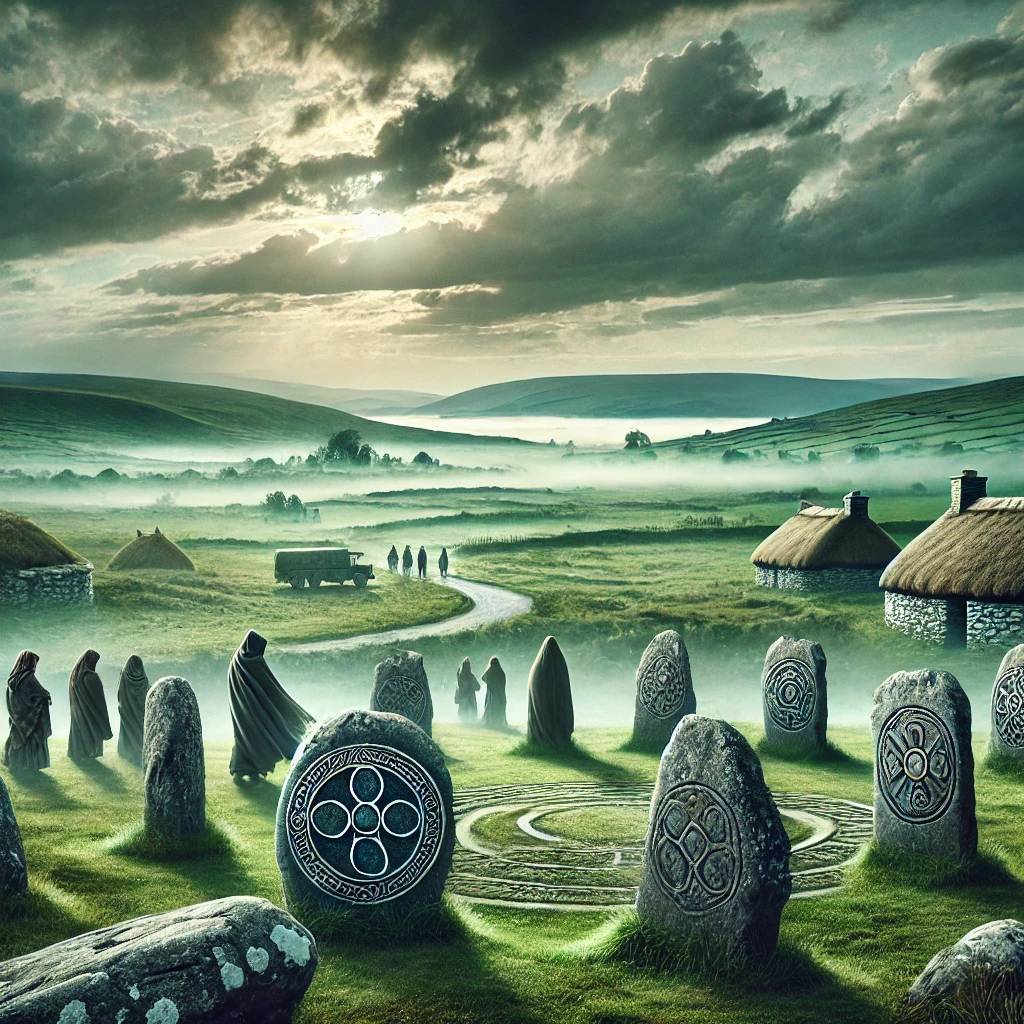
Mesolithic hunter-gatherers and Neolithic farmers formed the bedrock of ancient Irish society. They lived in wooden houses, fished rivers, built ceremonial enclosures, and left behind passage tombs and stone circles.
The Celts came around 500–300 BC, possibly as cultural diffusion rather than mass invasion. The idea of a Celtic “arrival” is being re-evaluated by modern archaeology.
So yes — there were people in Ireland long before the Celts.
Where Did the First Inhabitants of Ireland Come From?
Genetic research and archaeological findings suggest:
- Mesolithic settlers likely came from Western Europe (Iberia, France).
- Neolithic farmers shared ancestry with Middle Eastern agrarian communities, moving westward.
- Bronze Age influences came from central and northern Europe, blending with earlier populations.
The ancient people of Ireland history is one of waves, not walls—a slow interweaving of culture, belief, and blood.
What Is the Oldest Human Presence in Ireland?
The oldest known human remains in Ireland were found in Castlepook Cave, County Cork, dating back roughly 10,000 years. Stone tools from Mount Sandel in Derry provide further evidence of early settlements.
Who Are Most Irish Descended From?
Modern Irish people carry a mix of Mesolithic, Neolithic, and Bronze Age DNA, with significant influence from later Celtic and Viking gene flows. But the bones of Ireland’s soul are Neolithic — those early farmers who tamed the soil and raised the stones still whisper in our genes.
What Was Ireland Called in Ancient Times?
In early mythology and classical references, Ireland was called:
- Ériu – From the goddess Ériu, later anglicized as Éire.
- Hibernia – The Roman name.
- Inis Fáil – “The Island of Destiny,” used in bardic traditions.
- Scotia – A term sometimes used for Ireland before it became associated with modern Scotland.
Each name carries a song, a season, a sacred echo.
Where Did the Celts Come From Before Ireland?
The Celts originated in Central Europe, particularly the Hallstatt and La Tène cultures, now modern-day Austria, Switzerland, and Germany. They spread westward through Gaul (France) and Britain, eventually reaching Ireland, bringing new language, art, and tribal systems.
But in Ireland, Celtic identity didn’t replace — it merged, evolved, and became something uniquely Irish.
Where Did the Milesians Come From?
In Irish mythology, the Milesians were the final and most dominant invaders, said to come from Iberia (modern Spain). They were considered the ancestors of the Gaels, who defeated the Tuatha Dé Danann and became the true inheritors of Ireland.
Fact or fiction? A bit of both. But genetics now suggest a real Iberian connection, hinting that myth and blood memory may not be so far apart.
Ancient Ireland Tribes: Who Did Ireland Originally Belong To?
Ireland belonged to no single tribe — it was a patchwork of shifting kingdoms and tribal alliances:
- Érainn
- Uí Néill
- Fir Bolg
- Laigin
- Cruithne
Power passed like wind across hilltops, but the soul of Ireland remained collective.
5 Important Events in Ireland History (Ancient Era)
- Arrival of First Humans (~8000 BC) – Mesolithic settlements begin.
- Neolithic Revolution (~4000 BC) – Farming and megalithic tombs.
- Bronze Age (~2500 BC) – Metal tools and complex rituals emerge.
- Iron Age & Celtic Influence (~500 BC) – Social structure and language shift.
- Christianization (~400 AD) – St. Patrick and others transform the spiritual landscape.
Final Thoughts: Beneath the Stones, We Still Remember
Ireland didn’t begin with St. Patrick. It didn’t begin with the Celts. It began with fire in the forests, hands shaping earth, hearts carving symbols into stone.
The ancient people of Ireland are still here—in our blood, in our stories, in the fields that remember their names even when we don’t.
So walk a bit slower next time you see a standing stone or a moss-covered tomb.
It might be older than your memory can hold—but your spirit already knows it.
Sláinte.
Would you like a compelling image to bring these ancestors to life?
About the Author
