
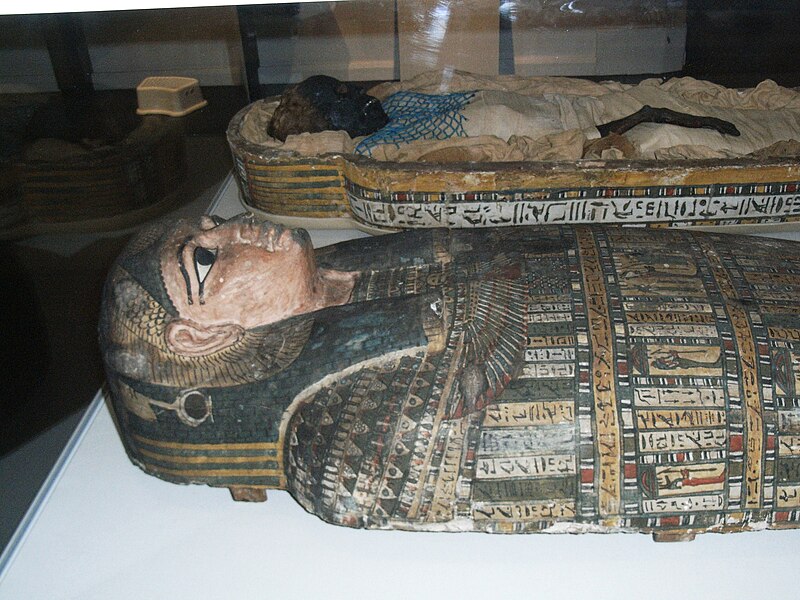
A Mistress of Thebes
Takabuti lived in Thebes, the beating heart of ancient Egypt during the 25th Dynasty (circa 660 BCE). At the time of her death, she was married, though little is known about her husband. What we do know, thanks to meticulous research and modern technology, is that Takabuti held an esteemed position in her society. She was the mistress of a great house, a role that placed her within the elite circles of Theban society. This title implies not only domestic authority but also a significant social standing—she was a woman of influence, navigating the intricate hierarchies of an ancient civilization steeped in ritual and tradition.
Her daily life would have been one of relative privilege, filled with the soft hum of servants attending to her needs, the aroma of incense wafting through finely adorned halls, and the ever-present rhythm of the Nile shaping the world outside her window. Yet, this life of comfort and power was fleeting. Takabuti’s existence was cut tragically short, leaving behind questions that have lingered for millennia.
Death in the Shadows
Takabuti’s death has been the subject of fascination and forensic investigation for decades. Modern examinations, including CT scans and radiocarbon dating, have revealed that she died violently. A deep wound between her shoulder blades suggests that she was likely attacked from behind, possibly during a tumultuous period in Thebes. Was she a victim of political strife, personal betrayal, or a random act of violence? The answers remain elusive, but the evidence speaks of a sudden and brutal end.
Adding to the intrigue, there is no conclusive record of her burial being desecrated—a common fate for many tombs of the period. Her body was mummified with great care, her wrappings treated with the finest resins, and she was laid to rest with artifacts that suggest her high status. Someone ensured she received the full rites of passage into the afterlife, a testament to her significance in life.
The Irish Connection
Takabuti’s journey to Ireland is itself a story of colonialism, curiosity, and the 19th-century obsession with all things Egyptian. Her mummy was acquired in 1834 by Thomas Greg, an affluent Irishman who purchased her from an Egyptian antiquities dealer. She arrived in Belfast in 1835, where she became an immediate sensation. Crowds gathered to glimpse the exotic relic of a faraway land, a phenomenon emblematic of the Victorian era’s fascination with the “Orient.”
In her new home, Takabuti has remained a source of wonder and scientific inquiry. Over the years, her story has been pieced together through painstaking research. DNA analysis has revealed her familial ties and hinted at her diet, health, and lineage. Her hair, remarkably preserved, provides a tangible connection to the young woman who lived thousands of years ago.
Takabuti’s Legacy
Takabuti is not just a mummy; she is a person whose life encapsulated the beauty and fragility of existence in ancient Egypt. Her story reminds us that history is not merely a chronicle of kings and conquests but also the intimate, personal tales of individuals. She was a woman who loved, ruled, and died too soon—a narrative that transcends time and geography.
In death, Takabuti has found a second life. She has become an ambassador for ancient Egypt, a cultural icon in Ireland, and a focal point for discussions about the ethics of displaying human remains. Her presence in Belfast prompts us to reflect on the complexities of cultural exchange, colonial legacies, and our enduring fascination with the past.
The Mistress Speaks
When you stand before Takabuti’s sarcophagus, you cannot help but feel the weight of her journey. From the bustling streets of Thebes to the quiet galleries of Belfast, her story resonates with an eerie familiarity. She is both alien and intimate, a figure from a distant world who whispers to us across the ages.
Takabuti’s life was extraordinary in its ordinariness—she was a woman of her time, shaped by the same joys, fears, and ambitions that drive us today. Yet, her story is also a reminder of life’s fragility, of the forces beyond our control, and of the enduring power of memory.
Her secrets may never be fully unraveled, but her legacy endures. Takabuti is not just an artifact; she is a testament to the timelessness of the human spirit, a voice from the past that challenges us to listen, learn, and remember.
About the Author
