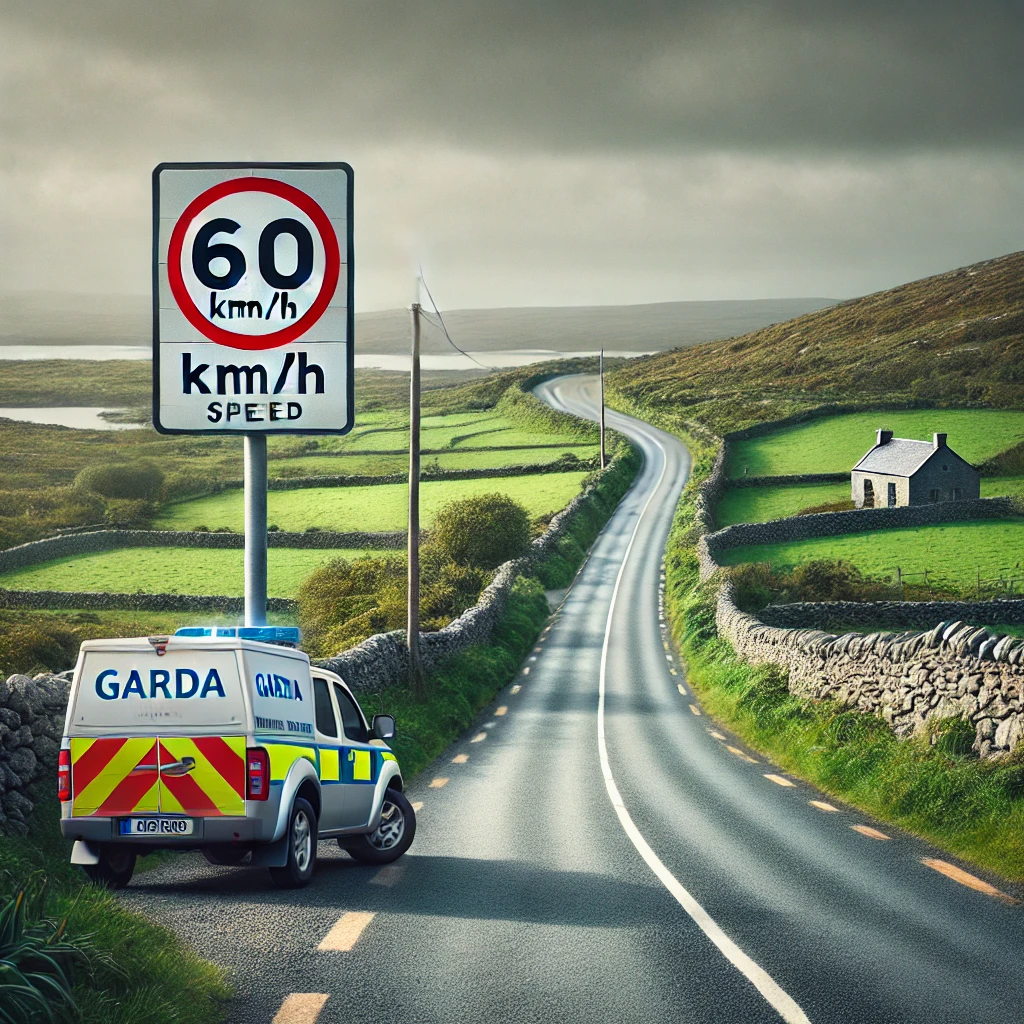
From today, speed limits on many rural local roads in Ireland have officially been reduced from 80km/h to 60km/h. This adjustment is being introduced to encourage safer driving habits and ultimately reduce the number of accidents on the roads.
This change is part of the Government’s Road Safety Strategy, which aims to cut fatalities and serious injuries on Irish roads by 50% by 2030.
Which Roads Are Affected?
Ireland’s road network is divided into local, regional, and national roads. The most extensive category is local roads, covering approximately 82,000km out of Ireland’s total 100,000km of roads.
The new speed limit applies to rural local roads, which are typically marked with an ‘L’ on maps. These roads mainly serve small communities, farms, and residential areas.
From today, motorists will notice updated road signs indicating the new 60km/h limit, replacing the previous 80km/h default speed on affected roads.
What Roads Are NOT Included?
- This does not apply to local roads in urban areas, though changes to those roads are planned for later this year.
- Regional roads (marked ‘R’) and National roads (‘N’) will retain their existing 80km/h speed limits unless separately reviewed.
How Are Local Authorities Implementing the Changes?
Local authorities have been tasked with updating road signs to reflect the new speed limits and have received grants to facilitate the transition.
Additionally, the meaning of the ‘Rural Speed Limit’ sign (a black circle with diagonal black lines, used internationally) has changed:
- Previously, it indicated that drivers must use their own judgment but never exceed 80km/h.
- From today, it means the maximum limit is now 60km/h.
While most updated signs have been installed nationwide, weather-related delays from storms like Éowyn have impacted some areas, meaning full implementation may take a few more days.
How Will the New Speed Limits Be Enforced?
As with all speed limits, exceeding 60km/h on affected roads is now an offence.
✔ The Department of Transport has worked closely with An Garda Síochána and other road safety authorities to ensure enforcement.
✔ Gardaí will be patrolling roads from today, ensuring drivers comply with the new limits.
✔ Chief Superintendent Jane Humphries of the Garda National Roads Policing Bureau emphasized that this is a collective effort for public safety:
“All we are asking is for people to take less than a minute longer for their journey to make the road safer for everyone.”
Why Are Speed Limits Changing?
These changes are data-driven, based on extensive research and international best practices.
✔ Speed is a contributing factor in nearly one-third of fatal road accidents.
✔ Countries like the UK and France have already lowered speed limits, with studies showing a direct link between reduced speed and fewer fatalities.
✔ A working group of experts was established in 2023 to review Ireland’s speed limits.
✔ In April 2024, the Road Traffic Act 2024 was signed into law, setting the legal framework for speed reductions on rural local roads, urban roads, and national secondary roads.
The Road Safety Authority (RSA) supports these measures, emphasizing that lower speed limits give drivers more time to react to potential hazards and reduce the severity of crashes.
“The force of impact in a crash increases exponentially with speed. Even small reductions in speed dramatically reduce the risk of fatalities.”
Are All Local Rural Roads Affected?
National law sets default speed limits for different road categories, but local councils have the authority to modify speed limits for roads under their control.
✔ Recent legislation has established a safer baseline of 60km/h for local rural roads.
✔ However, councils can still introduce ‘special speed limits’ where needed, allowing for flexibility in specific areas.
✔ In early 2024, the Department of Transport issued guidelines to local authorities on implementing these changes.
What Additional Speed Limit Changes Are Planned?
This is just Phase 1 of a broader three-phase plan.
✔ Later this year, further reductions will be introduced, including:
- Urban roads: Many will see speed limits reduced to 30km/h, especially in built-up areas, town centres, and housing estates.
- National secondary roads: Current speed limits of 100km/h will be lowered to 80km/h on many routes.
These further adjustments aim to make Irish roads safer for all users—drivers, cyclists, and pedestrians alike.
Where to Find More Information
✔ For general speed limit information, visit gov.ie/speedlimits.
✔ For updates on changes in your area, check with your local authority.
The changes being implemented today mark a significant shift in Ireland’s road safety policies, prioritizing lives over speed. With proper enforcement and public cooperation, this initiative has the potential to save hundreds of lives in the years to come.
FAQ’s New Speeding Laws and Speed Limit Changes in Ireland – Everything You Need to Know
Ireland’s road network is undergoing significant changes in speed limits, with new laws aimed at reducing fatalities and making roads safer. If you drive regularly in Ireland, understanding these new speed limits, enforcement policies, and penalties is crucial.
Let’s break it all down:
What Are the New Speeding Laws in Ireland?
As part of the Road Safety Strategy 2021-2030, Ireland has introduced reduced speed limits across various road types. These changes are based on extensive research that shows lower speed limits lead to fewer road deaths and serious injuries.
✔ The biggest change: Local rural roads (previously 80km/h) now have a default speed limit of 60km/h.
✔ Further reductions are planned for urban roads and national secondary roads later this year.
✔ New enforcement strategies include greater Garda presence and improved speed camera monitoring.
The goal is to cut road fatalities and serious injuries by 50% by 2030.
What Roads Are Changing Speed Limits in Ireland?
The new speed limit reductions apply to:
✔ Local rural roads (marked with an ‘L’) – Speed limits have dropped from 80km/h to 60km/h.
✔ Urban roads (later this year) – Many town centres, housing estates, and built-up areas will be reduced from 50km/h to 30km/h.
✔ National secondary roads – Speed limits will decrease from 100km/h to 80km/h in some areas.
These changes do not affect regional (‘R’) or national (‘N’) roads at this stage. However, future assessments may introduce additional changes.
How Do You Know When Your Speed Limit Changes?
✔ Road signs: The most reliable way to know a speed limit change is by checking speed limit signs on the road.
✔ Rural Speed Limit Signs: The familiar black circle with diagonal black lines now means the new 60km/h limit (instead of the old 80km/h).
✔ Navigation Apps: Apps like Google Maps and Waze often update speed limits based on real-time data.
✔ Local authority updates: Changes are announced by local councils and the Department of Transport, with many areas rolling out new signs over the coming weeks.
⚠ Important: Not all signs may be updated immediately due to weather delays. Always drive cautiously and assume the new limits apply.
How Much Can You Go Over the Speed Limit in Ireland?
Legally, you cannot exceed the speed limit at all.
However, in practice:
✔ Speed enforcement may allow a slight buffer for minor excesses (e.g. 1-2km/h over the limit).
✔ Fixed penalties apply if you exceed the limit, with fines starting from €160 and 3 penalty points.
✔ If you go 30km/h or more over the limit, the fines increase significantly, and court prosecution is possible.
Is There a Tolerance on Speed Camera Vans in Ireland?
✔ Yes, but it’s not officially stated.
✔ In practice, Garda speed cameras may allow a small margin (usually around 10% over the limit) before issuing fines.
✔ However, this is not guaranteed. If you exceed the limit, you risk getting caught—even at 1km/h over.
Best advice? Stick to the limit and don’t rely on any “hidden tolerance”.
Do Garda Cars Have Speed Cameras?
✔ Yes. Gardaí use handheld speed detectors and mobile speed cameras in patrol cars.
✔ Unmarked Garda vehicles also monitor speeds, particularly on major routes.
✔ Gardaí can pull you over directly or issue fines based on automatic speed detection.
If you’re caught speeding, you’ll receive a fixed fine notice via post with the option to pay or challenge the charge in court.
Do Variable Speed Cameras Flash?
✔ Some do, some don’t.
✔ Fixed speed cameras typically use infra-red, so you may not see a flash.
✔ Mobile speed vans do not flash visibly—they capture speed automatically.
✔ Some new average speed cameras track your speed between two points rather than at a single spot.
If you don’t see a flash, don’t assume you haven’t been caught.
Is It OK to Go Slower Than the Speed Limit?
✔ Yes, absolutely—but within reason.
✔ Speed limits are not targets—they are the maximum legal speed, not the required speed.
✔ Going too slow (e.g., driving at 40km/h in an 80km/h zone without reason) could frustrate other drivers and cause dangerous overtaking maneuvers.
✔ On motorways, driving too slowly can be hazardous. If you’re well below the limit, stick to the left lane.
In poor weather or heavy traffic, slowing down below the limit is recommended.
How Do You Know If Your Speed Is Increasing?
✔ Check your speedometer regularly—many drivers unintentionally speed up, especially on open roads.
✔ Use cruise control to maintain a steady speed on motorways and long rural stretches.
✔ Be aware of inclines—your vehicle may naturally gain speed going downhill.
✔ Watch for new speed limits—if you’ve just passed a sign, check your speed to ensure you’re complying.
Final Thoughts: Why These Changes Matter
The new speed limits in Ireland are designed to save lives. Whether you’re driving on a quiet rural road or a busy urban street, staying within the limit is about more than avoiding fines—it’s about protecting yourself and others.
✔ Speed contributes to one-third of road fatalities.
✔ Lower limits mean more reaction time and fewer serious crashes.
✔ The Gardaí will be strictly enforcing the new rules—so if you’re unsure, slow down.
For full details on the latest speed limit changes, visit: gov.ie/speedlimits.
About the Author
