In the rugged heart of Donegal, where Atlantic waves batter cliffs like war drums, a legend was forged. Red Hugh O’Donnell – Aodh Ruadh Ó Domhnaill to his Gaelic people – was no mere chieftain.
He was the pulse of Irish defiance, a flame-haired rebel who stared down Queen Elizabeth’s empire with a fire that still burns in story and song. The red hugh o’donnell story is one of prison breaks, battlefield glory, and a tragic end in Spain, where the city of Valladolid still honors him with torchlit reverence. From the shadowed cells of red hugh o’donnell castle in Dublin to the medieval streets of Castile, his tale is Ireland’s heartbeat, echoing across centuries.
Imagine a frozen Dublin night, 1591. Snow cloaks the Pale, and a young prince plots freedom from a stone prison. This is where our saga sparks. But first, let’s root ourselves in the wilds of Tyrconnell, where Red Hugh’s bloodline shaped a nation.
The O’Donnell Bloodline: Roots of the Red Hugh O’Donnell Family Tree
The O’Donnells were kings in spirit, lords of Tyrconnell – that untamed stretch of bog and mountain we now call County Donegal. The red hugh o’donnell family tree traces to Niall of the Nine Hostages, the mythic High King whose descendants ruled Ulster’s windswept hills. Born around 1572 in Lifford, Red Hugh was the eldest son of Hugh McManus O’Donnell, chieftain from 1566, and Iníon Dubh, the fierce MacDonald princess from Scotland’s isles. Her “Redshanks” – Highland mercenaries – bolstered Tyrconnell’s might, making it a thorn in England’s side.
Iníon Dubh was the steel in Red Hugh’s spine. His siblings – Rory, who’d inherit a broken realm, and sisters Nuala and Una – were woven into alliances through marriages, like his own betrothal to Rose O’Neill, daughter of Hugh O’Neill, Earl of Tyrone. This union bridged centuries of O’Neill-O’Donnell feuds, forging a pact that would shake Elizabeth’s rule. Fostered to clans like the MacSweeneys under Gaelic tradition, Red Hugh learned loyalty and war, his upbringing a crucible for rebellion.
Was Red Hugh Irish royalty? In the Gaelic world, chieftains were sovereigns, anointed not with crowns but with the stone of Doon at Kilmacrennan, wielding power under Brehon law. Red Hugh was a prince of the soil, a warrior-king whose red hugh o’donnell donegal roots ran as deep as the River Eske.
Captured and Unchained: Red Hugh’s Dublin Castle Escape
In 1587, at just 15, Red Hugh’s fate turned on a Judas kiss. Lured to a “Spanish” wine ship at Rathmullan by English spies under Lord Deputy Perrot, he was seized to break the budding O’Neill-O’Donnell alliance. Chained in Dublin Castle’s Record Tower – a dank fortress of despair – he languished for four years, plotting with fellow captives like Art and Henry O’Neill.
Did Red Hugh O’Donnell escape from Dublin Castle? Aye, and with a flourish that legends are made of. His first attempt in 1590 failed, leaving him in heavier irons. But Christmas 1591 brought a second chance. With the O’Neill brothers, he slipped through privy drains into a blizzard, fleeing 55 kilometers over the Wicklow Mountains to Fiach MacHugh O’Byrne’s glen. Art died in the snow; Red Hugh and Henry lost toes to frostbite – Red Hugh’s big toes, a mark that might yet name his bones. Carried on horseback when his feet failed, he reached Hugh O’Neill’s Dungannon, hailed as Aodh Eangach, the prophesied liberator.
Back in red hugh o’donnell donegal, he was crowned chieftain in 1592 at Kilmacrennan, ousting English sheriffs from his clan’s friary. From red hugh o’donnell castle in Donegal town – a 1474 stronghold built by his ancestor – he rallied gallowglasses and kerne, his mother’s Redshanks thundering like a Highland storm. The stage was set for war.
The Nine Years’ War: Red Hugh O’Donnell and Hugh O’Neill
Who are Hugh O’Neill and Red Hugh O’Donnell? Picture two titans: O’Neill, the Earl of Tyrone, a master of English tactics and Gaelic cunning; Red Hugh, the fiery prince of Tyrconnell, all heart where O’Neill was head. Bound by marriage and prison’s forge, they led the Ulster confederacy in the Nine Years’ War (1593–1603), a rebellion to break England’s yoke.
The war flared in ’93 when Fermanagh’s Hugh Maguire defied English sheriffs. Red Hugh and O’Neill struck like lightning: Clontibret ’95 saw English routs; Yellow Ford ’98 left 1,300 dead, Marshal Bagenal slain with 24 wounds. The red hugh o’donnell horse – swift Donegal ponies bred for bog and battle – was his thunder. At Curlew Pass ’99, his cavalry crushed 2,000 English under Clifford, the general’s head a trophy.
But Kinsale in 1601 was their undoing. 3,500 Spanish landed in Cork, not Ulster; Red Hugh and O’Neill marched 400 miles through winter mire, only for Spain’s del Águila to yield tamely. English pikes broke Irish lines; 1,400 fell. Kinsale’s defeat doomed Gaelic Ireland, paving the way for plantations.
Exile and Mystery: How Did Red Hugh Ó Donnell Die?
Broken but unbowed, Red Hugh sailed for Spain in December 1601, seeking Philip III’s aid. Welcomed in La Coruña as a Catholic hero – Ireland and Spain bound by Armada ties – he pleaded at Zamora for ships that never came. Was Red Hugh O’Donnell in Spain? Aye, for nine months, until illness struck at Simancas Castle in August 1602.
How did Red Hugh Ó Donnell die? Officially, a fever – perhaps tapeworm, perhaps war’s toll – claimed him at 29 after 16 days of agony, his will dictated in Irish to Donegal friars. But shadows linger: James Blake, a Galway merchant, was grilled by Spanish inquisitors, suspected of poisoning him with English gold. No proof stuck, but the tale persists. Philip III granted him a royal funeral, his coffin borne to Valladolid’s Franciscan friary, the Chapel of Marvels, beside Columbus’s first vault. The red hugh o’donnell grave lies there still, though the friary fell in 1835.
Valladolid’s Tribute: A Spanish City Honors an Irish Hero
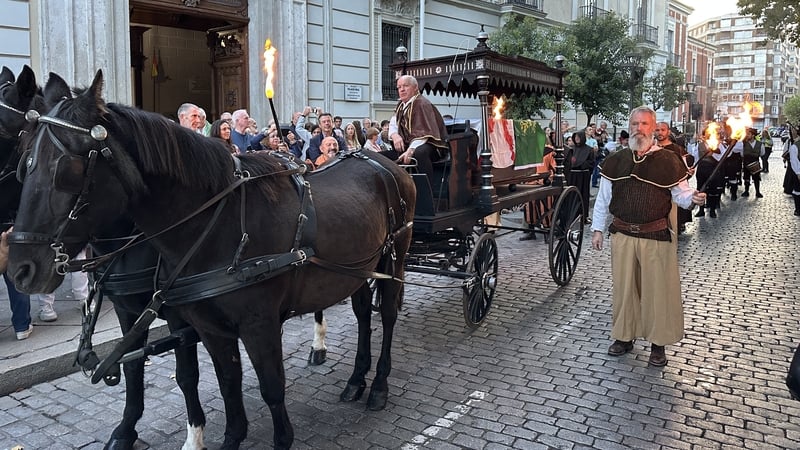
Four centuries later, Valladolid – Castile’s golden heart – pauses to mourn Red Hugh. Since 2022, thousands line its medieval streets for a reenactment of his 1602 funeral. A horse-drawn carriage, flanked by torchbearers, carries his coffin through winding alleys. Soldiers in 16th-century garb, Franciscan friars, Irish wolfhounds, and pipers playing Amhrán na bhFiann join King Philip and Queen Margaret’s shades. Irish army veterans march alongside Spanish pipers, a vibrant cortege pausing at the Chapel of Marvels’ site, where a plaque marks Red Hugh’s rest.
The mayor addresses crowds, wreaths pile high, and a lone piper’s lament echoes. Organized by the Irish-Hispano Association, founded 17 years ago by Carlos Burgos, this three-day festival – with history talks, film screenings, and music – celebrates Hispano-Irish bonds. “There’s a powerful brotherhood,” Burgos says, “a connection that spans centuries.” Hugo O’Donnell, 7th Duke of Tetuan and Red Hugh’s cousin’s descendant, adds, “He was Europe’s protagonist, loyal to his blood – and mine.”
In 2025, Minister Kevin ‘Boxer’ Moran, Ambassador Brian Glynn, and TD Paul McAuliffe joined the throng. Eddie Crawford, Lifford-born head of the Red Hugh Association, carried the tricolor: “I’m proud to honor our hero in Valladolid’s beautiful streets.” Lifford, Red Hugh’s birthplace, is twinned with Valladolid and Simancas, where his last will – dictated in Irish – rests in castle archives alongside O’Neill’s letters and Blake’s questioning.
The Association’s 2020 dig sought his bones under a bank where the friary stood, finding 16 skeletons – none his, their toes whole. Yet plaques endure, and hopes for DNA persist. Valladolid’s university and council back the events, a testament to a shared history.
FAQs: Unraveling Red Hugh’s Legacy
Did Red Hugh O’Donnell escape from Dublin Castle?
Yes, twice he defied the odds. In 1590, he slipped Dublin Castle’s grasp but was recaptured. In December 1591, with Art and Henry O’Neill, he braved a privy chute and a 55-kilometer trek through Wicklow’s snows. Frostbite claimed his toes, but he reached O’Byrne’s glen, then O’Neill’s Dungannon, igniting the Nine Years’ War. His escape was a slap to England’s face, proving Gaelic spirit unchainable.
Who are Hugh O’Neill and Red Hugh O’Donnell?
Hugh O’Neill, Earl of Tyrone, was the master strategist, blending English training with Gaelic loyalty. Red Hugh, prince of Tyrconnell, was his fiery counterpart, leading with heart and horse. Allies through marriage and prison, they forged the Ulster confederacy, waging the Nine Years’ War against Elizabeth’s forces. Their victories – Yellow Ford, Curlew Pass – shook England, but Kinsale’s loss broke their dream. O’Neill lived to exile; Red Hugh died young, a martyr in Spain.
Was Red Hugh O’Donnell in Spain?
Yes, after Kinsale’s defeat in 1601, he sailed to La Coruña, welcomed as a Catholic hero. For nine months, he sought Philip III’s aid, traveling to Zamora and Simancas. Illness struck before he reached Valladolid, Spain’s then-capital. His death there cemented a Hispano-Irish bond, honored today in Valladolid’s streets.
Was O’Donnell Irish royalty?
In Gaelic Ireland, the O’Donnells were sovereign chieftains, elected by tanistry and anointed at Doon Rock under Brehon law. Red Hugh, born to rule Tyrconnell, was a prince in all but crown – a descendant of Niall, defender of faith and land. His royal blood fueled his rebellion and endures in his legacy.
Who was the homeless woman found dead in Dublin?
In February 2024, Ann Delaney, a 47-year-old Carlow native, was found dead in her sleeping bag near Dublin Castle, steps from where Red Hugh was imprisoned. A former hospital worker, Ann battled addiction and shunned hostels, living on Aungier Street’s fringes. Her family’s visits brought songs and poetry, but couldn’t save her. A vigil drew hundreds, mourning a city’s failure to its vulnerable. Her story, though unrelated, mirrors Red Hugh’s in its cry for dignity against power’s indifference. In 2025, with 14,000 homeless in Ireland, Ann’s ghost haunts Dublin’s streets.
Who owns Castle Leslie now?
Castle Leslie, a 1,000-acre estate in Monaghan, remains with the Leslie family, tied to O’Neill lands. Built in 1870 by Sir John Leslie, it passed to Sir Jack in 1994, and now Samantha “Sammy” Leslie runs it as a luxury retreat. Host to Paul McCartney’s 2002 wedding, it stands as a living link to Ulster’s lords, echoing Red Hugh’s defiant era.
Where is Red Hugh O’Donnell buried?
Not to be confused with Hugh O’Neill, buried in Rome’s San Pietro di Montorio in 1616, Red Hugh rests in Valladolid’s lost Chapel of Marvels. Entombed in 1602 beside Columbus’s first vault, his red hugh o’donnell grave vanished when the friary was razed in 1835. A 2020 dig found ancient bones, none his. Plaques mark the site; DNA hopes linger. His rest remains a mystery, fitting for a prince who slipped every chain.
What happened to Hugh O’Neill?
After Kinsale and Red Hugh’s death, O’Neill surrendered at Mellifont in 1603, pardoned by James I. He rebuilt amid betrayals until 1607, when arrest rumors sparked the Flight of the Earls. With Rory O’Donnell and 90 others, he fled to Rome via Louvain. Exiled, pensioned by Spain, he died in 1616 at 66, a shadow of his former fire. His flight opened Ulster to plantations, ending the Gaelic order he and Red Hugh fought for.
A Flame Unquenched: Red Hugh’s Enduring Legacy
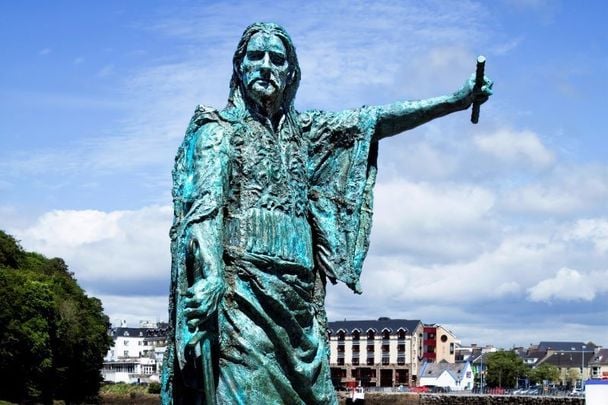
Red Hugh O’Donnell – escaped prisoner, cavalry lord, seeker of Spanish swords – died far from Donegal’s cliffs, yet his fire burns. In Valladolid, torches light his memory; in Lifford, statues gaze seaward. GAA clubs bear his name; descendants like Hugo O’Donnell carry his blood. The red hugh o’donnell story is Ireland’s: defiance against odds, brotherhood across seas. Visit Donegal Castle, tread Valladolid’s stones, and hear the echo of a prince who never knelt.
Seamus Hanratty, a published Irish historian and content creator, holds a BA in English and History from the University of Ulster and an LLB in Law from the University of Galway. With a passion for Ireland’s past, he weaves vivid narratives of Gaelic heroes and rebellion through books, podcasts, and online platforms. Connect with Seamus on LinkedIn to explore his latest works and historical insights.
About the Author
