On a quiet spring evening in 1943, a small community in west Donegal was shattered forever. What began as curiosity about a strange object floating offshore ended in one of the deadliest civilian tragedies in modern Irish history. The Ballymanus mine explosion claimed 19 lives — mostly young men and boys — and left a scar on the close-knit parishes of Mullaghduff, Annagry, and Kincasslagh that has never fully healed.
The Fateful Evening of May 10, 1943
Word spread quickly through Mullaghduff that something unusual was drifting in the water about a mile off Ballymanus Strand. It was a sea mine — a deadly remnant of the Second World War that had broken loose and washed toward the Donegal coast.
Ireland was officially neutral during the war, but the conflict still reached its shores through drifting wreckage, downed aircraft, and these drifting mines. On that May evening, as the tide came in, local people gathered on the beach out of curiosity. What happened next was both tragic and avoidable.
How the Disaster Unfolded
Local Garda Sergeant Frank Allen was informed of the mine but did not cordon off the area. Instead, Lieutenant Morgan Dunleavy from the Marine Service was sent to investigate. Despite warnings to keep clear, a group of over 20 men and boys stayed near the shoreline. Two men even tied a rope to the mine’s spikes and dragged it up onto the sand so they could examine it more closely.
At around 9:50pm, the mine exploded with devastating force. The blast was heard as far away as Letterkenny, over 40 miles distant. Seventeen people died instantly. Two more succumbed to their injuries in the following days.
The Victims: Young Lives Cut Short
The victims were almost all local teenagers and men in their prime. Among the dead were three sets of brothers from the same families — a heartbreaking detail that shows how deeply the tragedy struck individual households.
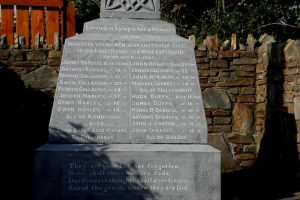
The names of those who lost their lives that night and in the days after include:
- The Gallagher brothers: Owen (21), Patrick (18), and Dominic (27)
- The Harley brothers: Joseph (17), Denis (16), and Owen (14)
- The Duffy brothers: Hugh (17) and James (16)
- Others from the area: Anthony and James Rodgers, John Roarty, John McKinley, Edward Gallagher, the Sharkey brothers, Manus O’Donnell, John Boyle, and John Joseph Carson.
A simple memorial now stands in their honour, remembering the 19 young lives lost to a war that was supposed to be far away.
The Aftermath and Lack of Full Accountability
The explosion devastated the community. Houses nearby were damaged, and families faced unimaginable grief as they searched for loved ones on the blood-stained beach. An inquest was held, but no full public inquiry ever took place. The families, supported by local clergy, decided against pushing for one, fearing it would only bring more pain.
The jury at the inquest noted that the disaster might have been prevented if the beach had been properly cordoned off. To this day, questions remain about the decisions made that evening.
Remembering the Ballymanus Mine Tragedy Today
More than 80 years later, the 1943 Donegal mine tragedy is still remembered locally. Annual commemorations and the memorial on the strand keep the memory alive. It stands as a sobering reminder of how even neutral Ireland was not completely untouched by the horrors of World War II.
For such a small rural community, losing 19 sons in a single evening was devastating. The story remains one of the least-documented major civilian disasters in Irish history, often overshadowed by other events of the era.
Conclusion
The Ballymanus mine explosion of 1943 is a heartbreaking chapter in Donegal’s history. It shows how a far-distant war reached out and tore apart a peaceful coastal community in the most sudden and brutal way. The 19 young men and boys who died that evening are gone, but their names and the quiet grief of their families endure in the hills and beaches of west Donegal.
Next time you drive through the wild beauty of Donegal’s coast, spare a thought for those lost on that terrible spring night in 1943.
About the Author
