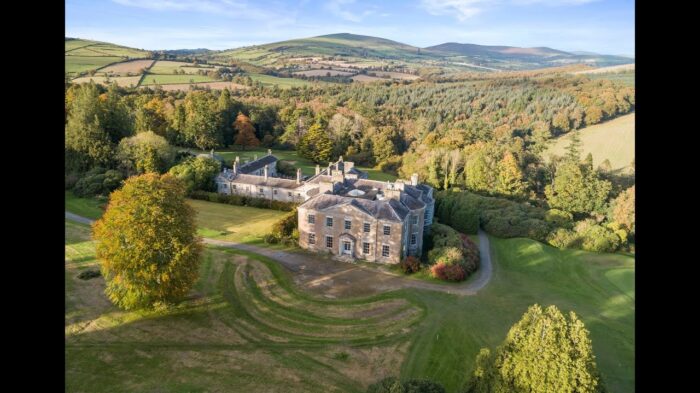
Picture this: a sprawling Georgian behemoth, crouching like a slumbering giant in the rolling green of County Wicklow, its 65,000 square feet whispering stories of power, loss, and defiance against time.
This is Coolattin House, Ireland’s largest private residence, a place where history doesn’t just linger—it screams.
From the Fitzwilliam dynasty’s iron grip to a scandal-soaked Coolattin House plane crash that shook the world, this estate is a living, breathing monument to Ireland’s turbulent past.
In this 2,000-word deep dive, we’ll unravel the Coolattin House history, answer burning questions like “Who owns Coolattin House?” and “When was Coolattin House built?”, and explore why this Wicklow wonder is more than just bricks and mortar. Buckle up—this is no ordinary house.
A Legacy Carved in Granite: The Fitzwilliam Family and Coolattin’s Roots
To understand Coolattin House, you need to start with the Fitzwilliams, a family whose name is etched into the very soil of Wicklow. In 1578, the land that would become the Coolattin House Wicklow estate was granted to Sir Henry Harrington, an English adventurer with a taste for conquest.
By 1638, it fell into the hands of Thomas Wentworth, the infamous “Black Tom,” Charles I’s ruthless Lord Deputy. Fast forward to 1782, and the estate landed with Charles Wentworth-Watson, the 2nd Marquess of Rockingham, a man who’d twice been Britain’s Prime Minister. When he died, his nephew, William Fitzwilliam, the 4th Earl, inherited the lot—90,000 acres of Irish land, a fifth of County Wicklow, home to 20,000 tenants.
The Fitzwilliams weren’t just landlords; they were titans. Their Coolattin House history is one of ambition and power. In 1794, the 4th Earl Fitzwilliam became Lord Lieutenant of Ireland, championing Catholic Emancipation—a bold move that got him sacked by the British government in 1795.
Undeterred, he decided to cement his legacy by building a grand residence on his Wicklow estate. Enter John Carr, a Yorkshire architect whose Palladian-meets-Adamesque style gave Coolattin its elegant symmetry, Tuscan columns, and a pediment flaunting the Fitzwilliam coat of arms.
FAQ: When Was Coolattin House Built?
Construction of Coolattin House began in 1776, with major work kicking off in 1796 under the supervision of Thomas Hobson of Yorkshire. The Irish Rebellion of 1798 damaged the partially built structure, delaying completion until 1801–1804. Later expansions in the 19th century, particularly under the 6th Earl Fitzwilliam in the 1870s, reshaped the house into the sprawling estate we know today.
Expansions and Alterations: A House That Grew With Time
The Fitzwilliams didn’t just build Coolattin House Wicklow; they reimagined it over centuries. The most significant changes came in the 1870s under the 6th Earl, who hired Yorkshire architect William Dickie.
Dickie added a new entrance, a south range, a servants’ wing, and stables, all faced with local granite to distinguish them from John Carr’s original render.
The new entrance, at what was once the rear, is a showstopper—paired Doric columns, a grand portico, and a sweeping granite staircase leading to a coved-ceiling hall. Inside, a baroque staircase inspired by Italian palaces steals the show, with arched windows and a balustraded gallery.
The interior saw dramatic changes too. The main entrance flipped from south to north, walls were knocked down to create vast reception spaces, and the library was decked out with rare Chinese wallpaper.
The dining room, with its half-executed bowed walls, hints at grand plans left unfinished. These expansions and alterations turned Coolattin into a labyrinth of 117 rooms across four floors, making it a prime candidate for events like a Coolattin House wedding.
The Tragedy of the Coolattin House Plane Crash
The Fitzwilliam saga took a dark turn in 1948 with the Coolattin House plane crash. The 8th Earl Fitzwilliam, who inherited the estate in 1943, died in a plane crash alongside Kathleen Cavendish, Marchioness of Hartington—sister of John F. Kennedy.
Their rumored romance added a layer of scandal to the tragedy, which rocked the Anglo-Irish elite.
The earl’s widow, Olive Plunket, stayed on at Coolattin until her death in 1975, when their daughter, Lady Anne Juliet Dorothea Maud Wentworth-Fitzwilliam (mother-in-law to Jacob Rees-Mogg), sold the estate.
FAQ: Who Owns Coolattin House?
Today, Coolattin House owner is The Coolattin House Limited Partnership, a group dedicated to restoring this historic gem. After changing hands multiple times since the Fitzwilliams sold it in 1975, the estate was acquired in the 1980s by an American couple, the Wardrops, who began restoration.
It later passed to a local golf club in 1995 before the current owners took over, aiming to preserve its legacy.
Later Years and Restoration Efforts: Saving a Giant
Post-Fitzwilliam, Coolattin House faced hard times. After Olive Plunket’s death, much of the estate’s land and contents were sold off, and the house fell into disrepair.
The Wardrops’ restoration in the 1980s breathed new life into it, but after Mr. Wardrop’s death, his widow sold it to a golf club in 1995. For 25 years, the house sat largely unoccupied, its grandeur fading.
Yet hope persists. Recent restoration efforts by The Coolattin House Limited Partnership aim to revive Ireland’s largest private house. With only 21 acres of the original 90,000 remaining, the challenge is immense, but the Irish Government’s 2023 recognition of its “significant architectural, aesthetic, and historical interest” underscores its importance.
Curious about visiting? Coolattin House opening times are limited due to its private status and ongoing restoration, so check with the current owners for access. As for those dreaming of owning it, Coolattin House for sale rumors swirl periodically, but no confirmed listings exist as of 2025.
Coolattin House Weddings: A Dream Venue?
With its grand halls and historic charm, Coolattin House wedding potential is undeniable. Imagine exchanging vows under the baroque staircase or hosting a reception in the library with its Chinese wallpaper. While not currently a public venue, restoration progress could open doors for events, making it a unique choice for couples seeking a historic backdrop.
Why Coolattin House Matters
Coolattin House Wikipedia entries only scratch the surface. This isn’t just a house; it’s a microcosm of Ireland’s history—land, power, rebellion, and redemption. From the Fitzwilliams’ dominance to the Coolattin House plane crash, from John Carr’s elegant design to modern restoration battles, Coolattin stands as a testament to resilience. Its 117 rooms, sprawling across 65,000 square feet, hold stories that demand to be told.
References and Further Reading
About the Author
