Mosney Railway Station opened that same year to service the resort.
Opened officially in July 1948 by then-Minister for Social Welfare, William Norton, Mosney soon became a beloved part of Ireland’s working class holiday culture, operating successfully under the Butlin’s name until 1982.
Initially, this “British” concept was controversial with publications like The Catholic Standard, criticising the whole idea. The church got their way, and so to appease the bishops Mosney’s camp was designed with a Catholic chapel and a resident priest.
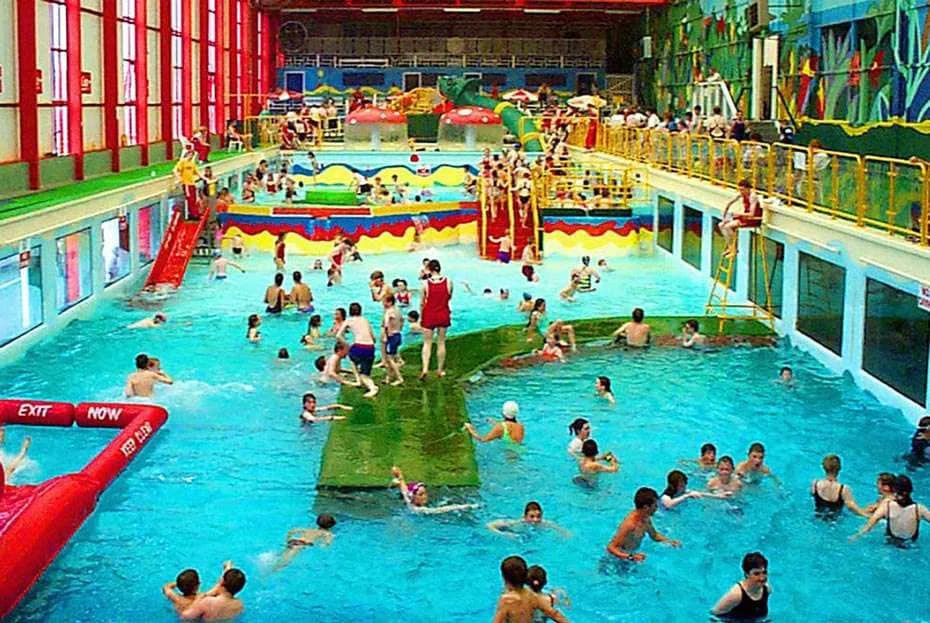
In 1982, Butlin’s sold the camp, and it was renamed Mosney Holiday Centre after the local townland. The site retained much of its original charm. One of its most legendary attractions was Funtropica Water Park with its iconic underwater windows, which looked into the popular Don Lowry’s bar. And of course, that Coca-Cola slide.
Mosney had a capacity of 2,800 campers and 4,000 day visitors. In addition to its chalets, there was a playground, arcades, shops, bar, and Shakers nightclub.
Mosney’s large capacity, with around 2,500+ beds, made it uniquely suited to hosting large events. It was particularly famous as the location for the national finals of the Community Games.
These televised events brought thousands of kids from across Ireland for more than 25 years. Each June, it also hosted the Lions Club holiday program, welcoming 1,200 guests from that social club community.
However, by the late 1990s, changes in holiday trends and difficulties in staffing led to a decline in visitor numbers. When package holidays abroad became cheaper, Mosney could no longer compete.
Finding staff for the short 12-week season proved difficult. Mosney’s final season as a holiday resort was in 2000.
In December 2000, the owner signed a five year, £15 million deal, allowing the Irish government to use it as a detention centre for asylum seekers.
Under a contract with the Department of Children, Equality, Disability, Integration and Youth, Mosney became a residential centre, initially housing about 600 people from over 20 countries.
Most of the holiday camp’s original amusements were closed, although some recreational facilities, like a football arena and play areas, remained. For those unfortunates detained indefinitely in that grim dilapidated site, life was no holiday camp.
About the Author
